


Hardness Tester: A Simple Guide to Metal Hardness Testing and Inspection
Introduction
Material hardness is an important factor in manufacturing, maintenance, engineering, fabrication, and quality control. It indicates how well a material can resist indentation, wear, deformation, or surface damage.
A hardness tester is used to measure this property and provide a numerical hardness value. Instead of judging a material only by appearance, technicians and engineers can use hardness testing to compare materials, inspect components, verify heat treatment, and support quality decisions.
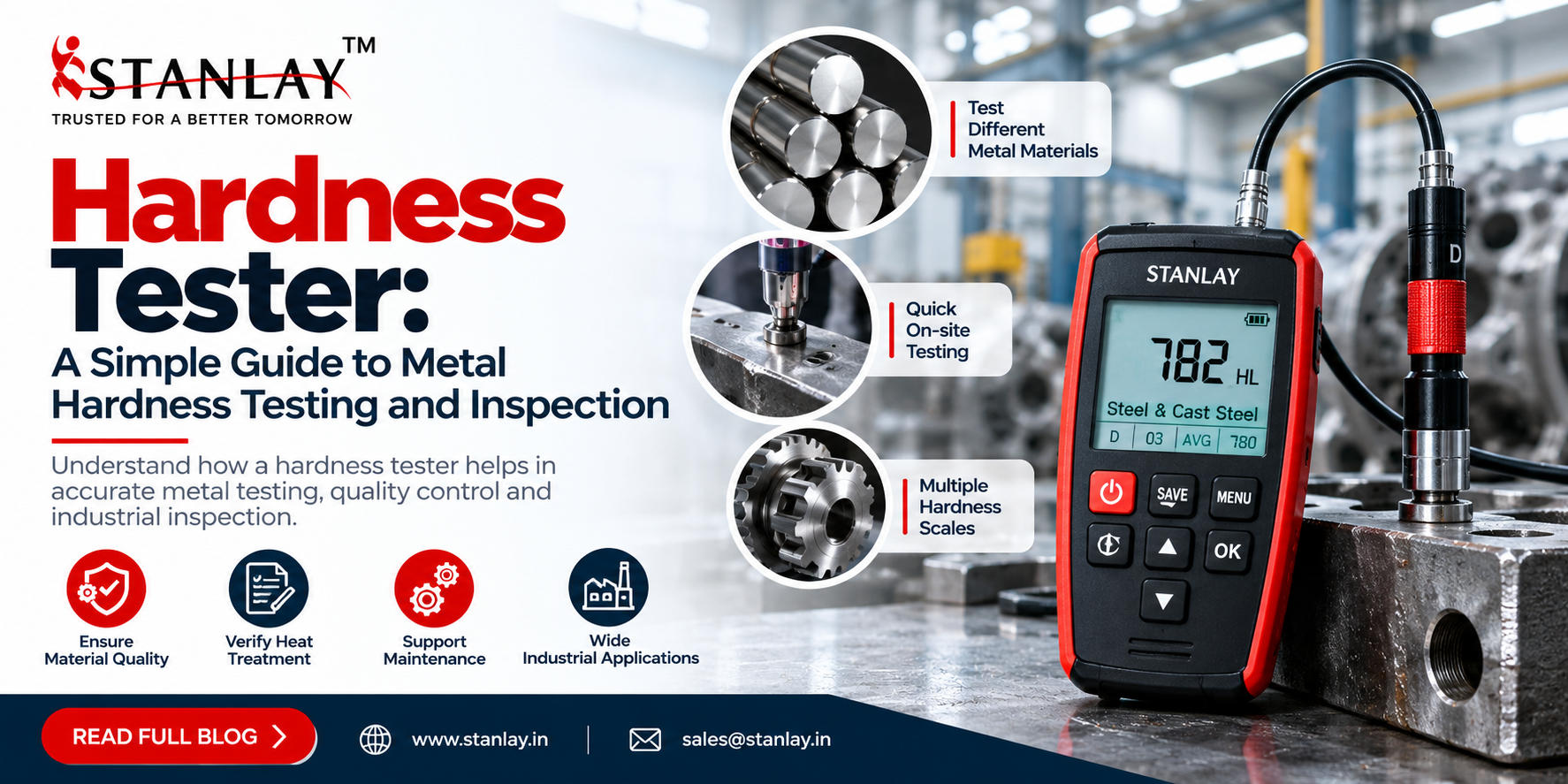
Portable hardness testers are especially useful when large or installed components cannot easily be taken to a laboratory. Stanlay lists portable Leeb hardness testers under its Material Inspection Gauges range for on-site testing of metallic materials.
What Is a Hardness Tester?
A hardness tester is an instrument used to determine the hardness of a material. In metal inspection, hardness values can help users understand whether a component has the expected mechanical characteristics.
Different hardness testing methods use different principles. Portable Leeb hardness testers, for example, use the Leeb hardness measuring principle and are designed for quick on-site testing of metallic materials.
A hardness tester may be used for:
-
Steel components
-
Cast steel
-
Stainless steel
-
Cast iron
-
Aluminium alloys
-
Dies and moulds
-
Bearings
-
Large machine parts
-
Heavy workpieces
-
Fabricated metal components
Why Is a Hardness Tester Important?
A hardness tester gives measurable information that can support inspection and quality control.
A metal component may look acceptable but still have incorrect hardness because of material variation, heat-treatment problems, manufacturing errors, or wear. Hardness measurement helps teams identify these differences before they lead to performance problems.
A hardness tester can support:
-
Incoming material inspection
-
Manufacturing quality control
-
Heat-treatment verification
-
Maintenance inspection
-
Failure analysis
-
Comparison of metal components
-
Production monitoring
-
Equipment condition assessment
Stanlay's hardness tester range includes portable equipment intended for metal processing, manufacturing inspection, failure analysis, and testing of large components that may be difficult to move.
How Does a Portable Hardness Tester Work?
A portable hardness tester using the Leeb method measures the response of an impact body when it strikes the test surface.
In simple terms, the instrument applies a controlled impact to the material and measures how the impact body behaves before and after contact. The result is converted into a hardness value.
This makes Leeb testing practical for large metal components where conventional bench hardness testing may not be convenient.
Stanlay's STH180 and STH600 portable hardness testers support measurement across metallic materials and provide readings in several hardness scales.
Hardness Tester Scales You May See
A hardness tester may display results in different hardness scales depending on the instrument and application.
Common scales include:
-
HL – Leeb hardness
-
HB – Brinell hardness
-
HRB – Rockwell B
-
HRC – Rockwell C
-
HRA – Rockwell A
-
HV – Vickers hardness
-
HS – Shore hardness
For example, Stanlay's STH600 and STH180 support HL, HB, HRB, HRC, HRA, HV, and HS scales.
The appropriate hardness scale depends on the material, industry requirement, specification, and inspection method.
Applications of a Hardness Tester
Hardness Tester for Manufacturing
Manufacturers can use a hardness tester to verify whether components meet the required hardness after machining, forming, casting, or heat treatment.
Testing during production can help identify variations before components move to the next stage.
Hardness Tester for Failure Analysis
When a metal component fails earlier than expected, hardness testing can provide useful supporting information.
An unusual hardness value may point toward material selection issues, improper heat treatment, or differences between the failed area and the expected specification.
Hardness Tester for Large Components
Large components such as heavy machine parts, dies, rollers, bearings, or installed equipment may be difficult to move to a testing laboratory.
A portable hardness tester allows testing to be carried out at the component location.
Hardness Tester for Maintenance
Maintenance teams can use hardness readings when assessing components and comparing them with known values or specifications.
Hardness testing can be combined with other inspection methods to build a more complete picture of component condition.
Benefits of Using a Portable Hardness Tester
A portable hardness tester can offer several practical advantages.
On-Site Testing
The instrument can be taken to the component instead of moving heavy equipment to a laboratory.
Fast Measurements
Portable testing allows users to obtain hardness results quickly during inspection.
Multiple Hardness Scales
Advanced instruments can display results in several common hardness scales.
Testing at Different Angles
Some portable Leeb testers support testing in multiple directions. Stanlay's STH600 includes automatic measuring-direction detection and supports versatile field testing.
Data Storage
Modern hardness testers may store measurement results for inspection records. The STH600 stores up to 500 measurement series, while the STH180 stores up to 100 measurement series.
How to Choose the Right Hardness Tester
Before selecting a hardness tester, consider the actual testing requirement.
1. Material Type
Check whether the instrument supports the metal you need to test, such as steel, stainless steel, cast iron, or aluminium.
2. Hardness Scale
Select equipment that supports the required hardness scales for your inspection work.
3. Component Size
For large or installed components, a portable hardness tester may be more practical than a fixed laboratory instrument.
4. Surface Condition
Surface roughness and preparation can affect hardness measurements. The test surface should meet the instrument's requirements.
5. Measurement Direction
If testing must be performed horizontally, vertically, or at different angles, choose an instrument designed for those conditions.
6. Data Storage
For quality-control programs, stored readings can make reporting and comparison easier.
7. Field Environment
Industrial inspection may involve dust, oil, vibration, or rough working conditions. A rugged instrument is useful for regular field use. Stanlay's STH600 is IP65 rated and designed for demanding field environments.
Best Practices When Using a Hardness Tester
For more reliable hardness measurements:
-
Clean the test surface before measurement.
-
Check that the material is suitable for the selected testing method.
-
Use the correct impact device where required.
-
Keep the tester properly positioned.
-
Take several readings rather than relying on one result.
-
Follow calibration procedures.
-
Record the material, location, hardness scale, and test conditions.
-
Compare results with the correct specification or reference value.
A hardness reading should always be interpreted together with the material type and inspection requirement.
Hardness Tester Solutions from Stanlay
Stanlay's Material Inspection Gauges range includes portable hardness testing equipment such as the STH600 Automatic Portable Hardness Tester and STH180 Portable Leeb Hardness Tester. The range is designed for metallic material testing, industrial inspection, manufacturing, and field applications.
Choosing the right hardness tester depends on the material, hardness scale, measurement range, surface condition, component size, and reporting needs.
Conclusion
A hardness tester is an important instrument for metal inspection, manufacturing, maintenance, and quality control. It provides measurable hardness data that can help verify materials, check production quality, support failure analysis, and inspect large components.
Portable hardness testers are particularly useful when testing must be performed on-site. By selecting the right instrument and following correct testing practices, technicians and engineers can obtain more consistent and useful hardness measurements.
FAQs
What is a hardness tester?
A hardness tester is an instrument used to measure how resistant a material is to indentation, deformation, or surface damage.
What is a portable hardness tester used for?
A portable hardness tester is used for quick on-site hardness testing of metals, especially large or installed components.
What is a Leeb hardness tester?
A Leeb hardness tester is a portable instrument that uses an impact-based method to measure the hardness of metallic materials.
Which materials can a hardness tester measure?
Depending on the model, a hardness tester can measure materials such as steel, cast steel, stainless steel, cast iron, and aluminium alloys.
What hardness scales can a portable hardness tester display?
Portable testers may support scales such as HL, HB, HRC, HRB, HRA, HV, and HS.
Where are hardness testers commonly used?
They are used in manufacturing, fabrication, metal processing, maintenance, failure analysis, heavy engineering, and quality control.
How do I choose the right hardness tester?
Choose according to material type, required hardness scale, component size, testing direction, field conditions, accuracy needs, and data-storage requirements.

 English
 Arabic
 French
 Portuguese
 Deutsch
 Turkish
 Dutch
Dutch
 Italiano
 Russian
 Romaian
 Portuguese (Brazil)
 Greek
Greek
 Bengali