


Solar Wind Hybrid Process Guide in India
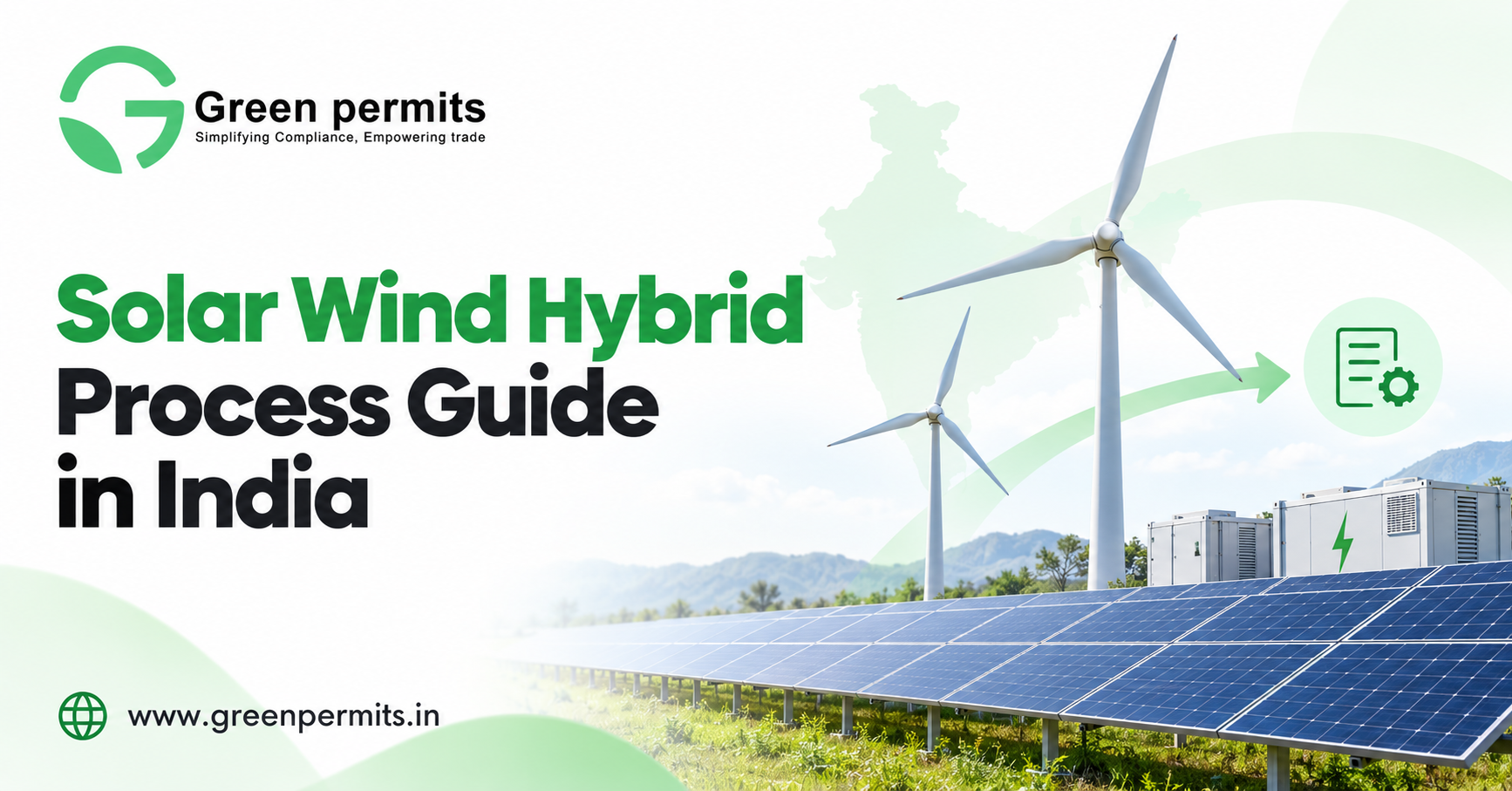
A Solar Wind Hybrid Project in India combines solar photovoltaic generation and wind power within one integrated renewable-energy system. The objective is to use the strengths of both resources so that electricity generation is spread across more hours of the day and, in some locations, across different seasons.
Solar power is strongest during daylight hours, while wind generation depends on local wind patterns and may continue during evenings, nights or periods when solar output is lower. When both resources are properly matched, a hybrid project can improve utilisation of land, transmission infrastructure and grid connectivity.
For investors, however, a hybrid project should not begin by simply combining a solar plant and wind turbines. The project must first evaluate solar resource, wind resource, land, grid capacity, plant size, machinery, generation profile, project cost and power offtake.
Green Permits Consulting supports developers with Solar Wind Hybrid feasibility studies, DPR preparation, site assessment, machinery planning, CAPEX and OPEX modelling and complete project implementation support.
How a Solar Wind Hybrid Project Works
A hybrid plant generates electricity from two renewable sources and supplies the combined output through common or coordinated electrical infrastructure.
The solar section uses photovoltaic modules to convert sunlight into DC electricity. Inverters convert this into AC power. The wind section uses turbine generators to convert wind energy into electrical power.
Both systems can then feed electricity through transformers and a common pooling substation before the power is exported to the grid or supplied under the project’s commercial arrangement.
The basic process is:
Solar PV + Wind Turbines → Power Conversion → Transformer → Pooling Substation → Grid / Consumer
If battery storage is added, part of the electricity can also be stored and discharged later.
Step 1: Solar Resource Assessment
The first stage is to understand how much solar energy is available at the proposed site.
The study should examine solar irradiation, temperature, shading, terrain and expected annual generation. These parameters help determine how much electricity can realistically be produced from each MW of solar capacity.
Module type, mounting structure and inverter configuration also influence output.
The objective is not simply to identify a sunny location. The project needs to estimate a reliable annual solar generation profile that can be compared with the wind profile.
Step 2: Wind Resource Assessment
Wind assessment is more site-specific than solar assessment.
The project needs to understand wind speed, direction, turbulence and seasonal variation at heights relevant to the proposed turbine.
Depending on the project, wind-resource assessment may use meteorological masts, LiDAR measurements, historical data and specialised modelling.
The study should identify when wind generation is strongest. This is important because the main benefit of a hybrid project comes when wind generation complements solar production instead of peaking at exactly the same time.
The correct evaluation is therefore not only:
How much wind energy is available?
It should also ask:
When is that wind energy available?
Step 3: Decide the Solar-Wind Capacity Mix
There is no rule that solar and wind capacity must be equal.
The correct ratio depends on site conditions and the commercial requirement of the project.
A location with excellent solar irradiation but moderate wind may use a larger solar component. Another location with strong night-time or seasonal wind may justify a larger wind share.
The capacity decision should therefore follow:
Solar Generation Profile + Wind Generation Profile + Grid Capacity + Buyer Requirement = Hybrid Capacity Mix
This gives a much stronger basis for plant sizing than selecting an arbitrary 50:50 combination.
Step 4: Solar Plant Machinery
The solar section typically includes PV modules, mounting structures, inverters, DC and AC cables, combiner systems, transformers and monitoring equipment.
Modules may be installed on fixed structures or tracking systems depending on project design.
The basic solar process is:
Sunlight → Solar Modules → DC Power → Inverter → AC Power → Transformer
Module efficiency is important, but investors should also consider degradation, warranty, temperature performance and expected lifetime generation.
The solar section should be designed together with the wind and grid infrastructure rather than as an independent plant.
Step 5: Wind Turbine Machinery
The wind section generally includes turbine blades, rotor, nacelle, generator, tower, foundation, transformer and control systems.
The wind turns the turbine blades, which rotate the generator and produce electricity.
The basic process is:
Wind → Rotor Blades → Generator → Electrical Output → Transformer
Turbine selection should match the site’s wind conditions.
A turbine designed for one wind regime may not perform efficiently at another location. Hub height, rotor diameter, rated power and turbine class should therefore be matched with the resource study.
Road access and crane movement must also be considered because wind-turbine components can be very large.
Step 6: Common Electrical Infrastructure
One of the main advantages of hybrid projects is the potential to use common electrical infrastructure.
Solar and wind output can be integrated through transformers, switchgear, internal collection lines and a pooling substation before grid export.
However, the project must calculate the maximum expected combined output.
The grid system should be designed around:
Solar Peak + Wind Peak + Export Limit
If solar and wind generate strongly at the same time, the evacuation system must be able to handle that combined output or the project must have an appropriate control strategy.
This is why electrical modelling is important before plant capacity is frozen.
Step 7: Grid Connectivity and Evacuation
Grid connectivity can decide whether a hybrid project is commercially feasible.
The project should identify the nearest suitable substation, voltage level, transmission route and available evacuation capacity.
A nearby substation does not automatically mean that spare grid capacity is available.
The developer may need to construct a dedicated transmission line, switchyard or additional electrical infrastructure. These costs should be included in the project CAPEX.
Grid assessment should therefore be completed before final land acquisition and before the solar-wind ratio is finalised.
Step 8: Land and Layout Planning
Solar and wind plants use land differently.
Solar modules require relatively continuous areas, while wind turbines are spaced apart. This can create opportunities to install solar modules in land between turbine locations where technically suitable.
The layout should consider turbine spacing, solar shading, transmission corridors, roads, drainage and equipment-access requirements.
The objective is to optimise:
Land → Solar Layout → Wind Turbine Locations → Common Electrical Infrastructure
rather than designing both technologies separately.
The site should also allow future expansion or the addition of battery storage if required.
Step 9: Hybrid Control and SCADA
A solar wind hybrid plant requires an integrated monitoring and control system.
SCADA can monitor solar generation, turbine output, electrical equipment and grid conditions. A plant controller can manage export limits, active power and reactive power where required.
If a Battery Energy Storage System is included, an Energy Management System can also control when the battery charges or discharges.
This control layer becomes important when the grid or power-purchase agreement imposes limits on export or requires a specific supply profile.
Step 10: Battery Storage - Where Required
Battery storage is not compulsory for every solar wind hybrid project.
However, a BESS may be added where the project needs to shift renewable electricity to another time period, manage peak demand or provide a more controlled output profile.
The process then becomes:
Solar + Wind → Grid Supply + Battery Charging → Battery Discharge When Required
The battery size should be defined in both MW and MWh and should be based on the project’s commercial requirement.
Adding storage without a clear revenue or operational purpose can unnecessarily increase CAPEX.
Step 11: CAPEX and Financial Feasibility
The total project cost depends on solar capacity, number and size of wind turbines, land, substation, transmission line, civil work and grid infrastructure.
A broad cost structure is:
Solar Plant + Wind Turbines + Civil Works + Electrical Infrastructure + Grid Connection + Development Cost
If battery storage is included, its CAPEX and augmentation or replacement requirements should be added separately.
The financial model should calculate annual generation from both resources, expected tariff or savings, O&M cost, financing and project cash flow.
Sensitivity analysis should also test lower generation, higher CAPEX and delayed commissioning.
Step 12: Project Implementation Roadmap
A practical Solar Wind Hybrid Project roadmap is:
Resource Study → Site Selection → Solar-Wind Mix → Grid Study → DPR → Approvals → Finance → EPC → Testing → Commissioning
Each stage should confirm whether the project remains technically and financially viable before major capital is committed.
The objective is to build one integrated renewable-energy project rather than two separate power plants sharing the same land.
How Green Permits Helps
Green Permits Consulting supports investors and renewable-energy developers with Solar Wind Hybrid Project feasibility studies, DPR preparation, resource assessment, site selection, machinery planning, grid-connectivity analysis, CAPEX and OPEX modelling and complete implementation support.
Read more about renewable-energy project feasibility and DPR consulting services here:
👉 https://www.greenpermits.in/09/solar-wind-hybrid-machinery-process-guide-india/
📞 Get Expert Assistance for Solar Wind Hybrid Projects
If you are planning a Solar Wind Hybrid Project in India, Green Permits Consulting can assist with feasibility study, DPR preparation, site assessment, machinery planning, financial modelling and project implementation.
🌐 Website: www.greenpermits.in
📞 Phone: +91 78350 06182
📧 Email: wecare@greenpermits.in

 English
 Arabic
 French
 Spanish
 Portuguese
 Deutsch
 Dutch
Dutch
 Italiano
 Russian
 Romaian
 Portuguese (Brazil)
 Greek
Greek
 Bengali