


Air Freight for Lithium Batteries in India
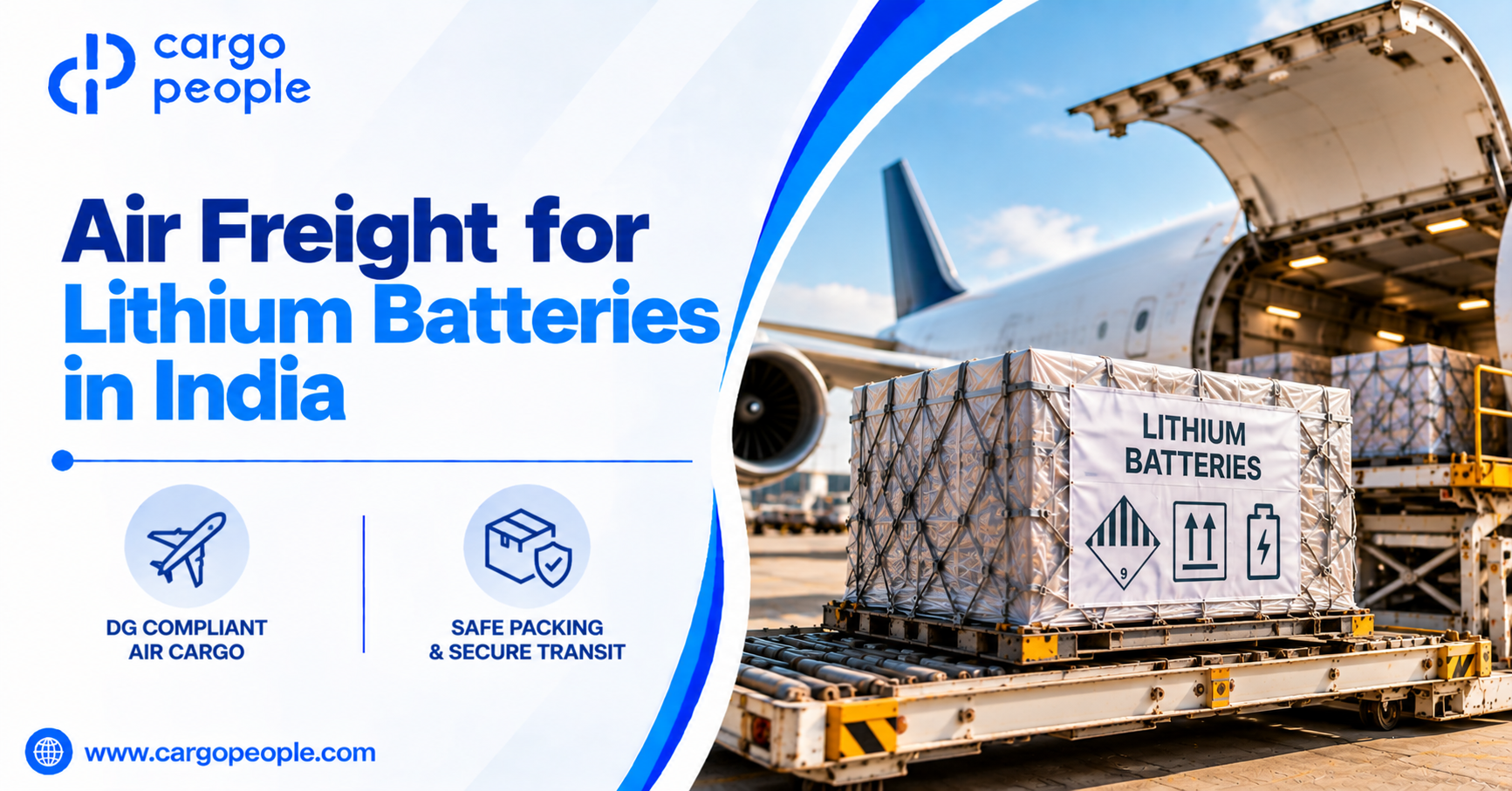
Shipping lithium-ion batteries by air requires much more planning than ordinary air cargo. Battery cells and packs can create fire and thermal-runaway risks if they are damaged, incorrectly packed, short-circuited, or transported without following dangerous goods requirements.
Air Freight for Lithium Batteries in India therefore requires correct UN classification, UN 38.3 documentation, compliant packaging, state-of-charge checks, airline acceptance, dangerous goods documentation, customs planning, and final delivery coordination.
Cargo People Logistics & Shipping Pvt. Ltd. supports importers, exporters, battery manufacturers, EV companies, electronics businesses, and energy-storage companies with lithium battery air freight, DG cargo coordination, customs clearance, warehousing, cargo insurance, and door-to-door delivery.
Why Lithium Batteries Need Special Air Freight Handling
Lithium batteries are classified as dangerous goods for air transportation. The exact shipping requirements depend on whether the batteries are transported separately, packed with equipment, or installed inside equipment.
Battery capacity, Watt-hour rating, number of cells, packaging configuration, state of charge, and shipment weight can also affect the applicable packing instruction and airline acceptance.
This means businesses should provide complete battery information before asking for a final freight rate. A normal air-freight quotation cannot automatically be used for lithium battery cargo.
UN 3480 and UN 3481 Classification
Lithium-ion batteries shipped by themselves are generally classified as UN 3480. Batteries packed with equipment or contained inside equipment are generally classified as UN 3481.
These classifications are important because they determine applicable packing instructions, package limits, marking, labelling, and aircraft restrictions.
Under IATA's 2026 guidance, standalone UN 3480 lithium-ion batteries are prohibited as cargo on passenger aircraft and must generally move on Cargo Aircraft Only services under the applicable provisions.
Importers and exporters should therefore confirm the battery configuration before arranging supplier pickup.
State of Charge Requirements in 2026
State of charge has become an increasingly important requirement for lithium battery air cargo.
Standalone UN 3480 lithium-ion cells and batteries must generally be offered for air transport at no more than 30% of their rated capacity, unless the appropriate regulatory approvals apply.
From January 1, 2026, IATA guidance also requires lithium-ion batteries packed with equipment under PI 966 Section I to be offered at no more than 30% state of charge. Under Section II, batteries above 2.7 Wh are also subject to the 30% limit unless the required approvals are obtained.
For batteries contained inside equipment under PI 967, reduced state of charge is strongly recommended but is not generally mandatory under the 2026 guidance.
UN 38.3 Test Requirements
Lithium cells and batteries intended for air transportation generally need to meet the applicable tests under UN Manual of Tests and Criteria, Part III, Subsection 38.3.
The manufacturer or supplier should be able to provide the relevant UN 38.3 test summary where required.
Importers should request this documentation before placing a large commercial order. Waiting until the battery shipment reaches the airport can result in booking rejection or additional handling costs.
A supplier simply stating that the batteries are "air-shippable" is not enough. Proper technical documentation should support the shipment.
Documents for Lithium Battery Air Freight
Battery air freight normally requires commercial documents together with technical and dangerous goods information.
Depending on the shipment, businesses may need:
- Commercial Invoice
- Packing List
- Air Waybill
- Battery technical datasheet
- UN 38.3 test summary
- UN number and proper shipping information
- Dangerous Goods Declaration where applicable
- Packing and labelling details
- IEC details for Indian imports
- BIS or other compliance documents where applicable
Model number, battery capacity, Watt-hour rating, quantity, manufacturer, and product description should remain consistent across the documentation.
Packaging Lithium Batteries for Air Transport
Lithium battery packaging is not one-size-fits-all.
The correct packing method depends on whether the batteries are standalone, packed with equipment, or contained in equipment, as well as their Watt-hour rating and quantity.
Packaging should protect cells and batteries against physical damage, movement, and short circuits. Depending on classification, UN specification packaging, cushioning, terminal protection, lithium battery marks, hazard labels, and Cargo Aircraft Only labels may also be required.
IATA guidance also notes that suitable packaging is a key element of safe battery transportation and that larger batteries may require UN specification packaging.
Businesses should never reduce protective packaging simply to lower chargeable air-freight weight.
Airline Acceptance for Lithium Batteries
Not every airline accepts every lithium battery shipment.
Airlines can apply operator-specific restrictions beyond the general dangerous goods requirements. Acceptance can depend on battery type, capacity, number of packages, origin, destination, aircraft type, and airline policy.
For this reason, the freight forwarder should obtain airline acceptance before cargo is transported to the airport.
Sending a battery shipment to the terminal without confirmed acceptance can result in storage charges, repacking, documentation correction, or return transportation.
Air Freight from China to India
China is a major sourcing market for lithium-ion cells, battery packs, electronics batteries, EV components, and energy-storage products imported into India.
Before collecting cargo from a Chinese supplier, Indian importers should confirm that the manufacturer can provide battery specifications, UN 38.3 information, correct dangerous goods classification, packaging details, and commercial documents.
The supplier's experience with battery exports is important.
A low product price can quickly become expensive if the shipment is rejected by the airline because the technical documents, state of charge, or packaging do not comply with the applicable requirements.
Customs Clearance in India
Airline acceptance and customs clearance are separate processes.
After the battery shipment arrives in India, the importer still needs to complete customs classification, Bill of Entry filing, duty payment, regulatory checks, and cargo release.
The customs team should receive clear technical details including battery chemistry, model, capacity, application, manufacturer, quantity, and HS Code.
A description such as "battery" is often too general for efficient customs planning.
Providing technical catalogues and datasheets before arrival can help the customs team prepare the clearance file.
BIS and Battery EPR Compliance
Some lithium battery categories may require BIS compliance depending on their application and specifications. Importers should verify the exact product rather than assuming every lithium battery follows the same certification requirement.
Businesses introducing batteries into the Indian market may also need to review their obligations under the Battery Waste Management framework and Extended Producer Responsibility requirements.
DG air-freight compliance, BIS certification, Battery EPR, and customs clearance are separate areas.
Completing one does not automatically satisfy the others.
Common Lithium Battery Air Freight Mistakes
One of the most common mistakes is asking for a general air-freight rate without telling the forwarder that the cargo contains lithium batteries.
Another problem is confirming a shipment before obtaining UN 38.3 information or checking the battery's state of charge.
Businesses should also avoid incorrect UN classification, incomplete battery specifications, unsuitable packaging, missing labels, and dispatching cargo before airline acceptance.
Most of these issues are easier to correct while the batteries are still at the supplier's factory.
How to Plan Lithium Battery Air Freight
Before requesting final airline booking, businesses should confirm:
- Battery chemistry and application
- UN 3480 or UN 3481 classification
- Watt-hour rating
- State of charge
- Number of packages and gross weight
- UN 38.3 documentation
- DG packaging
- Airline acceptance
- Customs documents
- BIS and EPR applicability
- Final delivery location
Providing complete information helps the freight forwarder select an appropriate airline and prepare a more accurate freight solution.
Why Choose Cargo People for Lithium Battery Air Freight?
Cargo People Logistics & Shipping Pvt. Ltd. supports lithium battery manufacturers, importers, EV companies, energy-storage businesses, electronics companies, distributors, SMEs, and corporate customers with DG air cargo.
Our services include lithium battery air freight, dangerous goods coordination, customs clearance, sea freight alternatives, warehousing, cargo insurance coordination, and door-to-door delivery.
Cargo People can coordinate battery shipments from overseas suppliers through international air transportation, Indian customs clearance, and onward delivery to factories, warehouses, distributors, or project sites.
Our focus is to connect DG documentation, airline acceptance, air freight, customs clearance, and final delivery through one coordinated logistics process.
👉 https://cargopeople.com/blog/air-freight-lithium-batteries-india/
📞 Get Expert Assistance for Lithium Battery Air Freight
If you are looking for Air Freight for Lithium Batteries in India or need support with UN 3480 or UN 3481 shipments, DG cargo handling, UN 38.3 documentation, airline acceptance, customs clearance, cargo insurance, warehousing, or door-to-door delivery, Cargo People Logistics & Shipping Pvt. Ltd. can help coordinate the complete shipment.
🌐 Website: https://www.cargopeople.com/
📞 Phone: +91 97174 65454
📧 Email: wecare@cargopeople.com
Contact Cargo People for lithium battery air freight and complete DG logistics support in India.

 English
 French
 Spanish
 Portuguese
 Deutsch
 Turkish
 Dutch
Dutch
 Italiano
 Russian
 Romaian
 Portuguese (Brazil)
 Greek
Greek
 Bengali