


Organic Soy Protein Market to Reach USD 1,772.3 Million by 2036, Expanding at 14.6% CAGR Amid Rising Plant-Based Protein and Organic Food Demand
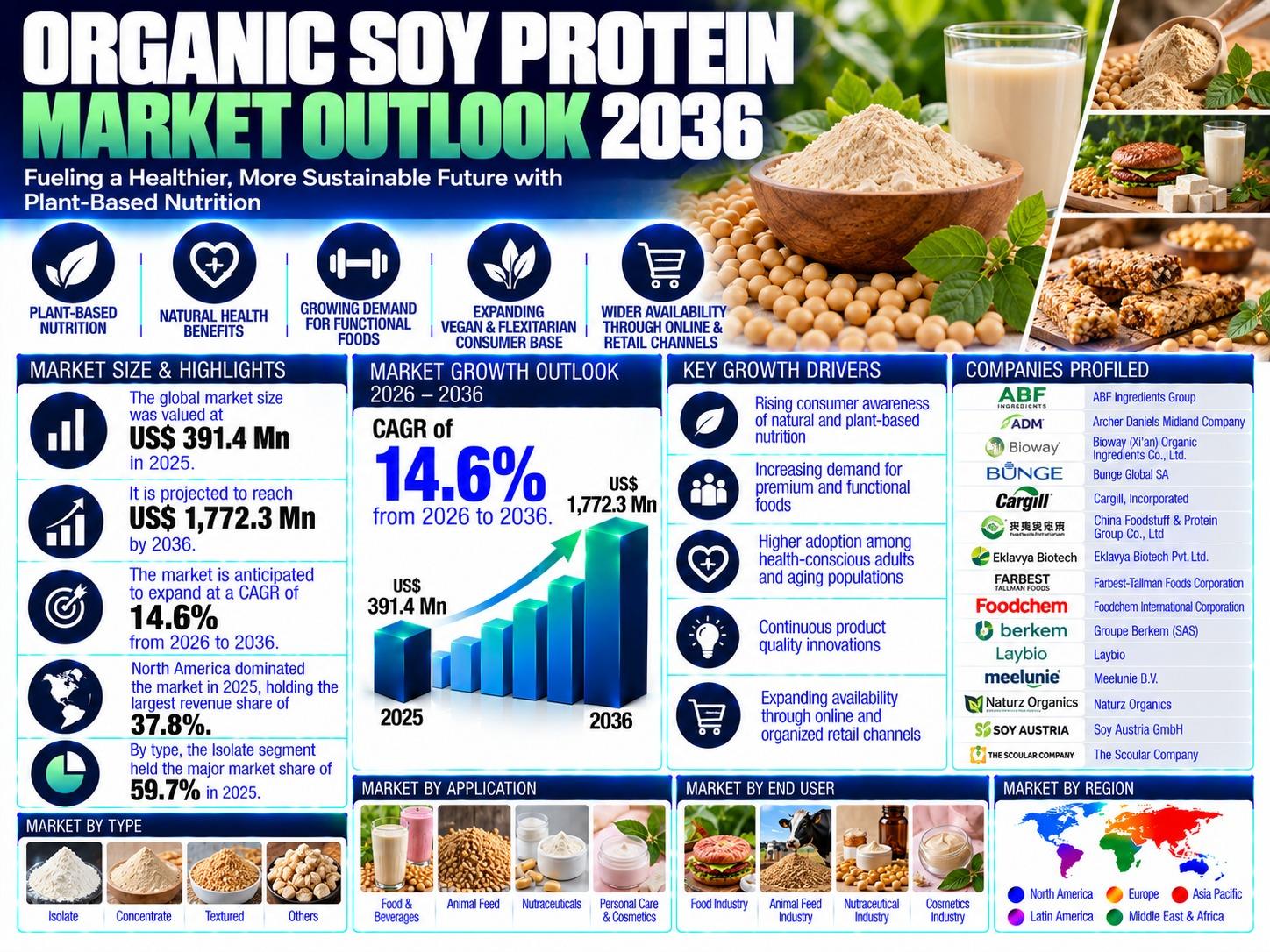
The global organic soy protein market was valued at US$ 391.4 Mn in 2025 and is projected to reach US$ 1,772.3 Mn by 2036, expanding at a CAGR of 14.6% from 2026 to 2036. The market is expected to witness significant growth during the forecast period, driven by increasing consumer awareness of natural health benefits, rising demand for premium and functional foods, growing adoption among health-conscious adults and aging populations, product quality innovations, and expanding availability through online and organized retail channels.
Organic soy protein is increasingly positioned at the intersection of plant-based nutrition, sustainability, and clean-label food trends. Its complete amino acid profile and functional properties make it an attractive ingredient for food and beverage manufacturers developing meat alternatives, dairy alternatives, sports nutrition products, protein supplements, bakery products, and other nutrition-focused formulations.
North America dominated the global organic soy protein market in 2025, accounting for 37.8% of revenue, supported by established organic regulations, strong consumer awareness, and a developed food processing industry. By type, the isolate segment held the largest share of 59.7% in 2025, owing to its high protein content, neutral flavor, solubility, and functionality across diverse applications.
Market Introduction
Organic soy protein is a plant-based protein extracted from organically cultivated soybeans produced without synthetic pesticides, chemical fertilizers, or genetically modified organisms. The ingredient is processed under organic conditions and is widely utilized in food, beverages, dietary supplements, and other nutrition-oriented formulations.
One of the principal advantages of organic soy protein is its ability to provide complete protein containing all essential amino acids. It is used in meat replacements, dairy alternatives, bakery products, protein bars, baby food, and clinical nutrition. Its clean taste, emulsifying properties, and water-binding capabilities also enable manufacturers to incorporate it into a broad range of formulations.
The market includes different product types, including soy protein isolates, soy protein concentrates, and textured soy protein. Isolates represent the highly concentrated form of soy protein, while concentrates retain greater quantities of fiber and carbohydrates. Textured soy protein is particularly relevant to meat analogues because its structure can help replicate the texture of meat-based products.
Organic soy protein offerings also include traditional certified organic ingredients, customized protein blends, and application-specific formulations for beverages, bakery products, and extrusion applications. Functional variants with optimized solubility and viscosity are increasingly relevant to manufacturers seeking specific formulation characteristics.
Rising Demand for Plant-Based Protein Foods Driving Market Growth
Growing consumer demand for protein-rich foods and increasing popularity of plant-based protein sources are major factors driving the global organic soy protein market. Soy, pea, and rice proteins are gaining acceptance as consumers in developed and developing economies increasingly adopt flexitarian and plant-focused dietary patterns.
Plant proteins are increasingly perceived as attractive nutritional alternatives because of their protein content and comparatively lower saturated fat profile. Organic soy protein has an additional advantage because of its established nutritional profile and complete amino acid composition.
Public health and nutrition organizations have continued to promote varied sources of protein, including legumes and soy. The source notes that agencies such as the USDA and FAO have promoted legumes and soy as sustainable protein sources. Such guidance has influenced consumer eating habits as well as food procurement strategies within institutions.
Food manufacturers are responding by expanding plant-based product portfolios, particularly in convenience meals, snacks, beverages, and nutrition products. Organic soy protein provides functionality required for extrusion, emulsification, and protein enrichment, strengthening its relevance in food formulation.
Demand is also supported by athletes and aging consumers seeking plant-based sources of nutrition. The source notes that USDA data published in 2024 showed continued growth in U.S. retail sales of plant-based foods by volume, with plant-based meat and dairy alternatives among the important performing categories.
As manufacturers expand their plant-based offerings, organic soy protein is expected to benefit from increasing demand for protein enrichment, clean-label formulations, and functional plant-based ingredients.
Expansion of Organic Food and Beverage Industries Supporting Market Expansion
The expansion of the organic food and beverage industry represents another significant growth driver for the organic soy protein market. Consumers increasingly associate organic certification with food safety, environmental responsibility, and higher-quality products. This perception is encouraging food manufacturers to develop or convert product lines toward organic-certified formulations.
Government-backed organic standards and labeling systems have also strengthened consumer confidence. The USDA National Organic Program and European Union organic regulatory systems impose requirements throughout the supply chain. Manufacturers seeking to maintain organic claims therefore require certified organic ingredients, creating a direct demand opportunity for organic soy protein suppliers.
Organic beverages and baby food have experienced strong shelf presence across retail channels, while organic soy protein is also relevant to functional snacks and other minimally processed formulations. Suppliers are responding through identity-preserved soybean sourcing and investment in organic-certified processing capabilities.
The source highlights the launch of a milk-plus-soy kids drink by Nestlé in April 2025 as an example of growing interest in protein-enriched products. At the ingredient level, manufacturers are increasingly emphasizing the organic identity of soy protein on labels to align with clean-label and organic positioning.
As organic products increasingly move beyond specialty stores into mass retail and foodservice channels, organic soy protein is positioned to support the development of scalable, nutritionally balanced, and certification-compliant food products.
Product Innovation and Supply Chain Integration Strengthen Market Potential
The global organic soy protein market is increasingly characterized by upstream integration and greater attention to traceability. Leading ingredient suppliers are entering organic soybean sourcing contracts to secure reliable supplies of certified raw materials.
Traceability, non-GMO certification, and allergen control are becoming important considerations as regulations and retailer requirements become more stringent. These factors are encouraging suppliers to strengthen their sourcing and processing capabilities while improving transparency throughout the supply chain.
Advancements in wet extraction and enzymatic processing have also improved protein purity and functionality. These improvements are expanding the applicability of organic soy protein across meat analogues, dairy alternatives, beverages, sports nutrition, and other functional food categories.
The combination of product innovation, quality improvements, organic sourcing, and application-specific formulations is expected to strengthen the long-term growth potential of the market.
Isolate Segment Holds Largest Share of Organic Soy Protein Market
The isolate segment accounted for 59.7% of the global organic soy protein market in 2025, making it the leading product type. The segment's dominance is primarily attributed to the high protein content and functional characteristics of organic soy protein isolates.
Organic soy protein isolates contain more than 90% protein, making them particularly suitable for applications requiring precise protein delivery and clean-label positioning. Their neutral flavor, high solubility, and strong emulsifying properties make them attractive to food and beverage manufacturers.
These characteristics are particularly important in beverages, protein powders, meat substitutes, and clinical nutrition products, where texture, mouthfeel, and flavor are important factors in consumer acceptance. Isolates allow formulators to achieve high-protein claims while limiting the influence of carbohydrates and flavor on finished products compared with concentrates.
The premiumization trend in plant-based foods is also supporting isolate demand. Brands increasingly position products around high-protein and lean-nutrition claims, which can be achieved efficiently through high-purity protein ingredients. Organic certification can further increase the perceived value of isolate-based products.
North America Leads the Organic Soy Protein Market
North America accounted for 37.8% of the global organic soy protein market in 2025, making it the leading regional market. Growth in the region is supported by strong consumer demand for organic and plant-based products, established organic regulations, widespread product availability, and a well-developed food processing industry.
The United States represents the largest national market in North America, supported by high retail penetration of organic and plant-based food products. Canada also contributes to regional growth through expanding organic farmland and increasing emphasis on sustainable agricultural and food solutions.
Both countries have established organic certification systems that support demand for compliant protein ingredients. The region also hosts major soy ingredient producers with vertically integrated supply chains, including Archer Daniels Midland Company and Cargill, which have invested in organic soybean sourcing, traceability, and clean-label product innovation.
Organic soy protein is widely used in North American plant-based meat, dairy alternatives, and nutrition products distributed through mass retail and foodservice channels. The combination of consumer awareness, ingredient manufacturing capabilities, and established distribution infrastructure is expected to help North America retain a leading position.
Competitive Landscape
The organic soy protein market includes major global ingredient companies as well as specialized organic protein manufacturers. Key participants include Archer Daniels Midland Company, Cargill, Incorporated, Bunge Global SA, ABF Ingredients Group, The Scoular Company, Bioway (Xi'an) Organic Ingredients Co., Ltd., China Foodstuff & Protein Group Co., Ltd., Eklavya Biotech Pvt. Ltd., Farbest-Tallman Foods Corporation, Foodchem International Corporation, Groupe Berkem, Laybio, Meelunie B.V., Naturz Organics, and Soy Austria GmbH.
Companies are competing through organic soybean sourcing, product quality, processing capabilities, traceability, application-specific formulations, and expansion of their distribution networks. Leading ingredient providers are also focusing on customized protein blends and functional formulations designed for specific food and beverage applications.
The market's competitive environment is further influenced by the increasing importance of organic certification, non-GMO status, supply chain transparency, and clean-label positioning. Manufacturers capable of providing consistent organic protein quality while meeting formulation requirements are positioned to benefit from growing demand.
Key Developments
In January 2026, Kolkata-based Annapurna Swadisht Limited announced plans to acquire a majority stake in Andri Agro Foods Private Limited. The move is intended to strengthen ASL's presence in the global organic soy protein market by leveraging Andri Agro's portfolio of soya chunks, granules, textured vegetable protein, and other value-added soy products.
In August 2025, Archer Daniels Midland Company announced measures to streamline its global soy protein production network. The company planned to leverage its recommissioned Decatur, Illinois facility and upgraded sites worldwide while ceasing operations at its Bushnell, Illinois plant. The initiative was aimed at improving efficiency and customer service while supporting rising global demand.
In April 2025, ICL Food Specialties announced that it would showcase a new range of textured soy protein products at IFFA 2025. The initiative highlighted ongoing product innovation within textured soy protein and the broader plant-based protein ingredient market.
Future Outlook
The global organic soy protein market is poised for significant expansion through 2036, supported by the convergence of plant-based nutrition, organic food consumption, clean-label preferences, and demand for functional protein ingredients. The market is projected to reach US$ 1,772.3 Mn by 2036, reflecting a 14.6% CAGR from 2026 to 2036.
Increasing adoption of flexitarian and vegan diets is expected to sustain demand, while growing interest in premium and high-protein products is creating additional opportunities for organic soy protein isolates. Continued improvements in extraction and processing technologies are likely to enhance product functionality and broaden applications.
Expansion of organic food from specialty retail into mainstream retail and foodservice channels is also expected to increase market penetration. At the same time, traceability, certified organic sourcing, non-GMO requirements, and supply chain integration will remain important competitive factors.
North America is expected to retain its leading position due to its established organic food ecosystem and strong ingredient manufacturing base. Overall, increasing consumer focus on natural and sustainable nutrition, combined with product innovation and wider distribution, is expected to drive robust growth in the global organic soy protein market over the forecast period.
Organic Soy Protein Market Segmentation
The organic soy protein market is segmented by type, grade, form, end-use industry, distribution channel, and region. By type, the market includes isolates and concentrates. By grade, it is divided into food grade and non-food grade.
Based on form, organic soy protein is available in liquid and dry formats. Dry products include powder, granules, chunks, flakes, and other forms such as strips. By end-use industry, the market covers food and beverages, animal nutrition, cosmetics and personal care, and pharmaceuticals and nutraceuticals.
Based on distribution channel, the market is divided into business-to-business and business-to-consumer channels. The latter includes online retail, supermarkets and hypermarkets, specialty stores, and other independent stores.
Geographically, the market covers North America, Europe, Asia Pacific, the Middle East & Africa, and Latin America, with country-level coverage including the U.S., Canada, the U.K., Germany, France, Italy, Spain, the Netherlands, China, India, Japan, South Korea, Australia, ASEAN countries, GCC countries, South Africa, Brazil, Mexico, and Argentina.

 English
 Arabic
 French
 Spanish
 Portuguese
 Deutsch
 Turkish
 Dutch
Dutch
 Italiano
 Russian
 Romaian
 Portuguese (Brazil)
 Bengali