


Why Can Translating Paid Ads Word for Word Weaken Performance Across Different Markets?
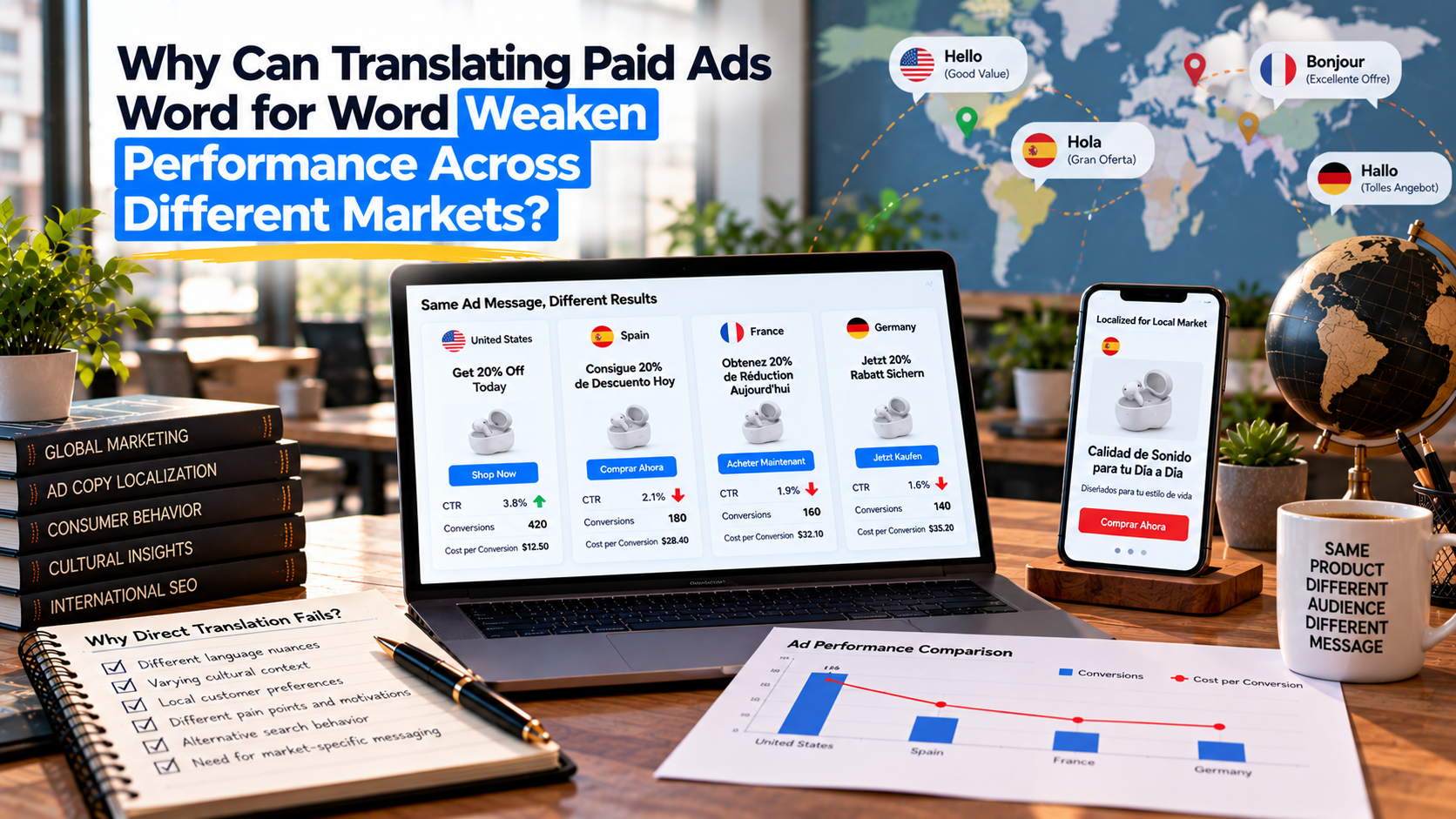
Expanding a paid advertising campaign into a new country often appears straightforward. A business takes its best-performing advertisement, translates the headline and description, changes the location targeting, and launches the campaign.
The translated advertisement may be grammatically correct but still produce weaker engagement, more expensive conversions, or lower-quality customers. This happens because language is only one part of communication. Buying behaviour is also influenced by culture, trust, local expectations, pricing habits, visual preferences, and the way people describe their problems.
Creative localization for paid advertising adapts the complete campaign experience for a specific market. It considers how the audience thinks and makes decisions rather than simply replacing words from one language with another.
Translation and Localization Are Not the Same
Translation focuses on communicating the meaning of written or spoken content in another language. Localization goes further by adapting that meaning to the expectations and context of a particular audience.
A literal translation may preserve the original sentence while losing its emotional effect. A phrase that sounds confident in one market may sound exaggerated, impersonal, or confusing somewhere else.
For example, an advertisement may use humour, urgency, or an informal expression that works naturally in its original language. When translated directly, the same message may feel unnatural because the new audience does not use that expression in everyday conversation.
A creative strategist should therefore protect the purpose of the advertisement rather than every individual word. The localized version may use different wording while delivering the same central promise.
Customer Problems May Be Described Differently
Two markets can experience the same practical problem but describe it in very different ways.
A business may refer to “operational efficiency,” while customers in another market search for a simpler way to describe saving time or reducing daily workload. A software company may promote “workflow automation,” but its intended audience may be more concerned about missed follow-ups, slow reporting, or managing work with a small team.
Direct translation often preserves the business’s terminology instead of discovering the language used by local customers.
Market-specific audience research can examine search behaviour, customer interviews, reviews, sales conversations, social comments, and competitor messaging. These sources help identify how people naturally explain their needs.
When advertisements use familiar language, audiences can recognise the relevance of the offer more quickly.
Cultural Context Changes How Messages Are Interpreted
Advertising does not exist separately from culture. Values such as independence, family security, status, convenience, savings, innovation, and social approval may carry different levels of importance across markets.
An advertisement built around personal achievement may perform well in one location, while a message focused on family benefit or collective success may feel more relevant elsewhere.
The tone of communication can also change. Some audiences respond positively to direct comparisons and confident claims. Others may prefer a more informative style supported by detailed evidence.
This does not mean relying on stereotypes. A market contains many different customer groups, and cultural assumptions should always be tested. The objective is to study how the intended audience responds rather than guessing based on nationality alone.
Trust Signals Need Local Relevance
A testimonial from a well-known company can create strong credibility in its home market. In a new location, potential customers may not recognise the company or understand why its experience is relevant.
The same issue can affect certifications, awards, media mentions, payment methods, warranties, and customer-support claims. A trust signal is valuable only when the audience understands it and considers it meaningful.
Localized proof may include customer examples from the same region, familiar industries, locally recognised payment options, relevant delivery information, or case studies that reflect similar business conditions.
Businesses should never invent local proof. If region-specific evidence is unavailable, they can use transparent product demonstrations, detailed explanations, verified results, or internationally understandable customer outcomes.
The Offer May Require Localization Too
Strong advertising cannot compensate for an offer that does not fit the local market.
A promotion may need to account for income levels, taxes, shipping costs, purchasing habits, contract preferences, currency, and payment availability. A monthly subscription that seems affordable in one country may represent a major commitment in another.
Customers may also expect different buying processes. Some audiences are comfortable completing a purchase online. Others may want to speak with a representative, receive a quotation, or use a familiar local payment method.
Effective creative localization for paid advertising connects the message with an offer that customers can understand and realistically accept.
Visuals Can Carry Different Meanings
Localization is not limited to copy. Images, colours, gestures, clothing, locations, household settings, and workplace scenes can all influence how an advertisement is perceived.
A generic stock photograph may look polished but fail to represent the audience. An unfamiliar environment can make an offer feel imported and less relevant. Even symbols and hand gestures may carry different meanings in different cultures.
Businesses should review whether the visual setting, people, product use, and on-screen text feel natural for the market.
However, localization does not mean adding national flags or obvious cultural symbols to every advertisement. Relevance often comes from subtle details such as the environment, use case, language style, and customer situation.
Platform Behaviour Varies Between Markets
The same platform may be used differently across locations. One country may have strong engagement with short-form video, while another customer group may respond better to search advertising, messaging applications, or detailed product pages.
Creative formats should reflect these behaviours.
A video advertisement may require local-language captions because many users watch without sound. A lead-generation campaign may need a messaging-based follow-up process. An ecommerce campaign may require clear delivery and payment information inside the advertisement because customers consider those details before clicking.
Professional paid advertising services should adapt creative formats and conversion paths to actual user behaviour rather than assuming that one campaign structure will work everywhere.
The Landing Page Must Continue the Localized Experience
A localized advertisement should not send visitors to a landing page that remains designed entirely for the original market.
This disconnect can reduce trust. The advertisement may use local language, but the landing page displays another currency, unclear delivery terms, unfamiliar examples, or poorly translated instructions.
The complete journey should remain consistent. This includes the headline, offer, forms, pricing, payment methods, testimonials, FAQs, customer support information, and confirmation messages.
Businesses should also check technical details such as language selection, mobile performance, date formats, address fields, telephone-number formats, and text direction where relevant.
Build Localization Around a Clear Process
Localization should begin with customer and market research rather than translation software.
A practical process may include:
1. Define the audience segment and desired campaign action.
2. Identify the original advertisement’s main promise.
3. Research local customer language, expectations, and objections.
4. Review pricing, payment, delivery, and legal requirements.
5. Adapt the copy, visuals, proof, offer, and landing page.
6. Ask a native speaker with marketing knowledge to review the message.
7. Test localized variations and evaluate business outcomes.
Native-language ability alone is not enough. The reviewer should understand the audience, product, and purpose of the campaign. A sentence can be linguistically correct while remaining commercially ineffective.
Test Markets Separately
Businesses should avoid combining several countries into one campaign simply because they share a language.
Customers in different regions may face different prices, competitors, economic conditions, and purchasing expectations. Separate campaign structures make it easier to control budgets, compare performance, and identify which localized elements are working.
Measurement should extend beyond click-through rate. Businesses should examine conversion rate, lead quality, acquisition cost, average order value, refund rate, sales cycle, and retained revenue.
An advertisement that attracts attention but produces weak customers is not successfully localized.
Protect the Central Brand Promise
Localization should not make the brand unrecognisable. The main value proposition, quality standards, and visual identity should remain consistent.
The goal is to distinguish between elements that must stay fixed and elements that can change. The brand promise may remain stable while the wording, examples, proof, imagery, and call to action are adapted.
This balance allows the business to communicate naturally without creating a completely different identity in every market.
Final Thoughts
A word-for-word translation can preserve language while losing relevance. Customers do not respond only to correct grammar; they respond to messages that reflect their needs, expectations, environment, and decision-making process.
Creative localization for paid advertising adapts the message, visuals, proof, offer, platform experience, and landing page while protecting the brand’s central promise.
Businesses entering new markets should treat localization as a strategic marketing process rather than a final translation task. A campaign becomes more effective when it sounds as though it was created for the audience—not merely converted from something created somewhere else.
Frequently Asked Questions
What is creative localization in paid advertising?
It is the process of adapting advertising copy, visuals, offers, proof, formats, and conversion journeys to suit the language and expectations of a particular market.
Is professional translation enough for an international ad campaign?
Professional translation improves linguistic accuracy, but effective advertising also requires cultural, commercial, and customer-specific adaptation.
Should businesses create separate campaigns for different countries?
Usually, yes. Separate campaigns provide better control over budgets, language, offers, reporting, and market-specific optimization.
Can the same advertising concept work across multiple markets?
Yes. The central concept can remain consistent, but its wording, examples, visuals, proof, and call to action may need localization.
How should localized campaign performance be measured?
Businesses should evaluate conversion rate, lead quality, acquisition cost, order value, sales outcomes, refunds, and retained revenue—not only clicks or engagement.

 English
 Arabic
 Spanish
 Portuguese
 Deutsch
 Turkish
 Dutch
Dutch
 Italiano
 Russian
 Romaian
 Portuguese (Brazil)
 Greek
Greek
 Bengali