


HID Amico in Saudi Arabia - Advanced Access Control Solutions
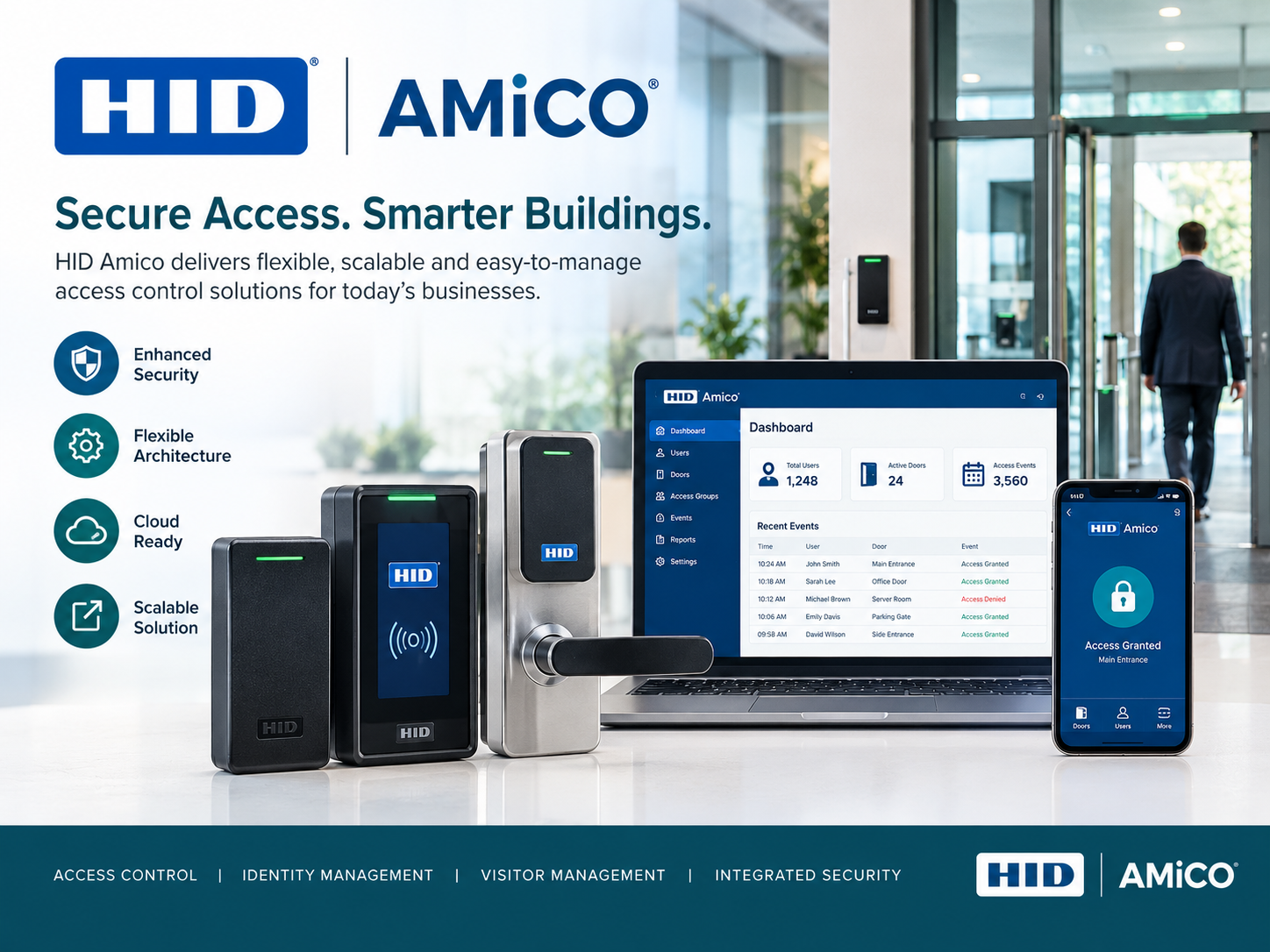
Organizations across the Kingdom are rethinking how they secure buildings, campuses, and critical infrastructure, and HID Amico has emerged as the platform driving that shift. Combining facial recognition, biometric authentication, and edge-based intelligence, this next-generation reader is redefining what advanced facial recognition access systems in KSA look like for enterprises, government facilities, and smart-city developments alike. This guide walks through the technology, its regional deployment, and why Saudi organizations are standardizing on it.
What Is HID Amico and Why It Matters for Saudi Enterprises
At its core, the HID Amico reader is a multi-modal biometric access device built for high-security environments where speed and accuracy cannot be compromised. It fuses facial recognition with mobile and card-based credentials into a single unit, giving facility managers one platform instead of a patchwork of legacy readers. For Saudi Arabia's rapidly expanding commercial and industrial sectors from Riyadh's financial district to Jeddah's logistics corridors — this consolidation directly supports Vision 2030's push toward smart, connected infrastructure.
Physical access control has traditionally relied on cards or PIN codes, both of which can be lost, shared, or cloned. Biometric authentication closes that gap by tying access to a physical characteristic that cannot be handed off, which is precisely why regulated sectors such as banking, healthcare, and government are moving toward it as a baseline requirement rather than an optional upgrade.
HID Amico Facial Recognition: Precision Built for Real-World Conditions
HID Amico Facial Recognition technology is engineered to perform reliably outside the controlled conditions of a lab — in bright Gulf sunlight, low indoor lighting, and even when users are wearing masks or head coverings common across the region. The system captures and matches facial data in real time, typically completing verification in well under a second, which keeps entry lanes moving during peak-hour traffic at offices, hospitals, and transit hubs.
This matters commercially as much as operationally. Long queues at turnstiles translate into lost productivity, and inconsistent recognition accuracy erodes user trust in the system altogether. By pairing high-resolution imaging with on-device processing, the reader delivers consistent match rates without depending on a constant, low-latency connection to a central server.
AI-Powered Anti-Spoofing and Liveness Detection
Facial recognition is only as trustworthy as its ability to resist spoofing attempts, and this is where the reader's AI-Powered Anti-Spoofing engine becomes critical. Rather than matching a flat image, the system analyzes depth, texture, and micro-movement to distinguish a live person from a photograph, video replay, or 3D mask presented at the camera.
Working alongside anti-spoofing is Liveness Detection, which continuously verifies that the subject in front of the sensor is a live, present individual rather than a static or manipulated representation. Together, these two layers form the backbone of a zero-trust approach to physical entry — an expectation increasingly written into Saudi regulatory and insurance requirements for high-security facilities.
HID Amico Biometric Reader: Technical Capabilities
As a HID Amico Biometric Reader, the device supports multiple credential types on a single reader body: facial recognition, mobile credentials, and traditional smart cards. This flexibility allows organizations to migrate at their own pace — running mixed-credential environments during rollout rather than forcing a disruptive, all-at-once cutover across every door.
● Sub-second facial match performance suited to high-traffic entry points
● Built-in tamper and intrusion alerts for exposed or perimeter-mounted installations
● Support for encrypted, regionally-compliant biometric data storage
● Compatibility with existing card-based infrastructure during phased migration
● IP-rated housing options suitable for the Kingdom's outdoor climate conditions
Organizations evaluating deployment can review the full HID Amico product specifications to compare reader models against their specific site requirements before procurement.
HID Aero Controller: The Backbone of a Scalable System
A biometric reader is only as capable as the controller managing it, and this is where the HID Aero Controller comes in. Built on an open, IP-based architecture, the controller handles credential validation, door logic, and event logging while remaining interoperable with third-party video management and building automation systems — a requirement for the integrated command centers now standard in Saudi mega-projects like NEOM and King Abdullah Financial District.
Because the controller communicates over standard network infrastructure rather than proprietary wiring, deployment and future expansion become considerably simpler for facilities teams managing multi-building campuses across Riyadh, Jeddah, Dammam, and beyond.
HID Access Control: A Unified Security Framework
Beyond individual readers and controllers, HID Access Control represents a complete security ecosystem — credentials, readers, controllers, and management software working from a single source of truth. This unified framework gives security teams centralized visibility across every entry point in an organization, whether that's one headquarters building or a distributed network of branches spanning multiple Saudi cities.
Centralized management also simplifies compliance reporting. When auditors or regulators request access logs for a specific zone or time window, a unified platform returns that data in minutes rather than requiring administrators to reconcile records across disconnected legacy systems.
HID Mobile Access: Credentials Without the Card
For organizations looking to reduce dependency on physical cards altogether, HID Mobile Access turns an employee's smartphone into a secure credential. Using encrypted Bluetooth and NFC communication, staff can tap or wave their phone at a reader for entry — eliminating the cost and administrative overhead of issuing, replacing, and deactivating physical badges.
Mobile credentials also solve a practical regional challenge: contractors, visitors, and temporary staff can be issued time-bound digital access remotely, without waiting on-site for a badge to be printed and encoded.
HID Amico Compared to Traditional Access Control Systems
Traditional card-and-PIN systems were designed for a slower era of building security, when a lost badge or shared code was an inconvenience rather than a breach. A modern biometric-first reader changes that calculus in three concrete ways: it removes credential sharing as a possibility, it produces a verifiable audit trail tied to an individual rather than a card number, and it cuts the recurring cost of badge printing, replacement, and deactivation. For a facilities team managing dozens of doors across a single campus, that difference compounds quickly into measurable savings and fewer help-desk tickets tied to lost or forgotten credentials.
The comparison becomes sharper still when weighed against legacy fingerprint scanners, many of which struggle with dust, moisture, or worn prints common among laborers on industrial sites. A contactless, camera-based approach sidesteps that failure mode entirely, which is one reason procurement teams across the region are shifting their specifications toward facial-first hardware for new builds and retrofits alike.
Data Privacy, Compliance, and Cybersecurity Considerations
Any biometric deployment raises legitimate questions about how facial data is stored, encrypted, and governed. Enterprise-grade implementations store templates — mathematical representations of facial features — rather than raw images, and encrypt that data both at rest and in transit. This distinction matters for compliance conversations with Saudi regulators and internal data-protection officers, since a stolen template cannot be reverse-engineered into a usable photograph the way a leaked image file could.
Cybersecurity hardening extends beyond the reader itself. Network segmentation between the access control system and general corporate IT, regular firmware updates, and role-based administrative permissions all reduce the attack surface — a set of practices that any qualified integrator should document as part of a deployment plan submitted for facility approval.
Conclusion
Saudi Arabia's security landscape is moving decisively toward biometric-first infrastructure, and HID Amico sits at the center of that shift alongside the HID Aero Controller and HID Mobile Access ecosystem. From AI-Powered Anti-Spoofing and Liveness Detection to unified HID Access Control management, the technology is proving itself across HID Amico Riyadh towers and HID Amico Jeddah facilities alike. For organizations planning their next phase of HID Amico KSA deployment, a certified local partner remains the deciding factor between a smooth rollout and a stalled one. Tektronix continues to lead that rollout across the Kingdom.

 English
 Arabic
 French
 Portuguese
 Deutsch
 Turkish
 Dutch
Dutch
 Italiano
 Russian
 Romaian
 Portuguese (Brazil)
 Greek
Greek
 Bengali