


What Are the Different Types of Machine Learning?
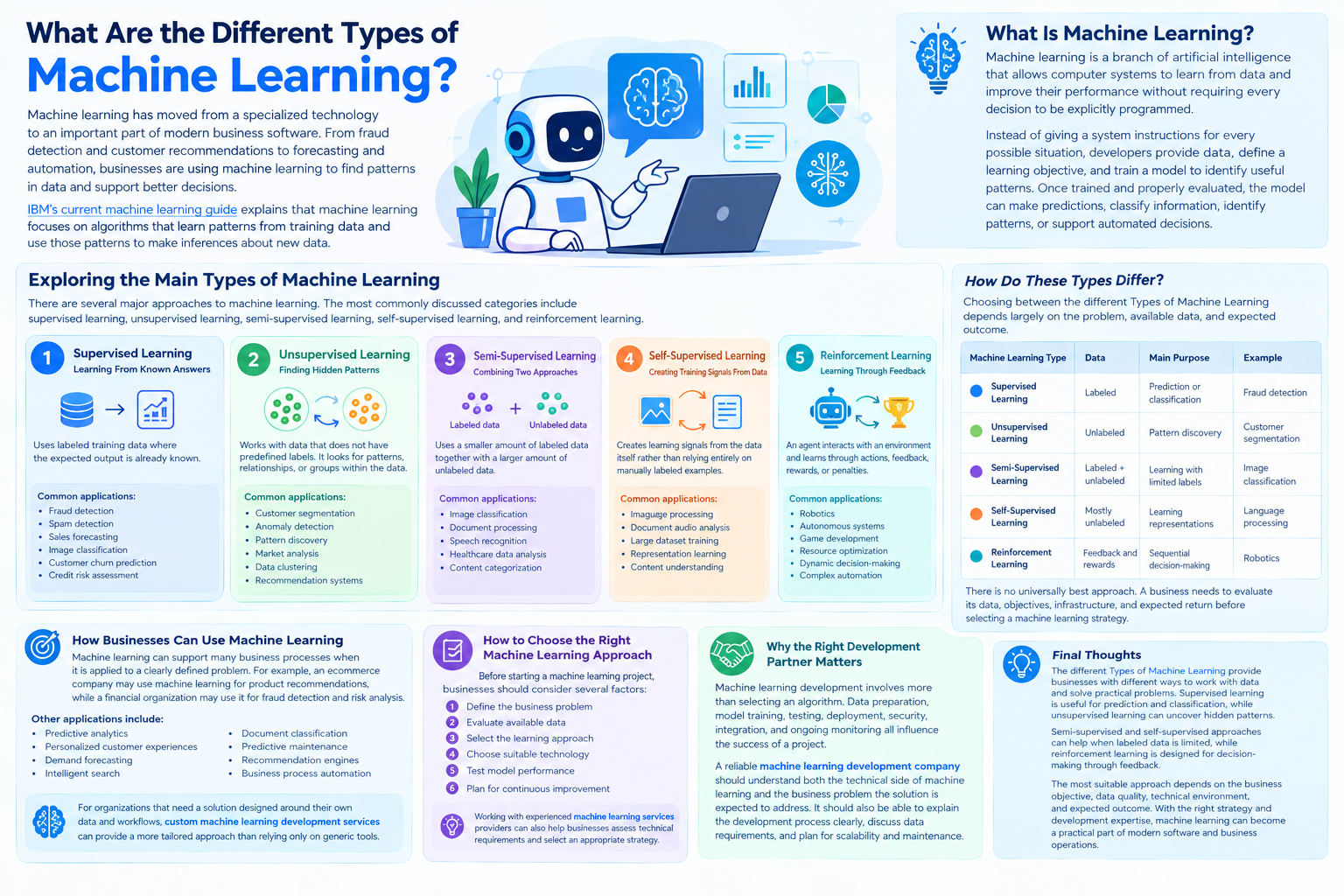
Machine learning has moved from being a specialized technology to an important part of modern business software. From fraud detection and customer recommendations to forecasting and automation, businesses are using machine learning to find patterns in data and support better decisions. IBM's current machine learning guide explains that machine learning focuses on algorithms that learn patterns from training data and use those patterns to make inferences about new data.
However, machine learning is not a single technique. There are different Types of Machine Learning, and each approach is designed for different kinds of data, problems, and business goals. Understanding these approaches can help businesses identify where machine learning can provide practical value.
What Is Machine Learning?
Machine learning is a branch of artificial intelligence that allows computer systems to learn from data and improve their performance without requiring every decision to be explicitly programmed.
Instead of giving a system instructions for every possible situation, developers provide data, define a learning objective, and train a model to identify useful patterns. Once trained and properly evaluated, the model can be used to make predictions, classify information, identify patterns, or support automated decisions.
The right approach depends on the type of data available and the outcome a business wants to achieve.
Exploring the Main Types of Machine Learning
There are several major approaches to machine learning. The most commonly discussed categories include supervised learning, unsupervised learning, semi-supervised learning, self-supervised learning, and reinforcement learning.
1. Supervised Learning: Learning From Known Answers
Supervised learning uses labeled training data, meaning the model receives examples where the expected output is already known.
For example, a company could train a model using historical transactions labeled as legitimate or fraudulent. The model can then learn patterns associated with each category and use them to classify new transactions.
Common applications include:
- Fraud detection
- Spam detection
- Sales forecasting
- Image classification
- Customer churn prediction
- Credit risk assessment
Supervised learning is particularly useful when a business has reliable historical data and a clearly defined outcome.
2. Unsupervised Learning: Finding Hidden Patterns
Unsupervised learning works with data that does not have predefined labels. Instead of learning from known answers, the model looks for patterns, relationships, or groups within the data.
A common example is customer segmentation. A business may have information about thousands of customers but no predefined customer groups. An unsupervised model can analyze purchasing behavior and identify groups with similar characteristics.
Typical applications include:
- Customer segmentation
- Anomaly detection
- Pattern discovery
- Market analysis
- Data clustering
- Recommendation systems
This approach can be valuable when businesses want to discover insights that they did not know to look for.
3. Semi-Supervised Learning: Combining Two Approaches
Semi-supervised learning sits between supervised and unsupervised learning. It uses a smaller amount of labeled data together with a much larger amount of unlabeled data.
This can be useful when creating labels for every data record would require significant time, money, or specialist effort.
For example, a company may have thousands of images but only a portion of them have been manually classified. A semi-supervised approach can use the labeled examples alongside the remaining unlabeled data during model training.
This method can be useful in areas such as:
- Image classification
- Document processing
- Speech recognition
- Healthcare data analysis
- Content categorization
4. Self-Supervised Learning: Creating Training Signals From Data
Self-supervised learning allows a model to create learning signals from the data itself rather than relying entirely on manually labeled examples.
This approach is especially useful when enormous quantities of unlabeled information are available. The model can learn relationships within the data and develop useful representations that can later support other machine learning tasks.
Self-supervised techniques have become particularly important in areas involving language, images, audio, and other large datasets.
For businesses, this approach can be relevant when large volumes of internal or publicly available data exist but manually labeling everything would not be practical.
5. Reinforcement Learning: Learning Through Feedback
Reinforcement learning takes a different approach. Instead of learning from a fixed set of labeled examples, an agent interacts with an environment and learns through actions, feedback, rewards, or penalties.
Think of it as learning through repeated experience. The system tries different actions and gradually learns which actions are more likely to produce the desired result.
Reinforcement learning can be applied to:
- Robotics
- Autonomous systems
- Game development
- Resource optimization
- Dynamic decision-making
- Complex automation
This approach is particularly useful when a problem involves a sequence of decisions rather than one simple prediction.
How Do These Types Differ?
Choosing between the different Types of Machine Learning depends largely on the problem, available data, and expected outcome.
| Machine Learning Type | Data | Main Purpose | Example |
|---|---|---|---|
| Supervised Learning | Labeled | Prediction or classification | Fraud detection |
| Unsupervised Learning | Unlabeled | Pattern discovery | Customer segmentation |
| Semi-Supervised Learning | Labeled + unlabeled | Learning with limited labels | Image classification |
| Self-Supervised Learning | Mostly unlabeled | Learning representations | Language processing |
| Reinforcement Learning | Feedback and rewards | Sequential decision-making | Robotics |
There is no universally best approach. A business needs to evaluate its data, objectives, infrastructure, and expected return before selecting a machine learning strategy.
How Businesses Can Use Machine Learning
Machine learning can support many business processes when it is applied to a clearly defined problem. For example, an ecommerce company may use machine learning for product recommendations, while a financial organization may use it for fraud detection and risk analysis.
Other applications include:
- Predictive analytics
- Personalized customer experiences
- Demand forecasting
- Intelligent search
- Document classification
- Predictive maintenance
- Recommendation engines
- Business process automation
For organizations that need a solution designed around their own data and workflows, custom machine learning development services can provide a more tailored approach than relying only on generic tools.
How to Choose the Right Machine Learning Approach
Before starting a machine learning project, businesses should consider several factors:
- Define the business problem: Clearly identify what the model needs to predict, classify, discover, or optimize.
- Evaluate available data: Check whether the data is labeled, unlabeled, structured, unstructured, sufficient, and reliable.
- Select the learning approach: Match the problem and data with supervised, unsupervised, semi-supervised, self-supervised, or reinforcement learning.
- Choose suitable technology: Consider programming languages, ML frameworks, cloud infrastructure, databases, and deployment requirements.
- Test model performance: Evaluate accuracy and other relevant metrics before putting the model into production.
- Plan for continuous improvement: Monitor model performance and update the system as business data and requirements change.
Working with experienced machine learning services providers can also help businesses assess technical requirements and select an appropriate development strategy.
Why the Right Development Partner Matters
Machine learning development involves more than selecting an algorithm. Data preparation, model training, testing, deployment, security, integration, and ongoing monitoring all influence the success of a project.
A reliable machine learning development company should understand both the technical side of machine learning and the business problem the solution is expected to address. It should also be able to explain the development process clearly, discuss data requirements, and plan for scalability and maintenance.
Final Thoughts
The different Types of Machine Learning provide businesses with different ways to work with data and solve practical problems. Supervised learning is useful for prediction and classification, while unsupervised learning can uncover hidden patterns. Semi-supervised and self-supervised approaches can help when labeled data is limited, while reinforcement learning is designed for decision-making through feedback.
The most suitable approach depends on the business objective, data quality, technical environment, and expected outcome. With the right strategy and development expertise, machine learning can become a practical part of modern software and business operations.

 English
 Arabic
 French
 Spanish
 Portuguese
 Deutsch
 Turkish
 Dutch
Dutch
 Italiano
 Romaian
 Portuguese (Brazil)
 Greek
Greek
 Bengali