


Japan Driving License Test 50 Questions: Important Road Signs to Review
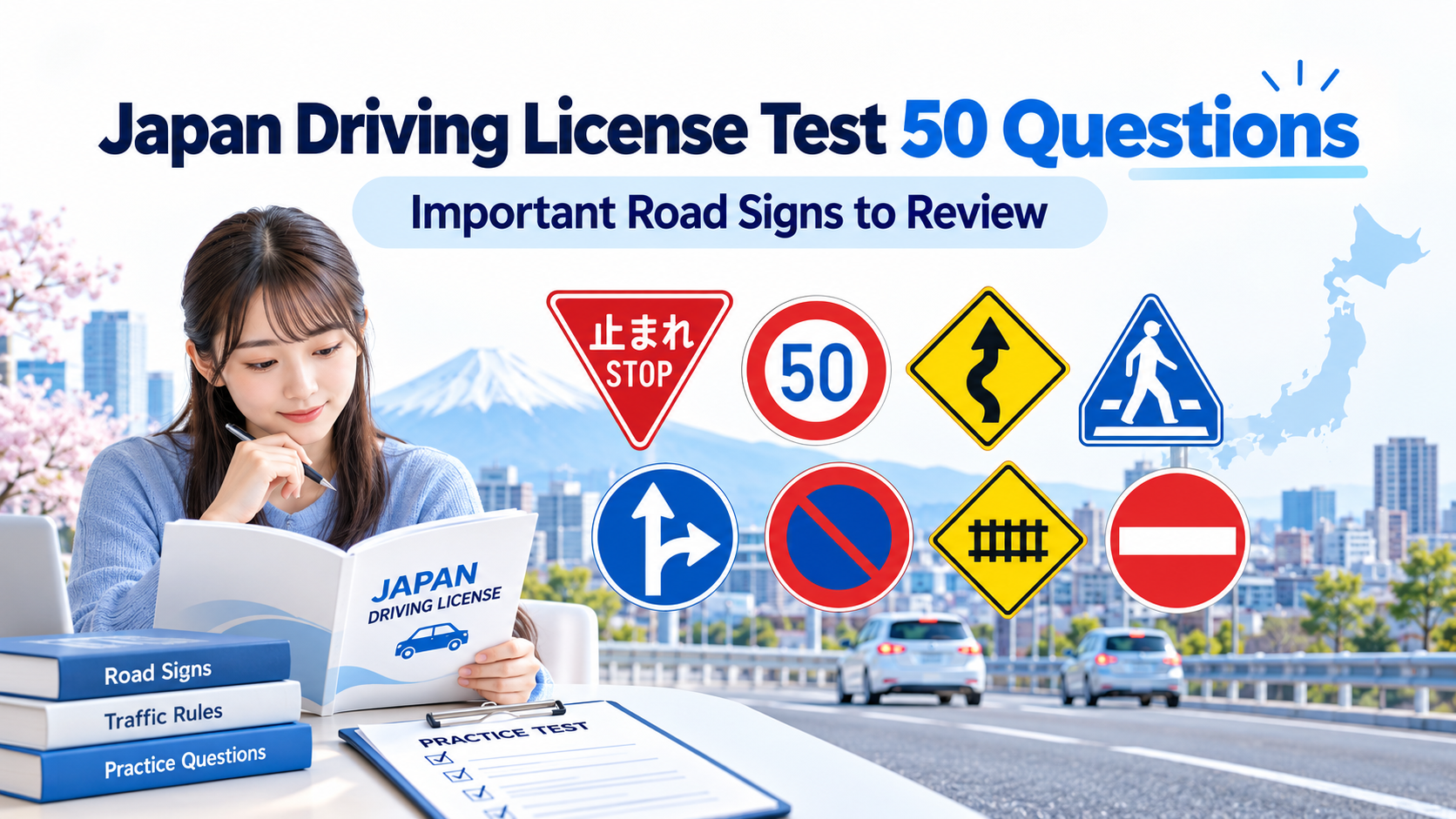
If you are preparing for the Japan driving license test 50 questions, road signs deserve a large part of your study time. The temporary licence written examination includes 50 questions and requires a score of at least 90 percent to pass. That means even a few mistakes can make a difference.
The test is not only about remembering what a symbol looks like. You need to understand what the sign requires you to do, when the rule applies, and how it affects other road users. Japan’s Traffic Signs can also differ from signs used in other countries, so foreign drivers should avoid relying only on previous driving experience.
Start With Stop and Slow Signs
Two of the most important signs to recognise are the Stop and Slow signs.
Japan’s Stop sign is an inverted red triangle. When you see it, you must come to a complete stop and check that it is safe before moving again. The National Police Agency specifically reminds drivers to check both left and right before proceeding.
The Slow sign is also an inverted triangle. It requires drivers to reduce speed enough to react immediately to danger. Official guidance describes this as travelling at a speed that allows an immediate stop, with around 10 km/h or less given as a practical guideline.
For the written test, pay close attention to the difference between slowing down and making a complete stop.
No Entry and One-Way Signs
No Entry and one-way restrictions are another area where learners can lose marks.
A No Entry sign tells you that vehicles must not enter from that direction. One-way signs show the direction in which traffic is permitted to travel. These signs often appear together in real driving situations, so the test may check whether you understand both the symbol and the correct action.
When studying Road and Traffic Signs, do not look at each sign in isolation. Think about what would happen if you approached it at an intersection or entered a street from the wrong direction.
Speed Limit Signs
Speed signs are easy to recognise, but questions can become more difficult when speed limits are combined with road conditions or other restrictions.
A circular speed limit sign shows the maximum permitted speed for that road section. For example, if a sign displays 50, you must not exceed 50 km/h while that restriction applies.
Do not assume that driving below the posted limit is always automatically safe. Weather, pedestrians, narrow roads, visibility and traffic conditions may require a lower speed.
No Parking and No Stopping
Parking restrictions are another useful topic to review before attempting the Japan driving license test 50 questions.
Japan distinguishes between locations where parking is prohibited and locations where both stopping and parking are prohibited. The two restrictions may look similar to a new learner, so spend time comparing their symbols.
A No Parking sign means you cannot park there. A No Stopping or Parking sign is stricter and prohibits both actions.
These questions often test whether you understand the rule rather than simply recognise the sign.
Pedestrian Crossing Signs
Pedestrian safety is especially important in Japan.
At a pedestrian crossing, drivers must stop and give way when pedestrians are crossing or are about to cross. The National Police Agency also states that pedestrians should be given priority at intersections and crossings.
When revising Traffic Signs, study both the pedestrian crossing sign and the road markings used to identify crossings.
A useful way to prepare is to ask yourself: “What should I do if someone is standing near this crossing?” Thinking through the real situation is often more useful than memorising an isolated definition.
Railway Crossing Warning Signs
Railway crossings are another important safety topic.
A warning sign may tell you that a railway crossing is ahead. Learners should understand that approaching a railway crossing requires extra attention, reduced speed and careful observation.
Questions can also test whether you understand where to stop, how to check for trains, and what to do when barriers or signals indicate that a train is approaching.
Lane and Direction Signs
Directional arrows and lane-designation signs tell drivers which movements are permitted from a particular lane.
At intersections, you may be required to use a specific lane depending on whether you are turning left, turning right or continuing straight. Japan’s official road-sign guidance also includes reserved lanes and direction-specific lane signs.
You should also recognise No U-turn signs and solid yellow centre-line markings. A solid yellow line generally must not be crossed when passing another vehicle.
Warning Signs Worth Reviewing
Warning signs tell you about conditions ahead rather than directly ordering you to stop or turn.
Important examples include:
-
Railway crossing ahead
-
School zone
-
Intersection ahead
-
Curves or bends
-
Narrow roads
-
Pedestrian areas
When answering a theory question, look beyond the picture. Ask what risk the sign is warning about and what adjustment a careful driver should make.
A Better Way to Study Road Signs
Trying to memorise dozens of signs in one sitting usually does not work well.
Group them by purpose instead:
Regulatory signs tell you what you must or must not do.
Warning signs alert you to hazards ahead.
Direction and lane signs control where vehicles may travel.
Pedestrian and road markings help explain who has priority and where drivers must stop or give way.
Then practise questions that place those signs in realistic traffic situations.
Prepare for Meaning, Not Just Recognition
The most useful preparation for the Japan driving license test 50 questions is understanding what each sign means in practice.
Knowing that a sign means “Stop” is only the first step. You should also know where to stop, what to check, and when it is safe to continue.
Study official Road and Traffic Signs, review common rules around intersections, pedestrian crossings and lane use, and test yourself regularly. If a practice question feels difficult, return to the rule behind it rather than simply memorising the correct option.
For more guidance on Japan’s written tests, prefecture procedures, road rules and licence preparation, visit our Japan Driving Licence Guide and continue reviewing the topics most likely to appear in your test.

 English
 Arabic
 French
 Spanish
 Deutsch
 Turkish
 Dutch
Dutch
 Italiano
 Russian
 Romaian
 Portuguese (Brazil)
 Greek
Greek
 Bengali