


Cash Basis vs Traditional Accounting for Sole Traders: Which Method Applies?
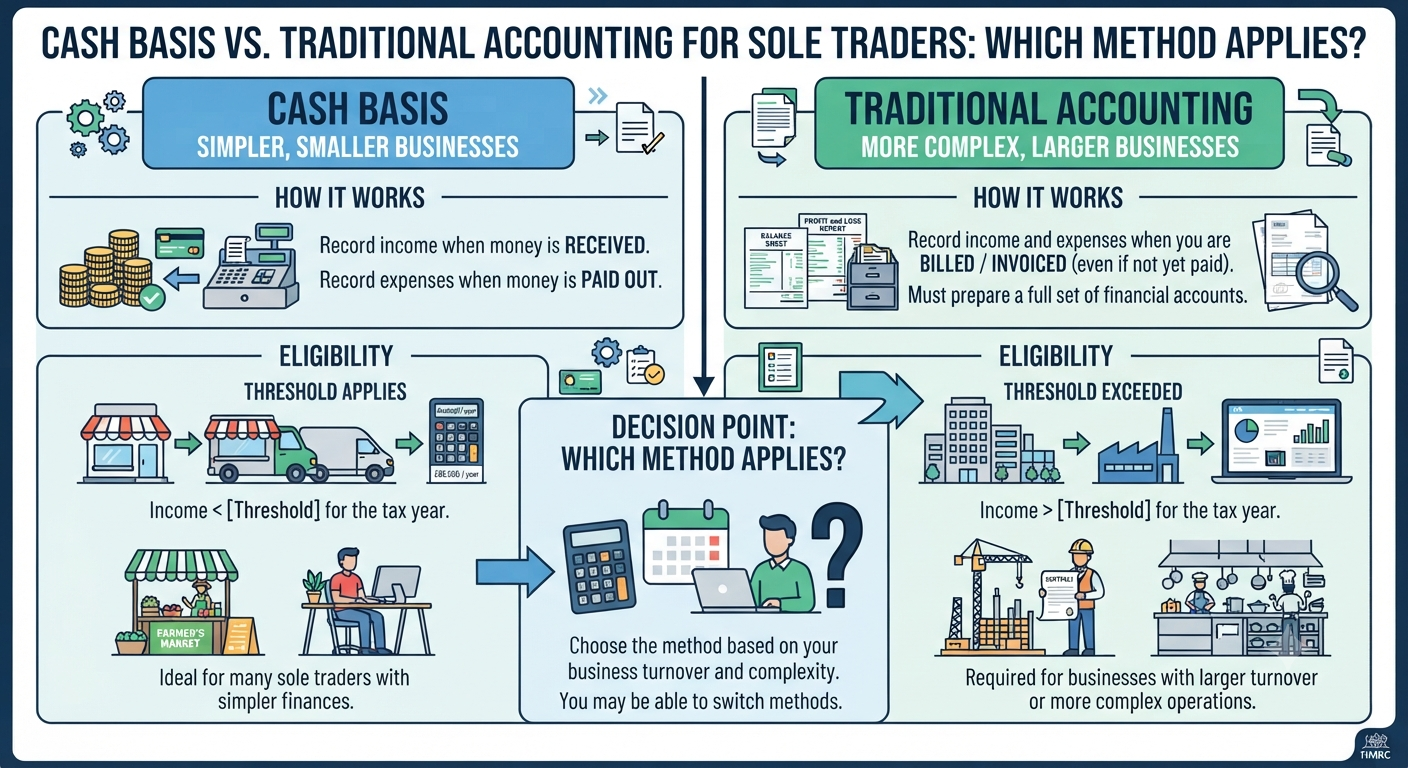
Understanding cash basis accounting for sole traders can help self-employed people choose an appropriate way to record their business income and expenses. The cash basis is a simplified method that can make accounting easier for eligible businesses, but it is not necessarily the right approach for everyone.
Before choosing an accounting method, it is useful to understand how cash basis works and how it differs from traditional accounting.
What Is Cash Basis Accounting?
Cash basis accounting is a method where you generally record income when you receive the money and expenses when you actually pay them.
For example, if you send an invoice to a customer in March but receive the payment in April, the income would generally be recorded when you receive the money under the cash basis.
This can make the system easier to understand for smaller businesses because the records are more closely connected to actual cash movements.
Who Can Use the Cash Basis?
The cash basis is mainly designed for eligible self-employed individuals and partnerships.
There are eligibility rules and circumstances where the cash basis may not be appropriate. The rules have also changed over time, so it is important to use the requirements that apply to the relevant tax year.
For many smaller businesses, the simplified approach can reduce the complexity involved in preparing accounts.
However, businesses with more complicated financial arrangements may benefit from considering traditional accounting instead.
How Does Traditional Accounting Work?
Traditional accounting, sometimes referred to as accrual accounting, records income and expenses based on when they are earned or incurred rather than simply when money changes hands.
For example, if you provide a service in March and issue an invoice but do not receive payment until April, the income may be recognised in the accounting period in which it was earned.
Similarly, expenses can be recorded when the business becomes liable for them, subject to the applicable accounting and tax rules.
This provides a different view of the business's financial position compared with the cash basis.
Cash Basis vs Traditional Accounting
The main difference is the timing of income and expenses.
With the cash basis:
-
Income is generally recorded when payment is received.
-
Expenses are generally recorded when they are paid.
-
Bookkeeping can be simpler for eligible businesses.
-
Cash flow can be easier to track from the accounting records.
With traditional accounting:
-
Income is generally recognised when earned.
-
Expenses are generally recognised when incurred.
-
Outstanding invoices and amounts owed can be taken into account.
-
The accounts can provide a broader picture of financial activity during an accounting period.
Neither approach should automatically be considered suitable for every business.
What Are the Potential Benefits of Cash Basis?
One advantage of the cash basis is simplicity.
If your business has relatively straightforward transactions, recording money when it comes in and goes out can make bookkeeping easier.
It may also reduce the difference between the profit shown in your records and the actual cash available in your business bank account.
This can be useful for sole traders who want a straightforward accounting system and do not have complicated financial arrangements.
Are There Any Limitations?
The cash basis is not suitable for every business situation.
For example, businesses that hold significant stock, have certain finance arrangements or require more detailed financial reporting may need to consider whether traditional accounting is more appropriate.
There can also be differences in how certain expenses, assets and financial transactions are treated.
If your business is growing or your financial situation is becoming more complex, it is worth reviewing whether your existing accounting method remains appropriate.
What About Business Equipment?
The way business equipment and other assets are treated can depend on the accounting method and the relevant tax rules.
Under the cash basis, eligible equipment costs may be treated differently from traditional accounting.
Rather than assuming that every purchase can be deducted in the same way, check the rules that apply to your circumstances and the tax year in question.
Keeping invoices and receipts for equipment purchases is important regardless of the accounting method you use.
Can You Change Your Accounting Method?
There are rules governing when and how a business can move between accounting methods.
Changing methods can also require adjustments to prevent income or expenses from being counted incorrectly.
For this reason, changing your accounting method should not be treated as simply switching a setting in bookkeeping software.
If you are considering moving from traditional accounting to the cash basis, or vice versa, professional advice can help you understand the implications.
Which Method Should a Sole Trader Use?
The appropriate method depends on the nature of your business, your income, expenses, customers, payment terms and financial arrangements.
A small sole trader with straightforward transactions may find the cash basis easier to manage. Another business may benefit from the greater detail provided by traditional accounting.
Instead of choosing an accounting method based only on simplicity, consider how each method reflects your business activity and tax position.
Get Professional Accounting Support
Choosing and maintaining the right accounting method can become more important as your business grows.
Tax Return Assist provides accounting support for sole traders and small businesses, including bookkeeping and tax-related services. If you are unsure which approach is appropriate for your circumstances, speaking with a Sole Trader Accountant can help you understand the options.
Final Thoughts
Cash basis accounting can provide a simpler way for eligible sole traders to record their business finances, particularly when transactions are straightforward. Traditional accounting provides a different approach based on when income is earned and expenses are incurred.
Before choosing or changing your accounting method, consider your business structure, financial activity and the rules applicable to your tax year. Keeping accurate records is essential whichever method you use.

 Arabic
 French
 Spanish
 Portuguese
 Deutsch
 Turkish
 Dutch
Dutch
 Italiano
 Russian
 Romaian
 Portuguese (Brazil)
 Greek
Greek
 Bengali