


BIS Certification for Stainless Steel Butt Hinges – Complete Guide for Manufacturers
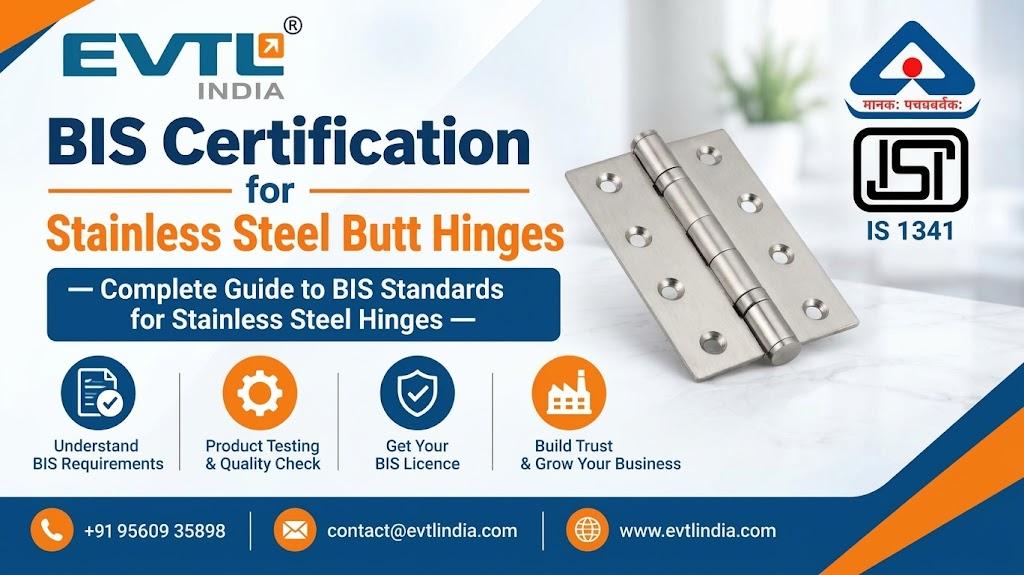
Stainless steel butt hinges are used in doors, cabinets, furniture, and many other products. They connect two parts and allow them to open and close smoothly. Since hinges are used again and again, their material, size, construction, and finish are important. BIS Certification for Stainless steel butt hinges is related to IS 12817:2020, the Indian Standard covering stainless steel butt hinges. Manufacturers need to understand this standard and the applicable BIS requirements before supplying covered products in India.
What Is IS 12817:2020?
IS 12817:2020 is the Indian Standard for stainless steel butt hinges. It gives requirements for different types and sizes of hinges.
The standard covers important points such as:
-
Product dimensions
-
Hinge construction
-
Material requirements
-
Screw holes
-
Pins and knuckles
-
Finish
-
Manufacturing requirements
BIS product information also provides details about sampling, testing equipment, inspection, and the scope of certification under this standard.
In simple words, IS 12817:2020 helps manufacturers understand what a stainless steel butt hinge should be like so that the product can meet the required quality level.
Is BIS Certification Required for These Hinges?
Stainless steel butt hinges covered by IS 12817:2020 are included in the Hinges Quality Control Order. The relevant order makes compliance with the applicable Indian Standard important for manufacturers covered by the requirement.
The 2025 Hinges Quality Control Order specifies 1 July 2025 as the implementation date for stainless steel butt hinges covered under IS 12817:2020.
Because BIS rules and Quality Control Orders can be updated, manufacturers should check the latest official requirements before starting an application.
What Types of Hinges Are Covered?
Stainless steel butt hinges are available in different sizes and designs. IS 12817:2020 covers several types, including:
-
Light-weight hinges
-
Light-weight unequal flap hinges
-
Medium-weight hinges
-
Medium-weight narrow hinges
-
Heavy-weight unequal flap hinges
-
Heavy-weight hinges
The standard also gives requirements for dimensions such as hinge length, breadth, flap thickness, hinge-pin diameter, number of knuckles, and screw-hole details.
This is important because a manufacturer needs to know exactly which types and sizes are being produced before deciding the certification scope.
Material Requirements
The material used in a hinge has a direct effect on its quality and durability. Manufacturers should therefore pay attention to the raw materials used during production.
BIS reference material states that the stainless steel used for the flap is required to conform to IS 6911, while the stainless steel pin is required to conform to IS 6528.
Manufacturers should keep proper records of their raw materials. Test certificates and other supporting documents may also be useful during the certification process.
What Is Checked During Testing?
Product testing is an important part of the certification process. It helps determine whether the hinge meets the requirements of the applicable standard.
Depending on the required test scope, checks can include:
-
Length and breadth
-
Flap thickness
-
Hinge-pin diameter
-
Number of knuckles
-
Screw holes
-
Pin requirements
-
Knuckle requirements
-
Manufacturing details
-
Finish
The BIS laboratory system lists testing facilities for IS 12817:2020. Manufacturers should select testing arrangements according to their product and the tests required for their application.
BIS Certification Process for Stainless Steel Butt Hinges
The certification process may seem difficult at first, but manufacturers can understand it by looking at it step by step.
Step 1: Check the Applicable Standard
First, confirm that the product comes under IS 12817:2020 and check the latest Quality Control Order and BIS requirements.
Step 2: Decide the Product Scope
The manufacturer should identify the hinge types and sizes that need to be covered.
This is important because a BIS licence has a defined scope. It does not automatically cover every type and size of product made by a company.
Step 3: Check the Manufacturing Facility
The factory should have suitable production facilities and quality-control arrangements.
The manufacturer should also check whether the required testing equipment is available according to the applicable requirements.
Step 4: Arrange Product Testing
The required product samples are tested against the applicable requirements.
The manufacturer should make sure that the sample represents the product for which certification is being requested.
Step 5: Submit the Application
After preparing the required information and documents, the manufacturer can submit the BIS application through the applicable process.
Step 6: Factory Assessment
Where required, BIS may assess the manufacturing facility. During this stage, the production process, quality-control system, testing arrangements, and product-related information may be checked.
Step 7: Correct Any Issues
If an issue is found during testing or assessment, the manufacturer may need to take corrective action and provide the required information.
Step 8: Grant of Licence
After the applicable requirements are successfully completed, BIS can grant the licence according to the approved scope and certification conditions.
Documents Required for the Process
The exact documents can vary according to the application. However, manufacturers may need information such as:
-
Factory address and ownership documents
-
Company registration documents
-
GST certificate
-
Product drawings
-
Product specifications
-
Manufacturing process details
-
Plant layout
-
Machinery list
-
Raw-material list
-
Raw-material test certificates
-
Testing equipment details
-
Calibration records
-
Quality-control information
-
Brand or trademark details
-
Details of authorised persons
It is better to prepare these documents before starting the application. Clear and matching information can help avoid unnecessary delays.
What Is the BIS ISI Mark?
The ISI Mark is a Standard Mark used for products covered by the applicable BIS certification requirements. It shows that the product is covered by a valid BIS licence and meets the conditions of the relevant standard and certification scheme.
The BIS ISI Mark For Stainless steel butt hinges should not be used simply because a product has been tested by a laboratory. The manufacturer must complete the applicable BIS certification process and use the mark according to the licence conditions.
The approved product scope is also important. A manufacturer should ensure that the products being marked are covered by the licence.
BIS Registration and Product Scope
Many manufacturers use the term registration when discussing BIS approval. However, it is important to understand what approval route applies to the particular product.
For covered stainless steel butt hinges, BIS Registration for Stainless steel butt hinges involves meeting the applicable certification requirements rather than simply submitting a basic registration form.
The manufacturer should first understand the product standard, testing requirements, factory requirements, documents, and approved scope.
BIS ISI Mark Certification for Stainless Steel Butt Hinges
Obtaining BIS ISI Mark Certification for Stainless steel butt hinges requires proper preparation. The product should meet the requirements of IS 12817:2020, and the manufacturer should be ready for the applicable testing and assessment stages.
One useful step is to check the product before applying. Manufacturers can compare their product drawings, dimensions, materials, testing facilities, and production process with the applicable requirements. Finding a problem before the application can save time later.
Common Problems Manufacturers Should Avoid
A manufacturer can avoid many problems by checking a few basic things in advance.
-
Do not use incorrect product dimensions.
-
Do not ignore raw-material requirements.
-
Keep product drawings updated.
-
Make sure documents contain matching information.
-
Keep testing equipment properly maintained.
-
Maintain calibration records where required.
-
Clearly define the product sizes and types.
-
Check the latest BIS requirements before applying.
A small difference between the actual product and the documents can lead to questions during assessment.
Requirements for Foreign Manufacturers
Foreign manufacturers supplying covered products to India also need to follow the applicable BIS requirements.
Their process can include additional requirements related to factory assessment, authorised representation, testing, and communication with BIS.
Therefore, an overseas manufacturer should check the current requirements for foreign manufacturers before beginning the application. The process should be planned according to the location of the factory and the applicable BIS certification route.
How EVTL India Can Help
Understanding a BIS standard can be difficult when a manufacturer is applying for the first time. There may be questions about documents, product testing, factory preparation, product scope, and the application process.
A BIS Consultant for Stainless steel butt hinges can help manufacturers understand these requirements and coordinate different activities involved in certification.
EVTL India provides support for BIS certification and product compliance. The team can assist manufacturers with documentation, testing coordination, application-related work, inspection preparation, and other certification activities.
Why Choose EVTL India?
EVTL India helps manufacturers understand and manage certification requirements in a more organised way.
Support may include:
-
Understanding the applicable BIS standard
-
Preparing certification documents
-
Coordinating product testing
-
Application assistance
-
Factory inspection preparation
-
Support with BIS-related queries
-
Guidance during different certification stages
Manufacturers should always check the latest official BIS requirements applicable to their product before taking any compliance decision.
Conclusion
EVTL India is one of the leading BIS Consultant in India, helping manufacturers obtain their BIS licenses hassle-free. For stainless steel butt hinges, manufacturers should understand IS 12817:2020, check the latest Quality Control Order, prepare the product and factory properly, complete the required testing, and follow the applicable BIS certification process.
Good preparation is important. When the product, documents, testing arrangements, and proposed licence scope are checked before applying, manufacturers can better understand what is required and avoid many common problems.
For assistance with BIS certification for stainless steel butt hinges, contact EVTL India:
Phone: +91 95609 35898
Email: contact@evtlindia.com
Website: www.evtlindia.com
Frequently Asked Questions
1. What is the standard for stainless steel butt hinges?
The applicable Indian Standard is IS 12817:2020 – Stainless Steel Butt Hinges.
2. Is BIS certification required for stainless steel butt hinges?
Stainless steel butt hinges covered by IS 12817:2020 are included in the Hinges Quality Control Order. Manufacturers should check the latest applicable order and BIS requirements before supplying the product.
3. What does IS 12817:2020 cover?
It covers requirements related to stainless steel butt hinges, including types, dimensions, construction, material, manufacturing, and finish.
4. What materials are specified for the hinge?
BIS reference material states that the stainless steel flap is required to conform to IS 6911, while the stainless steel pin is required to conform to IS 6528.
5. What is checked during testing?
Testing can include dimensions, screw holes, pins, knuckles, finish, and other requirements applicable to the product.
6. Does one BIS licence cover every hinge size?
Not necessarily. The licence has an approved product scope. Manufacturers should identify the required types and sizes during the certification process.
7. Can a BIS consultant help with the application?
Yes. A consultant can assist with documents, testing coordination, application-related work, factory preparation, and other certification activities.

 English
 Arabic
 French
 Spanish
 Portuguese
 Deutsch
 Turkish
 Dutch
Dutch
 Italiano
 Romaian
 Portuguese (Brazil)
 Greek
Greek
 Bengali