


BIS Certification for Steel Back Flap Hinges – Complete Guide to IS 3843:1995
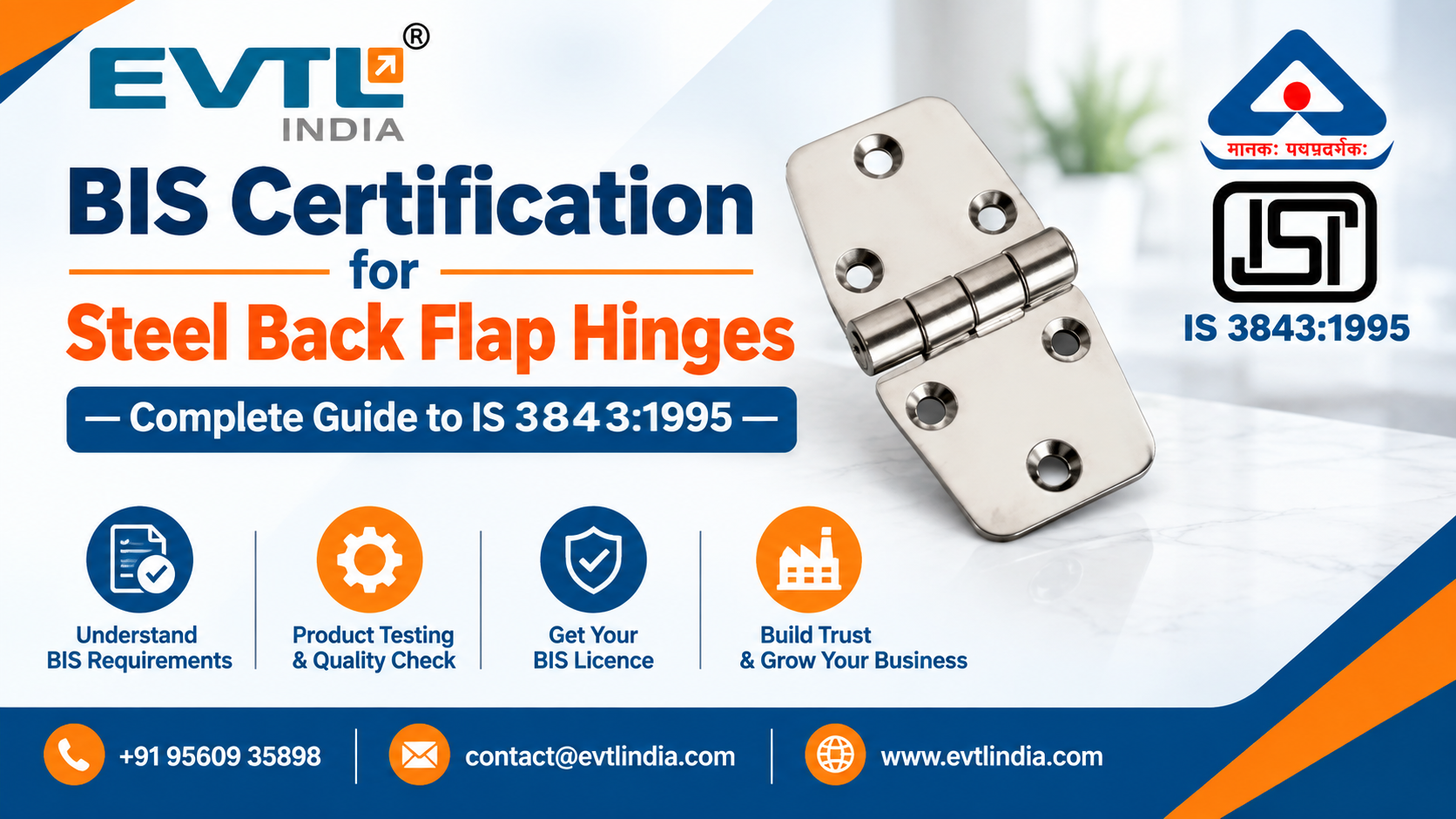
Steel back flap hinges are small but useful hardware products. They help flaps, lids, and panels open and close properly. These hinges can be used in furniture, cabinets, storage units, boxes, counters, and other products. Since they may be used many times, their material, dimensions, construction, and finish need proper attention. For manufacturers, IS 3843:1995 is an important Indian Standard related to steel back flap hinges.
What Are Steel Back Flap Hinges?
Steel back flap hinges are fittings used to connect a movable flap or panel to another part. They allow the flap to move while keeping it securely connected.
Although the product is small, its quality can affect the performance of the complete furniture or hardware item. A poorly made hinge may create problems such as incorrect fitting, rough movement, loose connections, or early wear.
For this reason, manufacturers should control the quality of raw materials and maintain proper production practices.
Why Is BIS Compliance Important?
BIS compliance helps manufacturers understand and follow the applicable requirements for their products. When looking for BIS For Steel back flap hinges, manufacturers should first identify the relevant standard and check the requirements that apply to their particular product.
The process is not limited to paperwork. Depending on the applicable BIS scheme, manufacturers may need to meet requirements related to product testing, documents, manufacturing facilities, quality control, and inspection.
Proper preparation can make the overall process more organised.
What Does the Standard Cover?
The applicable Indian Standard provides requirements for important aspects of steel back flap hinges. These requirements help manufacturers maintain consistent product quality.
The main areas include:
-
Material used for manufacturing
-
Dimensions and required measurements
-
Manufacture and construction
-
Finish and surface quality
Manufacturers should compare their product specifications with the applicable requirements before starting the certification process.
BIS Certification Process
BIS Certification for Steel back flap hinges involves several steps. The exact process can depend on the applicable BIS scheme and the manufacturer's circumstances.
Step 1: Understand the Requirements
First, identify the applicable standard and understand the product and certification requirements.
Step 2: Prepare Documents
Collect the required factory, product, manufacturing, testing, and quality-control information.
Step 3: Arrange Product Testing
Product samples may need to be tested according to the applicable requirements. The required tests should be identified before testing begins.
Step 4: Submit the Application
The manufacturer needs to submit the required information and documents through the applicable BIS process.
Step 5: Factory Assessment
Where applicable, BIS may assess the manufacturing unit. Production facilities, quality-control arrangements, testing facilities, and related areas may be checked.
Step 6: Complete Compliance Requirements
If observations or additional requirements are raised during the process, the manufacturer needs to address them as applicable.
Step 7: Receive the Required Approval
After the applicable requirements are successfully completed, the manufacturer can proceed according to the BIS decision and licence conditions.
Main Testing and Quality Checks
Testing helps determine whether the product meets the applicable requirements.
|
Area |
What It Means |
|
Material |
Checks the material used in the hinge |
|
Dimensions |
Checks size and important measurements |
|
Manufacture |
Checks construction and manufacturing quality |
|
Finish |
Checks surface quality and finishing |
Manufacturers should also carry out suitable quality checks during production. Finding problems early can help prevent defective products from reaching the final stage.
Documents Manufacturers Should Prepare
Good documentation is an important part of certification. The exact documents can vary according to the product and applicable BIS requirements.
Manufacturers may need information such as:
-
Factory and manufacturer details
-
Product specifications
-
Technical drawings
-
Raw material information
-
Manufacturing process details
-
Machinery details
-
Testing equipment information
-
Quality-control information
-
Relevant test reports
-
Details of authorised personnel
-
Other supporting documents requested during the process
All information should be accurate and consistent.
Benefits of BIS Compliance
Following applicable BIS requirements can provide several practical benefits to manufacturers.
Better Product Control
A proper quality-control system helps manufacturers maintain consistency between different production batches.
Clear Quality Requirements
The applicable Indian Standard gives manufacturers a clear reference for important product characteristics.
Customer Confidence
Proper compliance and permitted product marking can provide useful information to buyers about the product's certification status.
Better Manufacturing Practices
The certification process can encourage manufacturers to maintain proper records, testing arrangements, and production controls.
Regulatory Compliance
Where BIS certification is required by applicable regulations, following the prescribed requirements helps manufacturers meet their regulatory responsibilities.
BIS Registration and Licence
Manufacturers sometimes use the term BIS Registration for Steel back flap hinges when discussing product approval. However, the correct terminology can depend on the applicable BIS scheme.
For products covered under the ISI Mark product certification system, the approval is generally referred to as a BIS licence. Therefore, manufacturers should check the current applicable BIS scheme rather than relying only on commonly used terms.
Receiving approval is also not the end of the compliance responsibility. Manufacturers should continue to follow applicable requirements and maintain consistent product quality.
Importance of the ISI Mark
Where the applicable certification scheme requires the ISI Mark, manufacturers must follow the prescribed marking requirements.
The ISI Mark should only be used according to the applicable BIS licence and marking conditions. Manufacturers should not use the mark before obtaining the required approval.
Correct marking can help customers identify products that are covered by an applicable BIS licence.
Common Mistakes Manufacturers Should Avoid
Some simple mistakes can make the certification process more difficult. Manufacturers should try to avoid:
-
Incomplete documentation
-
Incorrect product specifications
-
Mismatch between drawings and actual products
-
Poor quality-control records
-
Inadequate testing arrangements
-
Inconsistent information in documents
-
Lack of factory preparation
-
Incorrect use of the ISI Mark
-
Failure to check the latest applicable requirements
Careful preparation before applying can help reduce unnecessary problems.
How a BIS Consultant Can Help
A BIS Consultant for Steel back flap hinges can help manufacturers understand the certification process and organise the required activities.
Consultancy support may include:
-
Reviewing the applicable requirements
-
Checking documentation
-
Supporting test coordination
-
Assisting with application preparation
-
Helping prepare for factory assessment
-
Supporting communication during the process
-
Explaining compliance-related requirements
This type of support can be useful for manufacturers who are applying for BIS approval for the first time.
Why Choose EVTL India?
EVTL India provides BIS certification and product compliance support to manufacturers. The team can help manufacturers understand applicable requirements, organise documents, coordinate testing, and prepare for certification-related activities.
Before starting the process, manufacturers can discuss their product details with EVTL India and understand what preparation may be required.
Conclusion
EVTL India is one of the leading BIS Consultant in India, helping manufacturers obtain their BIS licences hassle-free. For steel back flap hinge manufacturers, understanding the applicable Indian Standard and BIS requirements is an important part of product compliance. Proper documentation, suitable testing, manufacturing controls, and correct product marking can help create a more organised certification process.
Manufacturers should always check the latest applicable BIS requirements before applying because standards, schemes, and regulatory requirements may be updated.
Contact EVTL India
📞 +91 95609 35898
📧 contact@evtlindia.com
🌐 www.evtlindia.com
Frequently Asked Questions
1. What is the Indian Standard related to steel back flap hinges?
The relevant Indian Standard is IS 3843:1995. Manufacturers should check the current BIS requirements to understand how the standard applies to their product.
2. What are the main areas checked during testing?
The main areas can include material, dimensions, manufacturing quality, and finish, depending on the applicable requirements.
3. Why are technical drawings important?
Technical drawings provide information about the product's design, measurements, and construction. They can help ensure that the manufactured product matches the submitted specifications.
4. Is factory assessment required?
A factory assessment may be required under the applicable certification procedure. The assessment can cover manufacturing facilities, quality control, testing arrangements, and other relevant areas.
5. What happens if documents contain incorrect information?
Incorrect or inconsistent information can create problems during the certification process. Manufacturers should carefully check all documents before submission.
6. Can a consultant assist with product testing?
Yes. A consultant can help manufacturers understand the applicable testing requirements and coordinate relevant testing activities.
7. Can the ISI Mark be used before approval?
No. Where the ISI Mark is applicable, it should be used only according to the relevant BIS licence and prescribed marking requirements.
8. Does the manufacturer need to maintain quality after certification?
Yes. Manufacturers should continue to follow the applicable requirements and maintain consistent product quality after receiving approval.

 English
 Arabic
 Spanish
 Portuguese
 Deutsch
 Turkish
 Dutch
Dutch
 Italiano
 Russian
 Romaian
 Portuguese (Brazil)
 Greek
Greek
 Bengali