


BIS Certification for Parliament Hinges as per IS 362:1991 – Complete Guide
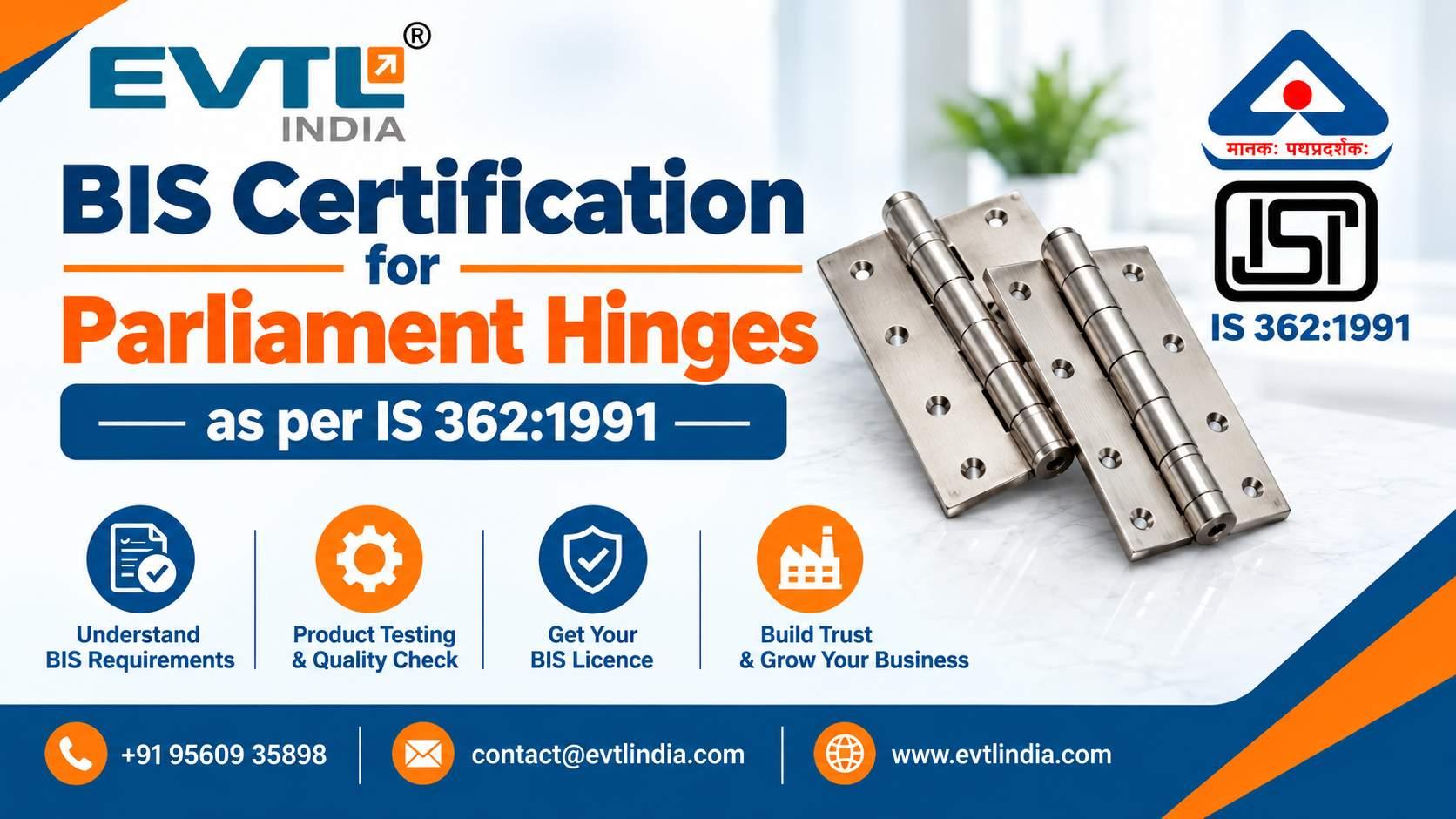
Parliament hinges are used for doors where a wider opening is needed. They are different from normal hinges because their design gives more space between the door and the frame. These hinges are used in homes, offices, hotels, hospitals, furniture and other places. For manufacturers, it is important to make these products according to the applicable Indian Standard and BIS requirements.
What Are Parliament Hinges?
Parliament hinges are special hinges made for doors that need to open wider than normal. Their design allows the door to move away from the frame when it opens. This can be useful when there is a thick frame, wall decoration or some other object near the door.
A good quality hinge should have proper dimensions, good finish and correct manufacturing. The hinge should also move smoothly after it is fitted to the door. Poor manufacturing can cause problems such as loose movement, improper fitting or early wear.
IS 362:1991 – The Applicable Indian Standard
IS 362:1991 is the Indian Standard related to Parliament hinges. Manufacturers should first check whether their product comes under the scope of this standard before starting the certification process.
The standard gives requirements related to the construction and quality of the product. It helps manufacturers understand how the hinge should be made and what requirements need to be checked.
A manufacturer should not select an Indian Standard only because the product name looks similar. The actual product, type, material and scope should be checked before applying.
What Does the Standard Cover?
The standard covers different types of Parliament hinges. The BIS product manual identifies Type 1, Type 2 and Type 3 within the product scope.
The product type is important because manufacturers need to know exactly which type they are making. They should also check the material and other product details before preparing the BIS application.
This step is simple but important. If the wrong product type or scope is selected at the beginning, it can create problems later during testing or assessment.
BIS Certification for Parliament hinges
Manufacturers who need BIS Certification for Parliament hinges should first check whether their product comes under the applicable Indian Standard and BIS requirements. The manufacturer should also prepare the required documents, product samples, testing arrangements and factory details before starting the application process.
The process is not only about filling out an online application. The manufacturer should have a suitable production process, proper quality checks, required testing arrangements and the documents needed for the application.
The product is checked against the requirements of the applicable standard. Samples may also be tested as part of the certification process.
Who Should Apply for Certification?
This information is mainly useful for manufacturers of Parliament hinges. It can also help businesses that are planning to manufacture these products for the Indian market.
Foreign manufacturers supplying covered products to India should also check the requirements that apply to them. Importers and suppliers should confirm whether the products they are dealing with have the required certification.
Before starting the process, it is better to check the latest BIS rules and the applicable Quality Control Order.
BIS Certification Process – Step by Step
The certification process can look difficult when a manufacturer is doing it for the first time. It becomes easier when the work is divided into simple steps.
Step 1 – Identify the standard
First, check whether the product falls under IS 362:1991 and identify the correct product type.
Step 2 – Check the product
Review the product dimensions, material, construction and finish against the applicable requirements.
Step 3 – Prepare the factory
The manufacturing unit should have suitable machines, inspection arrangements and required testing facilities.
Step 4 – Prepare documents
Company details, factory details, product information, manufacturing details and other required documents should be kept ready.
Step 5 – Arrange testing
Required samples should be prepared and testing should be completed as applicable.
Step 6 – Submit the application
After the required preparation, the BIS application can be submitted with the required information and documents.
Step 7 – Complete BIS assessment
BIS may assess the manufacturing unit and check the required arrangements and records.
Step 8 – Complete the remaining requirements
If any issue is found, the manufacturer may need to take corrective action and provide the required information.
Documents Manufacturers Should Keep Ready
The exact documents can depend on the application and current BIS requirements. However, manufacturers should keep basic factory and product information organised.
This may include company information, factory address, manufacturing process details, raw material information, machinery details, testing equipment details, quality-control information and product details.
Keeping these documents ready before applying can save time. It also helps the manufacturer answer questions during the certification process.
BIS ISI Mark Certification for Parliament hinges
After the applicable BIS certification requirements are completed and the licence is granted, the manufacturer can use the BIS Standard Mark according to the licence conditions.
The mark should not be used simply because an application has been submitted. Manufacturers should follow the marking conditions given by BIS and use the mark only as permitted.
The manufacturer should also maintain the required quality and testing controls after receiving the licence. Certification is not the end of the responsibility. Product quality must continue to be maintained.
BIS Testing Requirement for Parliament hinges
Testing is an important part of the certification process. The manufacturer needs to make sure that the product meets the applicable requirements of IS 362:1991.
Important areas can include dimensions and tolerances, manufacturing requirements and finish, as applicable to the product.
Before sending samples for testing, manufacturers should check their products carefully. A small mistake in dimensions or manufacturing can create problems during testing.
What Should Be Checked Before Testing?
A manufacturer can reduce avoidable problems by checking the product before submitting samples.
1. Check Dimensions
Measure the product properly and compare the measurements with the applicable requirements of the standard.
2. Check Manufacturing
Look at the hinge body, leaves, knuckles, pin and other parts. They should be properly made and assembled.
3. Check Finish
The surface should have the required finish and should not have obvious defects that affect the product.
4. Check Product Type
Make sure the sample being tested belongs to the same product type and scope mentioned in the application.
5. Check Sample Quality
Do not send a sample that is different from the normal production product. The sample should represent the product that the manufacturer plans to sell.
Why Product Consistency Is Important
Imagine a manufacturer makes a good sample for testing but produces a different product during regular production. This can create a quality problem.
For this reason, manufacturers should have proper checks during production. Raw materials, dimensions, manufacturing and final inspection should be controlled.
The aim is simple: the product tested for certification and the product made for customers should meet the same applicable requirements.
Common Mistakes Manufacturers Should Avoid
Many problems can be avoided if the manufacturer prepares properly.
Some common mistakes include:
-
Selecting the wrong Indian Standard
-
Not checking the product scope
-
Giving incorrect product information
-
Not checking dimensions before testing
-
Sending a poor-quality sample
-
Not keeping factory records properly
-
Not maintaining testing equipment as required
-
Using the BIS Standard Mark without following licence conditions
-
Not checking the latest BIS requirements
Taking care of these points before applying can make the process more organised.
What Happens During Factory Preparation?
Factory preparation is an important part of the process. The manufacturer should understand how the product is made from raw material to finished hinge.
There should be a clear manufacturing process. Workers should know the required quality checks. Inspection and testing arrangements should also be available as required.
Records are useful because they show that the manufacturer is actually following the planned quality process.
What Happens After Getting the BIS Licence?
Getting a BIS licence does not mean that the manufacturer can stop checking the product.
The manufacturer should continue production according to the applicable requirements. Quality checks and testing should be carried out as required. Records should also be maintained properly.
The manufacturer should also follow BIS requirements related to marking, surveillance, renewal and other applicable activities.
Why Should Manufacturers Check the Latest BIS Rules?
BIS standards and regulatory requirements can be updated from time to time. Quality Control Orders can also have amendments or changes.
Therefore, manufacturers should not depend only on an old article or information received from another company.
Before applying, it is better to check the latest information available from BIS and confirm the requirements that apply to the product.
How a BIS Consultant Can Help
A BIS Consultant for Parliament hinges can help a manufacturer understand the certification process in simple steps.
A consultant can help with checking the applicable standard, understanding product requirements, preparing documents, coordinating testing and preparing for the BIS assessment.
This can be useful for a manufacturer applying for BIS certification for the first time. However, the manufacturer remains responsible for making the product according to the applicable requirements.
Why Choose EVTL India?
EVTL India supports manufacturers with BIS certification-related work and helps them understand the process in simple language.
For Parliament hinge manufacturers, EVTL India can provide guidance on the applicable standard, documentation, testing and certification process.
The main benefit of taking professional guidance is that the manufacturer can understand the process before starting the application. This can help avoid common mistakes and unnecessary delays.
Conclusion
EVTL India is one of the leading BIS Consultant in India, helping manufacturers obtain their BIS licenses hassle-free. For Parliament hinge manufacturers, understanding the applicable standard, product requirements, testing process and BIS application steps is important.
A manufacturer should first check whether the product falls under IS 362:1991 and identify the correct product type. After that, the factory, documents, testing arrangements and product samples should be prepared properly.
Good preparation can make the certification process easier. Manufacturers should also remember that product quality needs to be maintained even after getting the licence.
For BIS certification guidance, contact EVTL India:
📞 +91 95609 35898
📧 contact@evtlindia.com
🌐 www.evtlindia.com

 English
 French
 Spanish
 Portuguese
 Deutsch
 Turkish
 Dutch
Dutch
 Italiano
 Russian
 Romaian
 Portuguese (Brazil)
 Greek
Greek
 Bengali