


BIS Certification for Steel Butt Hinges – Complete Guide for Manufacturers
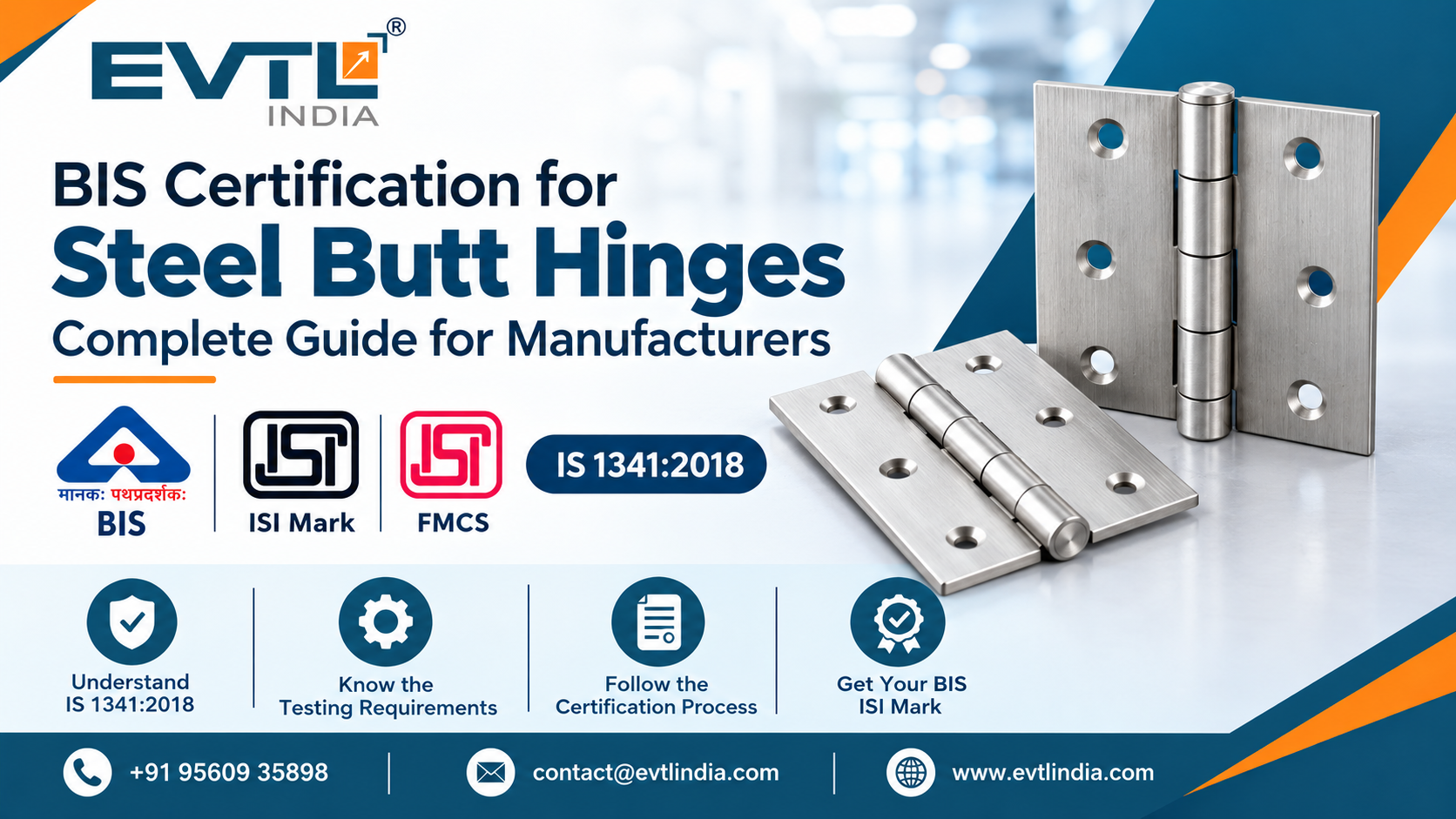
Steel butt hinges may look like a small part of a door, but they have an important job. They connect the door with its frame and allow it to open and close smoothly. These hinges are used in homes, offices, shops, hotels, factories, furniture and many other places. Since they are used regularly, their quality and proper manufacturing are important.
For manufacturers selling these products in India, understanding the applicable requirements is important. BIS For Steel Butt Hinges helps manufacturers understand the certification requirements and the steps involved in meeting the applicable quality conditions.
What Are Steel Butt Hinges?
A butt hinge is a common type of hinge fitted between a door and its frame. It normally has two metal plates, known as leaves, joined together with a hinge pin. One leaf is attached to the door, while the other is attached to the frame.
When the door is opened or closed, the leaves move around the hinge pin. The size, design and construction of the hinge can vary according to its intended use.
A good quality hinge should have proper dimensions, suitable material, good workmanship and an appropriate finish. Even though it is a small component, its quality can affect the movement and fitting of the door.
Why Certification Is Important
BIS certification is an important consideration for manufacturers whose products fall under applicable Indian requirements. The certification process checks whether the product and manufacturing arrangements meet the conditions specified under the relevant standard.
Certification involves more than simply using a BIS mark. Manufacturers may need to maintain suitable production facilities, quality-control arrangements, testing facilities, records and documents.
Before applying, it is therefore useful for a manufacturer to understand the product requirements and prepare the factory accordingly. Proper preparation can help avoid mistakes during testing and assessment.
Understanding IS 1341:2018
The applicable Indian Standard for steel butt hinges is IS 1341:2018. It provides requirements related to areas such as dimensions, manufacture, material and finish.
The standard covers different types and sizes of steel butt hinges. Manufacturers should identify the correct product type and size before preparing samples or submitting an application.
Understanding the standard is important because the product has to be assessed against the applicable requirements. Using the correct standard also helps the manufacturer prepare the right specifications and testing arrangements.
Different Types and Sizes
Steel butt hinges are available in different types and sizes. The selection normally depends on the size of the door and its intended application.
The product manual for IS 1341:2018 identifies product types such as LW, LWU, MWU, MW, BR, SQ, HW1 and HW2.
A manufacturer should clearly identify which type or types are being produced. Product details should remain consistent across the product, test samples, documents and application.
Understanding the Product Scope
Before starting the certification process, manufacturers should check the BIS Scope For Steel Butt Hinges carefully. This helps them understand which products and product types are covered by the applicable requirements.
Checking the scope at the beginning can prevent a manufacturer from preparing an application for the wrong product category. It can also help in deciding which sizes and types should be included in the application.
If a company manufactures several varieties, each product should be reviewed properly before the application is prepared.
What Is Checked During Testing?
Testing is an important part of the certification process. The BIS Testing Requirement for Steel Butt Hinges can include checks related to product dimensions, workmanship, manufacture, finish and other applicable characteristics.
Some of the product details that may be checked include:
-
Hinge size
-
Length and breadth
-
Flap thickness
-
Hinge-pin diameter
-
Number of knuckles
-
Screw-hole details
-
Dimensions and tolerances
-
Workmanship
-
Finish
-
Material-related requirements
These checks help determine whether the manufactured product meets the applicable requirements.
The exact testing requirements should always be checked against the current BIS requirements and relevant product documentation before testing.
Why Product Testing Matters
Testing gives manufacturers a practical way to check whether their product meets the required specifications. It can also help identify production problems before the product is supplied to customers.
For example, if the hinge dimensions are not correct or the pin does not meet the required specification, the manufacturer can identify the issue and make suitable corrections.
Testing also helps manufacturers maintain consistency between different production batches. This becomes particularly useful when products are manufactured in large quantities.
Samples Required for Testing
Product samples are an important part of certification. The samples should represent the actual product manufactured at the factory.
The manufacturer should make sure that the samples have the correct type, size, material and construction. The information given for the samples should also match the product details submitted during the certification process.
The BIS Product Manual for Steel Butt Hinges provides information about product types and the applicable sampling and testing approach. Manufacturers should check the latest version of the product manual before preparing samples.
Documents Required
Documentation is another important part of the certification process. Manufacturers need to provide information about their company, factory, product and quality-control arrangements.
Depending on the application, documents may include:
-
Factory or company details
-
Manufacturing process information
-
Machinery details
-
Testing facility information
-
Product specifications
-
Raw material details
-
Quality-control information
-
Test reports, where applicable
-
Details of the responsible person
-
Other documents required by BIS
The exact document requirements may vary according to the application. It is therefore better to check the current requirements before submitting documents.
How the Certification Process Works
The process generally begins with understanding the applicable standard and checking whether the product falls within the relevant scope.
The manufacturer then prepares the required documents and product information. An application is submitted through the applicable BIS process.
Product samples may then need to be tested through the required testing arrangements. The manufacturing unit and quality-control facilities may also be assessed as applicable.
If any problem is identified during testing or assessment, the manufacturer may need to take corrective action. Once the applicable requirements are completed successfully, the certification process can move forward according to BIS rules.
Factory Inspection and Assessment
Factory assessment is an important part of the process where applicable. It helps check whether the manufacturer has suitable facilities to produce the product consistently.
Areas such as machinery, production facilities, testing arrangements, quality control and records may be reviewed during the assessment.
Manufacturers should keep the factory and documents ready before the assessment. The employees responsible for production and quality control should also understand the basic product requirements.
Good preparation can make the assessment process easier and can help the manufacturer respond properly if any issue is raised.
Common Mistakes to Avoid
Manufacturers can face unnecessary delays when basic information is not prepared correctly. Some common mistakes include:
-
Selecting the wrong product type
-
Giving incorrect product details
-
Submitting samples that do not match the actual product
-
Keeping incomplete documents
-
Not checking testing requirements
-
Ignoring quality-control records
-
Making changes to the product without reviewing the compliance requirements
-
Not preparing the factory properly for assessment
Checking all information before submission can help reduce such problems.
BIS License Process
After the required testing, documentation and assessment steps are completed, the manufacturer can proceed with the applicable BIS License For Steel Butt Hinges process.
The manufacturer should make sure that the information provided during the process is accurate and matches the actual production setup.
Once certification is granted, the manufacturer must continue to follow the applicable requirements. Maintaining product quality after certification is just as important as completing the initial process.
Role of a Consultant
For a manufacturer, understanding every stage of the BIS process can sometimes be difficult. A BIS Consultant for Steel Butt Hinges can help explain the requirements and guide the manufacturer through the different stages.
A consultant may assist with document preparation, testing coordination, application support, product requirement review and communication during the certification process.
However, the manufacturer is still responsible for producing a product that meets the applicable requirements and maintaining proper quality controls.
How EVTL India Helps Manufacturers
EVTL India provides BIS consultancy support to manufacturers seeking guidance for product certification. The team can help manufacturers understand applicable requirements, prepare documents and coordinate different stages of the certification process.
For steel butt hinges, proper planning is useful because product specifications, samples, documents, testing and factory arrangements all need to be considered together.
Manufacturers can contact EVTL India for guidance related to the applicable BIS certification process.
Phone: +91 95609 35898
Email: contact@evtlindia.com
Website: www.evtlindia.com
Why Manufacturers Should Follow the Standard
Following the applicable Indian Standard gives manufacturers a clear reference for important product requirements. It can help them maintain consistency in dimensions, construction, material and finish.
A proper quality-control system can also help identify production problems early. This can reduce the chances of repeated issues during testing and inspection.
Manufacturers should therefore treat compliance as a regular part of production rather than something to consider only when applying for certification.
Conclusion
EVTL India is one of the leading BIS Consultant in India, helping manufacturers obtain their BIS licences hassle-free. For steel butt hinge manufacturers, understanding IS 1341:2018, preparing suitable samples, maintaining proper documents and keeping the manufacturing unit ready are important parts of the certification journey.
The process may seem difficult at first, but proper preparation can make it much easier. Manufacturers should first understand their product, check the applicable requirements and then prepare the required documents and testing arrangements.
With the right guidance, manufacturers can avoid common mistakes and handle the certification process in a more organised way. EVTL India can assist manufacturers with professional guidance and support throughout the applicable BIS certification process.

 English
 Arabic
 French
 Spanish
 Portuguese
 Deutsch
 Turkish
 Dutch
Dutch
 Italiano
 Romaian
 Portuguese (Brazil)
 Greek
Greek
 Bengali