


How Can Too Many Offers Make Paid Campaign Results Harder to Interpret?
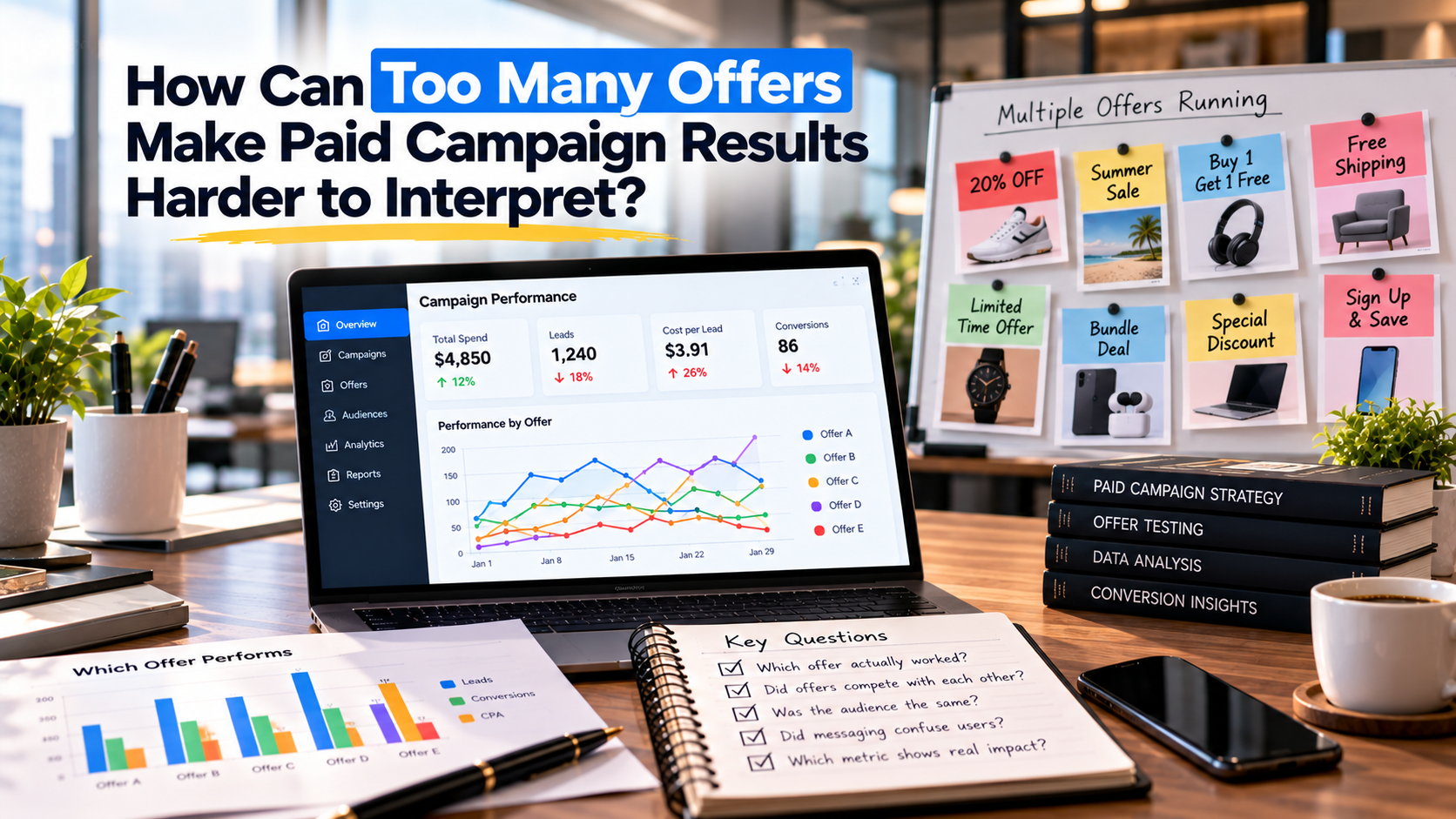
Businesses often create multiple offers to attract different customer types. One campaign may promote a free consultation, another a discount, and a third an educational download. A fourth may advertise a premium package while a fifth promotes a limited trial.
Each offer can appear reasonable on its own. The problem begins when too many offers run simultaneously without a clear structure.
Campaign data becomes divided across different actions, audiences receive inconsistent messages, and the marketing team struggles to determine which offer is actually creating valuable customers.
Offer fragmentation in paid advertising occurs when a business spreads its budget, creative, landing pages, and conversion data across too many offers. Instead of learning which proposition produces profitable growth, the company creates several small data sets that are difficult to compare.
A focused performance marketing strategy should define the role of each offer and connect it with a specific customer stage and business objective.
What Is an Advertising Offer?
An advertising offer is the reason a prospect is encouraged to take action.
It is more than the product or service itself. The offer combines what the customer receives, the conditions attached to it, the value presented, and the next step.
Examples include:
· A free consultation
· A product discount
· A trial period
· A downloadable guide
· A demonstration
· A bundled package
· Free delivery
· A limited-time bonus
· A money-back guarantee
A strong offer helps the customer understand why acting now is worthwhile. It should also attract the type of person the business can serve successfully.
What Is Offer Fragmentation?
Offer fragmentation happens when advertising activity is divided across several offers that compete for budget, attention, and conversion data.
For example, a service company may run separate campaigns for a free audit, strategy call, downloadable checklist, webinar, and discounted package. If the total monthly budget is limited, each campaign may receive too little spend to produce reliable results.
The business then faces several questions:
· Is one offer genuinely stronger?
· Does one campaign attract better customers?
· Are people responding only because something is free?
· Which offer produces revenue?
· Are different audiences being compared fairly?
· Does each offer need its own landing page?
Without enough data, marketers may answer these questions through assumptions rather than evidence.
Why Do Businesses Create Too Many Offers?
Offer fragmentation often develops gradually.
A campaign may struggle, so the business creates a new offer instead of identifying why the original one failed. Different departments may promote separate ideas. Competitor offers may also encourage the company to introduce discounts, trials, and bonuses without considering how they fit the wider strategy.
Another cause is the belief that every customer segment needs a completely different proposition.
Different messages can improve relevance, but not every audience requires a separate commercial offer. Sometimes the same core offer can be presented through different customer problems, benefits, creative formats, and use cases.
How Can Multiple Offers Divide Campaign Learning?
Advertising platforms require conversion data to identify patterns. When the budget is divided among several offers, each campaign may receive only a small number of results.
Suppose a company can generate 100 monthly conversions with one offer. If the same budget is divided across five offers, each may produce approximately 20 conversions or fewer.
This creates smaller samples and greater performance volatility. One campaign may appear to win because it gained a few additional conversions by chance.
Fragmented data can make it difficult to understand:
· Which audience is most valuable
· Which creative message is effective
· Which landing page converts better
· Which offer produces stronger lead quality
· Where additional budget should be allocated
A simpler structure can produce clearer evidence and faster learning.
Can Different Offers Attract Different Lead Quality?
Yes. The offer strongly influences who responds.
A free resource may attract a large audience interested in learning but not ready to buy. A discount may attract price-sensitive prospects. A consultation may appeal to people seeking personalised advice, while a product demonstration may attract those comparing specific solutions.
The cheapest offer conversion is not always the most valuable.
Businesses should compare offers using deeper outcomes, including:
· Qualified-lead rate
· Appointment attendance
· Proposal requests
· Completed purchases
· Average customer value
· Customer acquisition cost
· Revenue
· Retention
An experienced paid advertising specialist should evaluate whether an offer produces meaningful commercial results rather than judging it only by form submissions.
How Can Offer Fragmentation Confuse Customers?
Customers may encounter several advertisements from the same company during their buying journey.
If each advertisement presents a different price, package, bonus, or promise, people may become uncertain about the actual value of the service.
They may wonder:
· Which offer is genuine?
· Should I wait for a better discount?
· Why is the same service presented differently?
· Am I missing a stronger package?
· Will the current offer remain available?
Inconsistent offers can also create problems for sales teams. A prospect may mention a promotion the representative does not recognise or request conditions that apply only to another campaign.
Offer variety should support customer choice, not create unnecessary confusion.
Should Each Funnel Stage Have a Different Offer?
Different funnel stages can justify different calls to action, but they should remain connected.
A new prospect may not be ready to book a sales call. Educational content or a simple demonstration could be more appropriate. A returning visitor who has reviewed pricing may need proof, an objection answered, or a direct consultation offer.
The progression could look like this:
1. Educational insight for an unfamiliar audience
2. Case study for an engaged prospect
3. Service explanation for someone evaluating the solution
4. Consultation or purchase offer for a high-intent visitor
These steps are different, but they support one customer journey. Fragmentation occurs when offers compete with one another without a clear sequence.
How Can Businesses Decide Which Offer to Prioritise?
The strongest offer is not always the one generating the largest response. It should produce a suitable balance between conversion volume, customer quality, and profitability.
Businesses can assess an offer by asking:
· Does it address an important customer problem?
· Is the value easy to understand?
· Does it attract the intended customer?
· Can the business deliver what is promised?
· Does it support a profitable sales process?
· Is the next step clear?
· Can results be tracked accurately?
Historical sales conversations, customer reviews, enquiries, and objections can provide useful information.
The business should prioritise one core offer and test meaningful improvements before creating several unrelated alternatives.
How Should Offer Tests Be Structured?
A good offer test begins with a clear hypothesis.
For example:
· Will a free audit attract more qualified prospects than a consultation?
· Will a bundled package increase average order value?
· Will clearer pricing improve lead quality?
· Will a guarantee reduce purchase hesitation?
The test should keep other major factors as consistent as possible. If the audience, creative style, landing page, and offer all change simultaneously, the result will be difficult to interpret.
Each test also needs enough time and data. Ending a test after a few conversions may identify a temporary winner rather than a reliable improvement.
What Role Does Creative Play in Offer Performance?
The same offer can produce different results depending on how it is communicated.
Creative should explain:
· The customer problem
· What the offer includes
· The main benefit
· Why it is relevant
· What makes it credible
· Any important conditions
· The next action
Weak creative can make a valuable offer appear ordinary. It may focus on the discount while ignoring the outcome or describe the features without explaining why they matter.
Reviewing a relevant creative portfolio can help businesses understand how visual direction, messaging, and offer presentation work together.
When Are Multiple Offers Appropriate?
Multiple offers can be useful when a business serves genuinely different customer groups or buying stages.
Separate offers may be justified for:
· Consumer and enterprise customers
· Different geographic markets
· New and returning customers
· Products with different profit margins
· Distinct service categories
· Seasonal campaigns
· Upsells and renewals
However, each offer should have a defined purpose, sufficient budget, appropriate creative, and accurate tracking.
The question is not whether the business can create another offer. It is whether the new offer will produce useful learning or commercial value.
How Can Offer Performance Be Reported Clearly?
Offer reporting should connect early campaign activity with final customer outcomes.
A useful report may include:
· Spend by offer
· Conversion volume
· Cost per initial conversion
· Qualified-lead rate
· Sales conversion rate
· Average revenue per customer
· Refund or cancellation rate
· Customer acquisition cost
· Total profit contribution
This prevents the business from scaling an offer simply because it generates inexpensive conversions.
It also helps marketing, sales, and management agree on what success means.
Final Thoughts
More offers do not automatically create more growth. When a business spreads limited advertising resources across too many propositions, it can weaken campaign learning and make results difficult to interpret.
Offer fragmentation in paid advertising divides budgets, data, creative attention, and customer expectations. It can also cause teams to compare offers that attract completely different levels of intent.
A stronger approach is to prioritise a core offer, define its role in the customer journey, and test improvements through a controlled process. Additional offers should be introduced only when they serve a distinct audience, stage, or commercial objective.
Clear offers create clearer campaign data. They also make it easier for customers to understand the value and decide what to do next.
Frequently Asked Questions
What is offer fragmentation in paid advertising?
It is the division of advertising budgets and conversion data across too many offers, making campaign performance harder to evaluate.
Is it wrong to advertise several offers?
No. Multiple offers can be useful when they serve distinct customer groups or funnel stages and each has sufficient budget and tracking.
How many offers should a business test at once?
There is no universal number. The business should test only as many as its budget and conversion volume can support reliably.
Can a free offer reduce lead quality?
It can attract people interested mainly in the free benefit. Qualification and follow-up data should be used to evaluate the offer’s true value.
Should discounts be used to improve campaign performance?
Only when they support profitability and customer value. A discount may increase conversions while reducing margins or attracting customers unlikely to return.

 English
 Arabic
 French
 Spanish
 Portuguese
 Deutsch
 Turkish
 Dutch
Dutch
 Italiano
 Russian
 Portuguese (Brazil)
 Greek
Greek
 Bengali