


How Meta Ads Automation Can Help Agencies Manage Campaigns at Scale
Managing paid social campaigns can be relatively straightforward when a business has only a few campaigns running. For an agency, however, the situation changes quickly.
An agency may be responsible for several client accounts, each with different budgets, audiences, creative strategies, campaign objectives, and performance targets. As the client portfolio grows, the amount of operational work grows with it.
Campaign setup, budget monitoring, reporting, creative testing, optimization, and account management can consume a significant amount of time.
This is where Meta ads automation can become an important part of an agency's workflow.
Instead of requiring marketers to manually perform every repetitive task, automation can handle predefined processes while the agency team remains responsible for strategy and decision-making.
Why Agencies Need a Different Approach
Managing advertising for one business and managing advertising for multiple businesses are two very different workflows.
A single advertiser may have a few campaigns and one advertising account to monitor. An agency could have dozens of client accounts, each containing multiple campaigns and ad sets.
The team may need to check:
- Campaign spending
- CPA
- ROAS
- CTR
- Creative performance
- Budget allocation
- Audience performance
- Campaign status
Checking these metrics manually across every account can quickly become repetitive.
The challenge becomes even greater when the agency wants to scale its client base without increasing administrative work at the same rate.
What Is Meta Ads Automation?
Meta ads automation refers to using software and predefined rules to automate parts of campaign management across Facebook and Instagram advertising.
Instead of manually checking every campaign, an agency can establish conditions that determine when an action should occur.
For example, a team could create rules around CPA or ROAS.
A simplified workflow might look like this:
If CPA exceeds the agency's threshold → pause or flag the campaign.
If ROAS reaches the desired level → increase the budget according to the strategy.
If performance changes significantly → alert the relevant team member.
The agency decides what the rules should be. Automation handles the repetitive monitoring and execution.
This can allow marketers to spend more time on strategic decisions instead of repeatedly performing routine checks.
Managing Multiple Client Accounts
One of the biggest problems agencies face is account switching.
A media buyer managing ten or twenty clients may need to move between different advertising accounts throughout the day. They may also have separate spreadsheets, reporting tools, creative folders, and communication channels for each client.
This creates unnecessary context switching.
A centralized system can provide a single operating layer while keeping individual client environments separated.
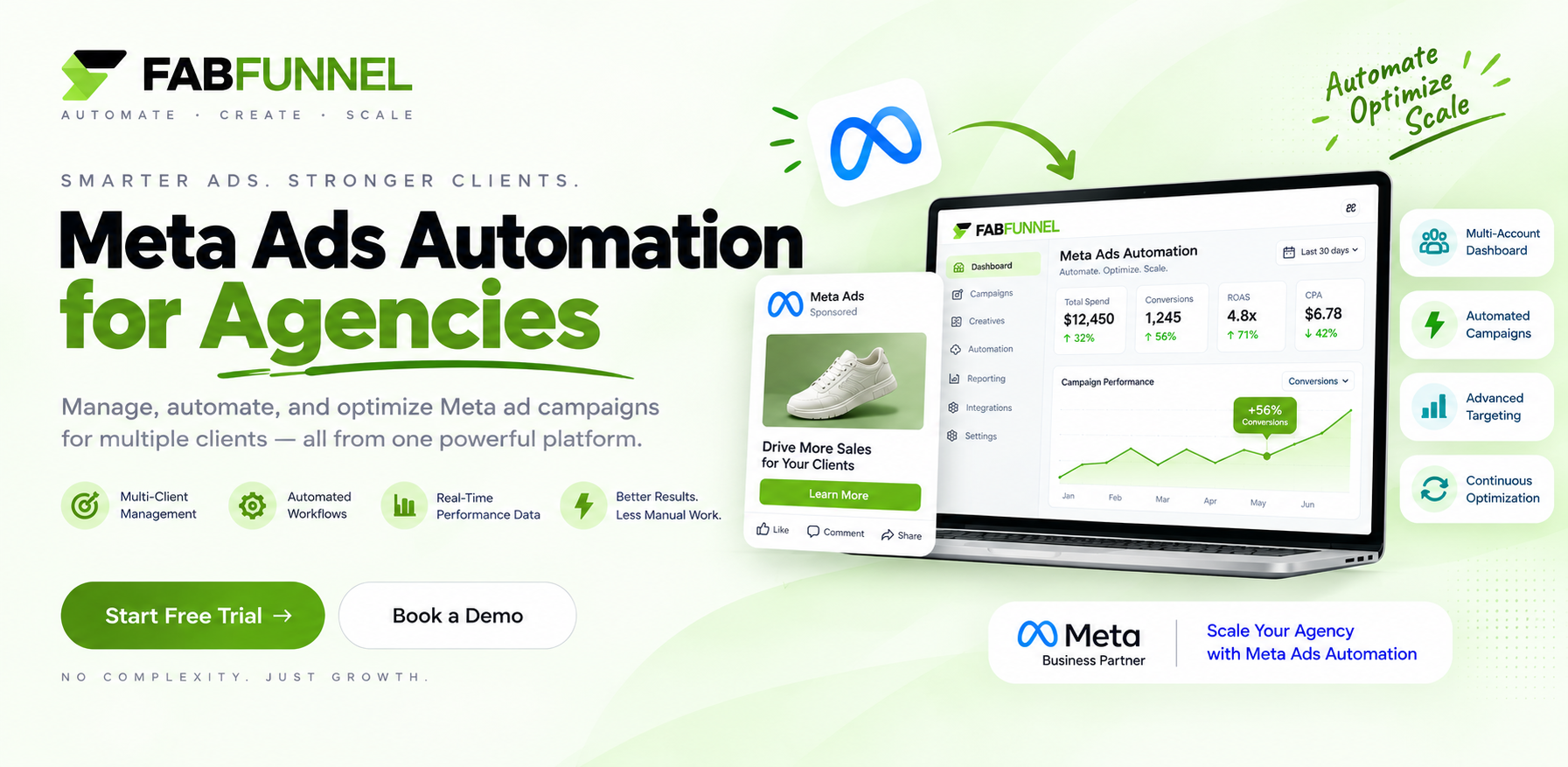
FabFunnel's agency platform is designed around multi-client operations, with separate workspaces for client accounts, creative libraries, and automation rules. It also provides team permissions so agencies can control access across different client environments.
This approach can make it easier for agencies to manage a larger portfolio without mixing client information.
Automated Reporting Saves Operational Time
Reporting is another major part of agency work.
Clients expect regular information about how their campaigns are performing. Depending on the campaign, an agency may need to report metrics such as spend, ROAS, CPA, CTR, impressions, clicks, and conversions.
Collecting these numbers manually from multiple accounts can take hours.
A centralized reporting system can reduce this administrative workload.
FabFunnel's Multi Ad Account Reporting brings connected accounts into a unified dashboard, with metrics such as spend, ROAS, CPA, CTR, impressions, and clicks. The platform states that campaign data syncs every 15 minutes, and reports can be exported for clients or stakeholders.
This means marketers can spend less time collecting numbers and more time understanding what those numbers mean.
Bulk Campaign Launching
Another area where agencies can benefit from automation is campaign deployment.
Imagine an agency has developed several creative variations for a client. Each variation needs to be added to a campaign, configured with the appropriate targeting and budget, and then launched.
Doing this manually for every variation can be tedious.
Bulk campaign launching allows marketers to prepare multiple variations and deploy them together.
FabFunnel's Meta platform includes a Bulk Launcher that supports large-scale campaign deployment, allowing agencies and media buyers to configure campaign variations and launch them in bulk.
This doesn't replace the campaign strategy. The agency still decides what to test, which audiences to target, and how the budget should be allocated.
The automation simply reduces the amount of manual execution required.
AI Can Support Creative Development
Creative testing is another area where AI can complement automation.
Advertising teams often need to develop multiple creative variations to understand which messages and formats resonate with their audiences.
AI can assist by generating initial concepts for:
- Static advertisements
- Carousels
- Stories
- UGC-style videos
- Reels
- Product-focused creative
FabFunnel's Meta platform includes an AI creative generation feature called Genie, which can produce image and video variations in Meta-compatible formats and send them into the Bulk Launcher workflow.
Human review remains important, particularly when creative needs to follow brand guidelines or communicate a specific offer.
The advantage is that marketers can start with more concepts and spend their time refining the strongest ideas rather than creating every variation from scratch.
Automation Can Run Beyond Working Hours
Advertising campaigns don't stop when an agency team finishes work for the day.
Budgets continue running overnight and during weekends.
This creates another opportunity for automation.
If an agency has predefined rules around CPA, ROAS, budget thresholds, or other performance conditions, those rules can continue monitoring campaigns outside normal working hours.
FabFunnel's automation system states that rules can run continuously and take actions when conditions are met. Its rule engine supports actions such as pausing campaigns, adjusting budgets, sending alerts, and logging actions.
This can help agencies create guardrails around campaign spending without requiring someone to watch the dashboard constantly.
AI and Automation Are Not the Same Thing
It's useful to distinguish between AI and automation.
Automation generally follows predefined instructions.
AI can assist with analysis, recommendations, and content generation.
For example:
Automation: Pause a campaign when CPA exceeds a defined limit.
AI: Analyze campaign data and identify an account where CPA has been increasing.
Automation: Increase a budget when ROAS reaches a predefined threshold.
AI: Help the marketer investigate why one creative is outperforming another.
Combining both can create a more flexible advertising workflow.
Human Strategy Still Matters
Automation should not mean handing every advertising decision to software.
Campaign performance depends on many factors, including audience behavior, creative fatigue, seasonality, competition, offers, landing pages, and broader business objectives.
Software can identify that performance has changed.
A marketer still needs to determine why it changed and what should happen next.
This is why automation works best when it supports human expertise.
The technology can handle repetitive processes while marketers focus on strategy, creative direction, client objectives, and interpreting campaign results.
Building a Scalable Agency Workflow
A scalable Meta advertising workflow can be thought of as several connected stages:
Plan → Create → Launch → Monitor → Optimize → Report
Automation can support each stage.
Creative AI can accelerate ideation.
Bulk tools can simplify campaign deployment.
Automation rules can monitor performance.
Centralized reporting can organize campaign data.
AI assistants can help analyze account-level information.
When these systems work together, an agency can potentially manage more campaign activity without adding the same amount of repetitive administrative work.
What Agencies Should Automate First
Agencies don't need to automate everything immediately.
A sensible starting point is to identify repetitive tasks that occur frequently and follow predictable patterns.
Good candidates include:
- Performance alerts
- Budget rules
- Campaign monitoring
- Recurring reporting
- Bulk campaign deployment
- Creative variation generation
Once these processes are working reliably, an agency can gradually expand its automation strategy.
The Future of Meta Advertising for Agencies
As agencies manage more clients, operational efficiency becomes increasingly important.
The objective isn't simply to run more campaigns. It is to create a workflow where the team can manage campaign volume without spending most of its time on repetitive administrative work.
For agencies exploring Meta ads Automation for Agencies, the combination of multi-client workspaces, automation rules, reporting, bulk campaign deployment, and AI-assisted creative generation provides one approach to organizing Meta advertising operations.
The technology can handle repetitive execution while the agency retains control over strategy and client relationships.
Final Thoughts
Meta advertising requires continuous testing, monitoring, and optimization.
For agencies, the challenge becomes managing all of these activities across multiple clients without allowing operational work to overwhelm the team.
Automation can help by handling predictable campaign actions, while AI can support creative generation and campaign analysis.
Centralized reporting can reduce manual data collection, and multi-client workspaces can make account management easier to organize.
The most practical approach is not to automate every decision. Instead, agencies can use automation for repetitive tasks while keeping strategic decisions in the hands of experienced marketers.
As agency portfolios grow, this combination of technology and human expertise can provide a more structured foundation for managing paid social campaigns at scale.

 English
 Arabic
 French
 Spanish
 Portuguese
 Deutsch
 Turkish
 Dutch
Dutch
 Italiano
 Russian
 Romaian
 Portuguese (Brazil)
 Bengali