


Vector Illustration vs Raster Graphics: Key Differences Explained
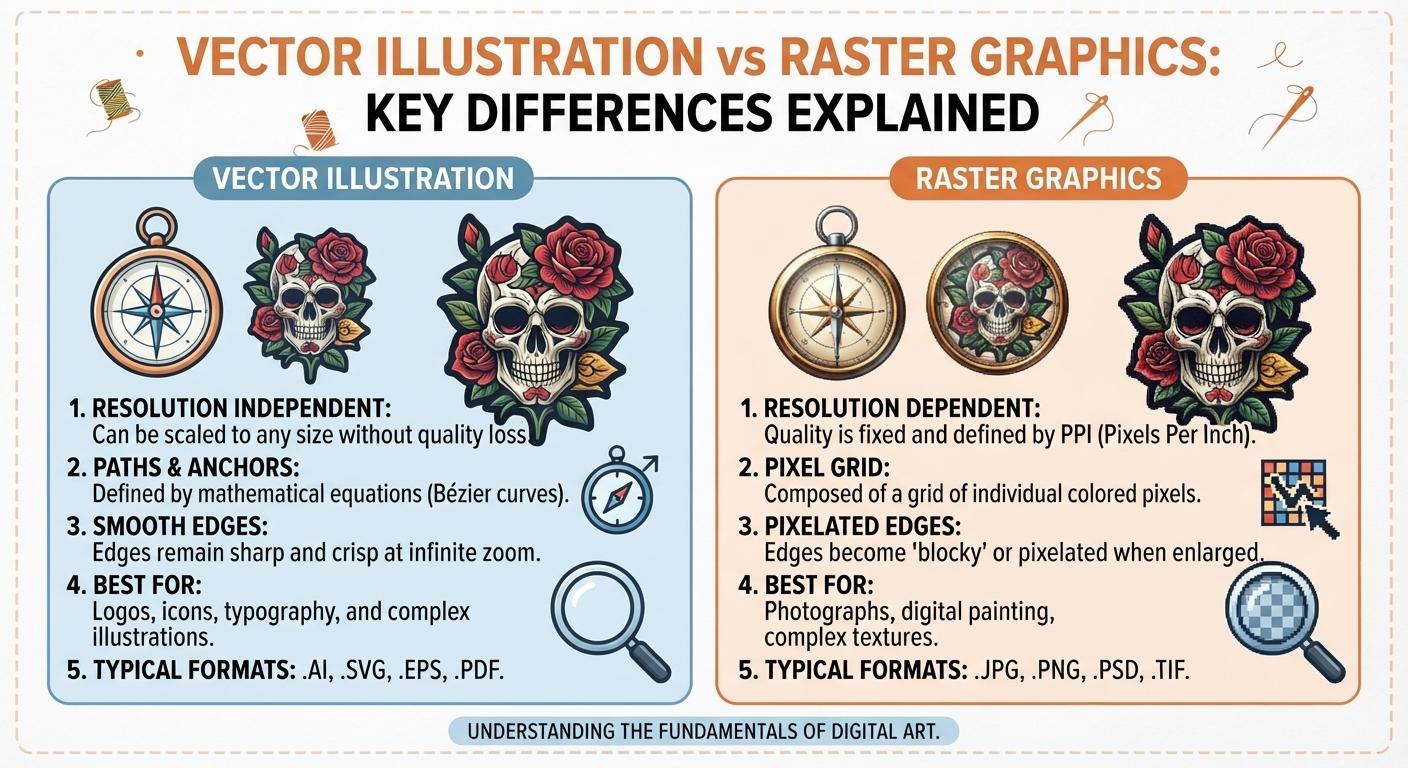
Digital graphics are an important part of modern branding, marketing, websites, packaging, advertising, and print design. Two of the most common graphic formats are vector illustrations services in USA and raster graphics. Although both are used to create and display visual content, they work in very different ways.
Understanding the difference between vector and raster graphics can help designers, businesses, and marketers choose the right format for their projects. The best choice usually depends on the type of artwork, required quality, intended use, and final output.
What Is Vector Illustration?
A iconicstitches vector illustration is a digital graphic created using mathematical paths, points, lines, curves, and shapes. Instead of storing an image as individual pixels, vector artwork uses mathematical information to define each element of the design.
Because vectors are based on mathematical paths, they can be resized without losing their original quality. This makes vector illustrations particularly useful for logos, icons, illustrations, signs, packaging, and other designs that may need to appear in multiple sizes.
Common vector file formats include AI, EPS, SVG, and PDF. These formats are widely used for professional graphic design and printing.
What Are Raster Graphics?
Raster graphics are images made up of tiny individual squares called pixels. Each pixel contains color information, and millions of pixels can combine to create a detailed photograph or digital image.
Raster images are commonly used for photographs, digital artwork, screenshots, textures, and images with complex color variations. Popular raster formats include JPG, JPEG, PNG, GIF, and TIFF.
Unlike vector graphics, raster images have a fixed resolution. When a raster image is enlarged beyond its original resolution, the pixels can become visible, resulting in a blurry or pixelated appearance.
Vector Illustration vs Raster Graphics
The biggest difference between vector and raster graphics is how they store visual information. Vector art iconicstitches uses mathematical paths, while raster graphics use pixels.
1. Scalability
Scalability is one of the major advantages of vector illustration. A vector logo can be enlarged from a small website icon to a large billboard without losing sharpness.
Raster graphics have limitations when enlarged. If a low-resolution image is stretched too far, it can become blurry or pixelated.
For designs that need to work across multiple sizes, vector graphics are often a practical choice.
2. Image Quality
Vector illustrations maintain clean and sharp edges at different sizes because their paths are mathematically calculated. This is especially important for logos, typography, icons, and line-based artwork.
Raster images can provide excellent quality at their original resolution, especially when they contain detailed photographs. However, their quality depends heavily on resolution and image dimensions.
3. File Size
File size depends on the complexity of the artwork, but simple vector graphics can often be relatively lightweight because they store paths and shapes instead of individual pixels.
Raster images can become larger when they have high resolutions, multiple colors, or detailed photographic information. High-resolution images are particularly useful for professional printing but may require more storage space. GET FREE QUOTE
4. Editing
Vector artwork can usually be edited element by element. Designers can change individual shapes, colors, lines, or text without affecting the entire design.
Raster editing works differently. Software such as Photoshop allows users to edit pixels, adjust colors, remove backgrounds, retouch photographs, and manipulate individual areas of an image.
The editing process therefore depends on the type of artwork being created.
5. Best Uses
Vector illustrations are commonly used for:
- Business logos
- Brand identity designs
- Icons
- Illustrations
- Typography
- Signs and banners
- Packaging
- Stickers
- Embroidery digitizing references
- Print-ready artwork
Raster graphics are commonly used for:
- Photographs
- Product images
- Social media photos
- Digital paintings
- Website images
- Textures
- Photo editing
- Detailed visual compositions
Which Format Should You Choose?
There is no single format that is best for every project. The right choice depends on what you are designing.
If you are creating a logo, icon, illustration, or branding element, vector artwork can be useful because the design can be resized while maintaining sharp edges.
If you are working with photography or highly detailed images, raster graphics are generally more suitable because pixels can represent complex colors, shadows, gradients, and photographic details.
In some projects, designers use both formats. For example, a marketing design might combine a vector logo with a high-resolution raster photograph.
Vector and Raster for Printing
Both vector and raster graphics can be used for printing, but the requirements are different.
Vector files are especially useful for logos, text, line artwork, and designs that need to be printed at different dimensions. They help maintain clean edges when the artwork is scaled.
Raster images should generally have an appropriate resolution for their intended print size. A low-resolution image may look acceptable on a small screen but become blurry when printed at a larger size.
For professional printing, designers should always check the printer's required file format, dimensions, color mode, and resolution.
Can Raster Images Be Converted to Vector?
Yes. A raster image can be converted into vector artwork through a process commonly known as vector tracing or vectorization. This process recreates the image using paths and shapes instead of pixels.
Simple logos and line drawings can often be converted relatively easily. Complex photographs, however, may require significant manual work to produce a clean and useful vector version.
Professional vector conversion can help businesses prepare artwork for printing, branding, signage, packaging, and other applications where scalable graphics are required.
Conclusion
Iconics stitches service provider is Vector illustration and raster graphics both have important roles in digital design. Vector graphics are based on mathematical paths and are ideal for scalable designs such as logos, icons, illustrations, and branding materials. Raster graphics are pixel-based and are particularly effective for photographs, digital artwork, and images containing complex details.
Understanding these differences makes it easier to select the appropriate format for a specific project. By choosing the right graphic type from the beginning, designers can maintain visual quality, improve editing flexibility, and prepare artwork more effectively for digital or print use. GET FREE QUOTE

 English
 Arabic
 French
 Spanish
 Portuguese
 Deutsch
 Turkish
 Italiano
 Russian
 Romaian
 Portuguese (Brazil)
 Greek
Greek
 Bengali