


Autonomous Mobility Expands as Automakers and Technology Firms Build Partnerships
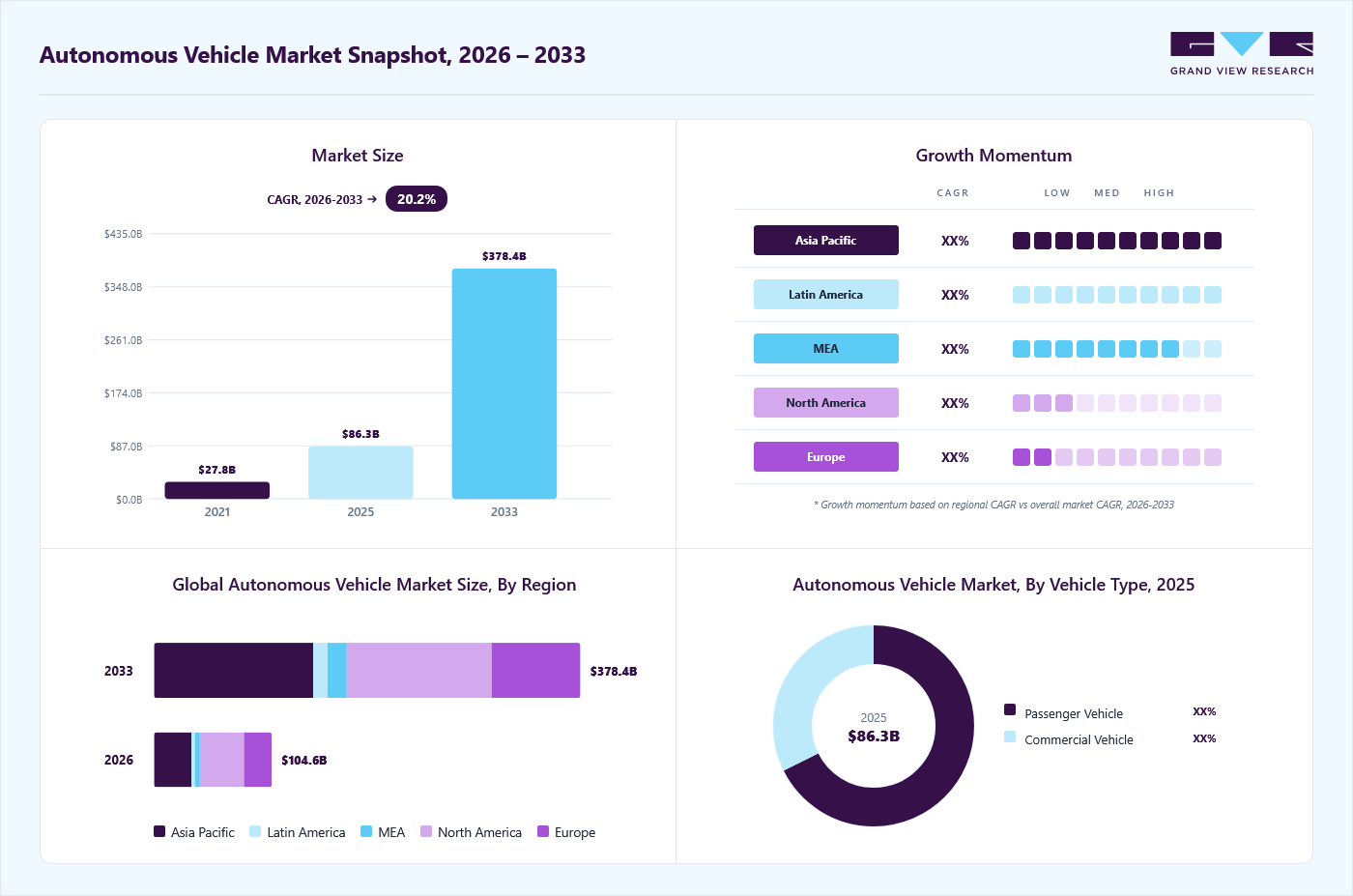
The autonomous vehicle market is expanding as advances in artificial intelligence, sensor technologies, connectivity, and intelligent transportation infrastructure accelerate the development of automated mobility. The market was valued at USD 86.3 billion in 2025 and is estimated to reach USD 104.6 billion in 2026, before growing to USD 378.4 billion by 2033 at a 20.2% CAGR from 2026 to 2033. Growing demand for safer transportation, connected mobility, logistics efficiency, and advanced autonomous driving capabilities is creating new opportunities across passenger and commercial vehicles.
Passenger Vehicles Provide the Largest Market Foundation
Passenger vehicles accounted for 67.6% of revenue in 2025, making them the leading vehicle type. Consumer interest in safer, more convenient, and efficient transportation is encouraging automakers to integrate increasingly sophisticated autonomous capabilities into passenger vehicles.
Advances in sensors, AI algorithms, and connectivity are improving the feasibility of autonomous passenger vehicles. Driver-assistance technologies also provide an important pathway toward higher levels of automation by introducing consumers to automated steering, acceleration, and other functions.
Commercial vehicles, however, are projected to register the fastest growth, with a 26.3% CAGR over the forecast period. Logistics companies, delivery operators, and commercial transportation businesses are exploring autonomous technology to streamline operations, optimize supply chains, and address repetitive or long-distance driving requirements.
Transportation Applications Extend Beyond Passenger Mobility
Transportation represented 84.6% of revenue in 2025, reflecting the broad role of autonomous vehicles across personal mobility, logistics, shipping, ridesharing, and industrial operations.
Autonomous technology can support route optimization, operational efficiency, and transportation reliability. The expansion of autonomous logistics and delivery services is particularly important as e-commerce increases pressure on businesses to improve delivery speed while controlling operating costs.
Autonomous trucks and delivery vehicles are being tested for long-haul freight and last-mile applications, while automated mobility services are creating opportunities for robotaxis and other transportation models.
Level 1 Automation Still Represents a Major Entry Point
Level 1 autonomy held the largest market share at 43.1% in 2025. Adaptive cruise control and lane-keeping assistance are examples of Level 1 technologies that provide basic driving support without requiring major infrastructure changes.
Their integration across contemporary vehicle models has helped make automated driving features more accessible. As consumers become familiar with driver-assistance technologies, manufacturers can continue developing more advanced systems.
At the higher end of the automation spectrum, Level 4 & 5 is expected to register the fastest CAGR over the forecast period. These systems are designed to operate with minimal or no human intervention, supported by advances in AI, sensors, and computing power.
Connectivity Is Becoming an Essential Layer
The expansion of 5G connectivity and intelligent transportation infrastructure is creating a stronger technological foundation for autonomous mobility. Autonomous vehicles require real-time data exchange involving vehicles, cloud platforms, traffic systems, and transportation networks.
Low-latency connectivity can support vehicle-to-vehicle and vehicle-to-infrastructure communication while enabling remote diagnostics, software updates, and advanced fleet management. Smart traffic management systems and connected roadways can also provide vehicles with additional information about traffic and road conditions.
Logistics Creates a New Commercial Opportunity
The growth of autonomous logistics and delivery services is opening another important application area. E-commerce growth is increasing the need for efficient delivery operations, while autonomous vehicles could help fleet operators improve utilization and reduce dependence on drivers for repetitive transportation tasks.
Automated freight corridors, autonomous delivery pilot programs, and commercial testing are supporting this opportunity. Regulatory progress related to autonomous vehicle testing is also contributing to deployment possibilities in commercial transportation.
High Costs Remain a Deployment Challenge
Autonomous vehicle development requires substantial investment in LiDAR, radar, cameras, AI processors, high-performance computing, software development, simulation, testing, and validation.
Deployment can also require fleet management platforms, data-processing infrastructure, software maintenance, real-world testing, and over-the-air updates. These expenses can make autonomous vehicles more costly than conventional vehicles and may limit adoption in price-sensitive markets.
Regional Development Reflects Infrastructure and Technology Adoption
North America dominated the market with a 38.0% revenue share in 2025, supported by established technology infrastructure and an environment conducive to autonomous vehicle testing and development. The U.S. held the largest share within the North American market in 2025.
Asia Pacific is projected to record the fastest regional growth, with a 25.0% CAGR from 2025 to 2030 according to the GVR page. China, Japan, and South Korea are investing in connected and autonomous mobility as densely populated urban areas seek solutions for transportation challenges, mobility, and efficiency.
Europe is also advancing autonomous mobility through investments in AI, connected vehicles, smart infrastructure, and automated public transportation. Autonomous taxis and shuttles are being tested as part of broader urban mobility initiatives.
Market Size & Forecast
The autonomous vehicle market is projected to grow from USD 104.6 billion in 2026 to USD 378.4 billion by 2033, representing a 20.2% CAGR from 2026 to 2033. AI development, sensor improvements, connectivity, autonomous logistics, intelligent infrastructure, and the progression toward higher levels of vehicle automation are expected to remain central to market development.
FAQs
What is driving autonomous vehicle market growth?
Advances in artificial intelligence, sensor technology, connectivity, road safety requirements, intelligent transportation infrastructure, and demand for more efficient mobility are supporting autonomous vehicle market growth.
Which autonomous vehicle segment holds the largest market share?
Passenger vehicles led the vehicle type segment with a 67.6% revenue share in 2025, while transportation accounted for 84.6% of the market by application and Level 1 autonomy held a 43.1% share.
Key Autonomous Vehicle Companies:
· AUDI AG.
· Ford Motor Company
· Mercedes-Benz Group
· Nuro, Inc.
About us:
Grand View Research, a market research and consulting company, provides syndicated research reports, customized research reports, and consulting services. Grand View Research database is used by the world's renowned academic institutions and Fortune 500 companies to understand the global and regional business environment. Our database features thousands of statistics and in-depth analysis on 46 industries in 25 major countries worldwide.

 English
 Arabic
 French
 Spanish
 Portuguese
 Deutsch
 Turkish
 Dutch
Dutch
 Italiano
 Romaian
 Portuguese (Brazil)
 Greek
Greek
 Bengali