


TDS Challan Explained for Businesses That Want Better Tax Compliance
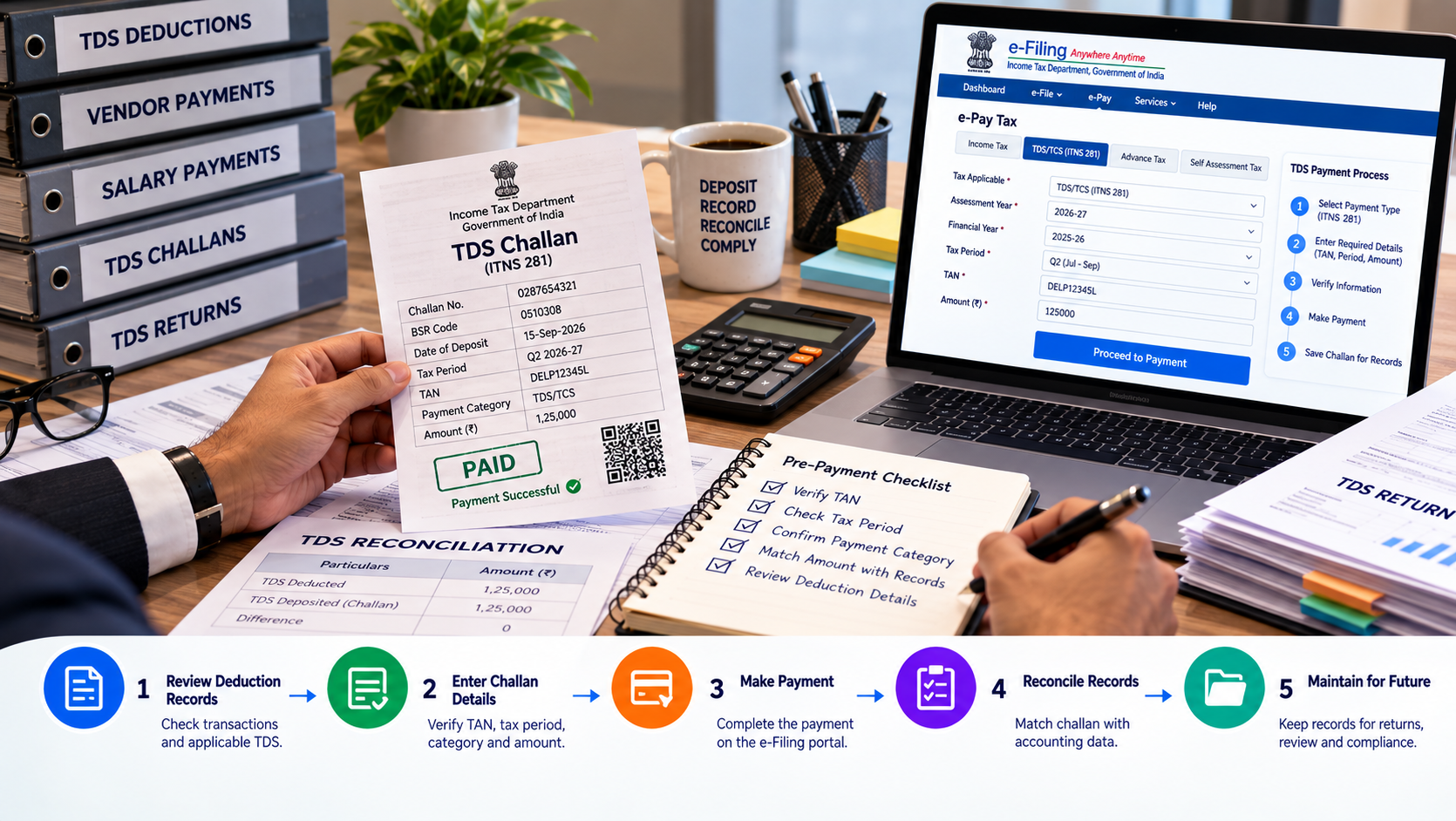
Tax compliance is not limited to calculating deductions and filing returns. Businesses also need to ensure that the tax deducted at source is deposited correctly and that payment records are maintained for future reference. A TDS challan plays an important role in this process by recording the payment of TDS to the government.
For businesses, accountants, and tax professionals, understanding how challans work can help prevent payment-related errors and make return preparation more organized. Whether a business is making regular vendor payments, processing salaries, or managing other transactions covered by TDS provisions, accurate challan details are an essential part of its compliance records.
What Is a TDS Challan?
A TDS challan is a payment record used when depositing tax deducted at source with the government. It contains important details related to the payment, such as the amount deposited, the relevant tax period, and the deductor's identification details.
For regular TDS and TCS payments, ITNS 281 is the challan form associated with the Income-tax Act, 1961. The applicable form and payment process should be checked against the relevant tax period and the instructions available on the Income Tax Department's e-Filing portal.
A challan is more than proof of payment. Its details are also important when businesses reconcile deposited tax with the information reported in their TDS statements.
Why TDS Challan Details Matter
Even when the correct amount of tax has been deducted, errors in payment information can create additional work during reconciliation and return preparation. Incorrect identification details, an unsuitable payment category, or a mismatch in the amount deposited may require investigation.
Maintaining accurate challan information helps businesses:
- Keep a record of TDS payments made to the government.
- Match deposited amounts with accounting records.
- Reconcile challan details with TDS return information.
- Investigate payment discrepancies more systematically.
- Retrieve payment records when preparing statements or responding to queries.
For organizations handling numerous transactions, maintaining a consistent process for recording and checking challans can make tax administration easier to manage.
Common Details to Check Before Making a TDS Payment
The information required depends on the applicable challan and payment process. Before proceeding, businesses should carefully review the details entered in the payment form.
| Detail | Why it matters |
|---|---|
| TAN or other required identification | Helps identify the deductor or taxpayer associated with the payment |
| Applicable tax period | Ensures the payment is associated with the correct period |
| Tax and payment category | Helps direct the payment to the appropriate category |
| Amount payable | Should match the tax liability and relevant records |
| Applicable section or payment details | Helps ensure the payment is classified correctly |
| Contact and other required particulars | Supports the payment process and related communication |
The details above are a practical review checklist, not a complete list of mandatory fields for every challan. Always follow the current instructions displayed on the official portal.
How to Approach TDS Challan Payment
A careful payment process begins with reviewing the underlying deduction records. Businesses should first determine the amount payable and identify the correct payment category before generating the challan.
A typical workflow involves the following steps:
- Review the deduction records
Check the relevant transactions, applicable TDS provisions, and the amount that needs to be deposited. Resolve any differences in the underlying calculations before proceeding. - Select the applicable payment option
Use the Income Tax Department's e-Filing portal and select the appropriate payment option for the applicable tax regime and period. The available options may differ depending on the type of payment. - Enter and verify the details
Complete the required fields and carefully review the deductor details, payment category, tax period, and amount. - Complete the payment
Follow the payment instructions provided by the portal. Retain the payment confirmation and challan-related information for your records. - Reconcile the payment
After payment, compare the challan details with the accounting records and the information that will be used in the TDS statement. Keep the supporting records accessible for future reference.
The exact screens and steps can change, so users should follow the current instructions provided through the official e-Filing portal.
Common TDS Challan Mistakes and How to Avoid Them
Small errors can create unnecessary complications when payment records are matched with TDS statements. A basic review process can help identify issues before they affect subsequent compliance work.
- Incorrect Identification Details
Errors in TAN or other required identification information can create inconsistencies in payment records. Verify the details against official records before submitting the payment. - Wrong Tax Period or Payment Category
Selecting an incorrect period or payment category can make reconciliation more difficult. Confirm the applicable requirements before generating the challan. - Mismatch Between Payment and Accounting Records
The amount deposited should be consistent with the amount payable. If the figures differ, investigate the reason rather than carrying the discrepancy into the return preparation process. - Missing Payment Records
Businesses should retain challan receipts, payment confirmations, and related accounting entries. A clear filing system makes it easier to retrieve information when preparing returns or reviewing earlier payments.
How Software Can Simplify Challan Management
When a business handles only a small number of payments, maintaining challan information manually may appear manageable. However, the process can become more demanding when several departments, branches, vendors, or filing periods are involved.
Tax and accounting software can help organize relevant information and connect payment records with broader compliance activities. Depending on the solution, useful capabilities may include:
- Maintaining structured records of TDS payments.
- Importing relevant data from accounting systems.
- Organizing challan details for reconciliation.
- Supporting the preparation and review of TDS statements.
- Generating reports for internal checks and record keeping.
Software can reduce repetitive administrative work, but it does not remove the need to verify payment information or follow the applicable tax rules.
Businesses evaluating software for wider tax management can explore Webtel's Web-e-GoldMine platform. Its tax and compliance software offerings can be reviewed to understand whether they fit an organization's TDS, TCS, income tax, and related workflow requirements.
Before choosing a solution, businesses should assess the features available, compatibility with existing systems, data security, and the level of support provided.
Choosing a Practical Approach for Your Business
The way a business manages TDS challans depends on its transaction volume, accounting setup, and compliance responsibilities. A small enterprise may need a straightforward system for recording payments, while a larger organization may require a more coordinated process across multiple teams.
When evaluating a manual or software-based workflow, consider whether it helps your team:
- Verify payment details before submission.
- Maintain accessible records of completed payments.
- Match challans with accounting entries and TDS statements.
- Identify discrepancies and track their resolution.
- Keep information organized across filing periods.
A practical system should make these activities easier to perform consistently without adding unnecessary complexity.
Frequently Asked Questions
What is the purpose of a TDS challan?
A TDS challan records the deposit of tax deducted at source with the government. Its details help businesses maintain payment records and reconcile deposited tax with their TDS statements.
Which challan is used for regular TDS payments?
ITNS 281 is associated with regular TDS/TCS payments under the Income-tax Act, 1961. The applicable form and procedure should be confirmed for the relevant tax period and legislation.
Why should businesses reconcile TDS challans?
Reconciliation helps businesses check whether the tax payment details match their accounting records and the information reported in TDS statements. It can also help identify discrepancies that need attention.
Can software help manage TDS challan records?
Yes. Depending on its features, tax software can help organize payment information, support reconciliation, and maintain records used during return preparation. Users should still verify the information and retain payment confirmations.
How can businesses explore Webtel's tax compliance solutions?
Businesses can visit Webtel's income tax software page to explore its income tax-related offerings. They can also review Web-e-GoldMine to learn about Webtel's broader tax and compliance software options.
Conclusion
A TDS challan is an important part of the tax deduction process because it records the payment made to the government and supports subsequent reconciliation. Accurate payment details, organized records, and a careful review process can help businesses manage this responsibility more consistently.
For organizations handling frequent TDS payments, suitable software may make it easier to organize challan information and connect it with return preparation. The most practical approach combines accurate accounting records, timely payments, and verification of the applicable filing requirements.

 English
 Arabic
 Spanish
 Portuguese
 Deutsch
 Turkish
 Dutch
Dutch
 Italiano
 Russian
 Romaian
 Portuguese (Brazil)
 Greek
Greek
 Bengali