


DIESEL LOCOMOTIVE ENGINE TOOLS: How to Organize a Workshop Tool Kit for Faster Maintenance Work
A workshop may have the right tools and still lose time.
Why?
Because maintenance work becomes slow when measuring instruments, grinding wheels, pilots, commutator stones and spare parts are stored without any clear system.
A technician may know what is needed for a job but still spend valuable time searching for it, checking compatibility or finding out that a worn accessory was never replaced.
For workshops handling DIESEL LOCOMOTIVE ENGINE TOOLS, good organization can make maintenance work more practical.
The goal is not simply to keep tools in one place.
The goal is to create a system where technicians can quickly identify:
-
what the tool is,
-
what job it is used for,
-
which machine it works with,
-
whether it is ready to use,
-
and when it needs replacement.
1. Organize Tools by Maintenance Function
Instead of storing everything together, divide tools according to the work they support.
For example, a workshop can create separate groups for:
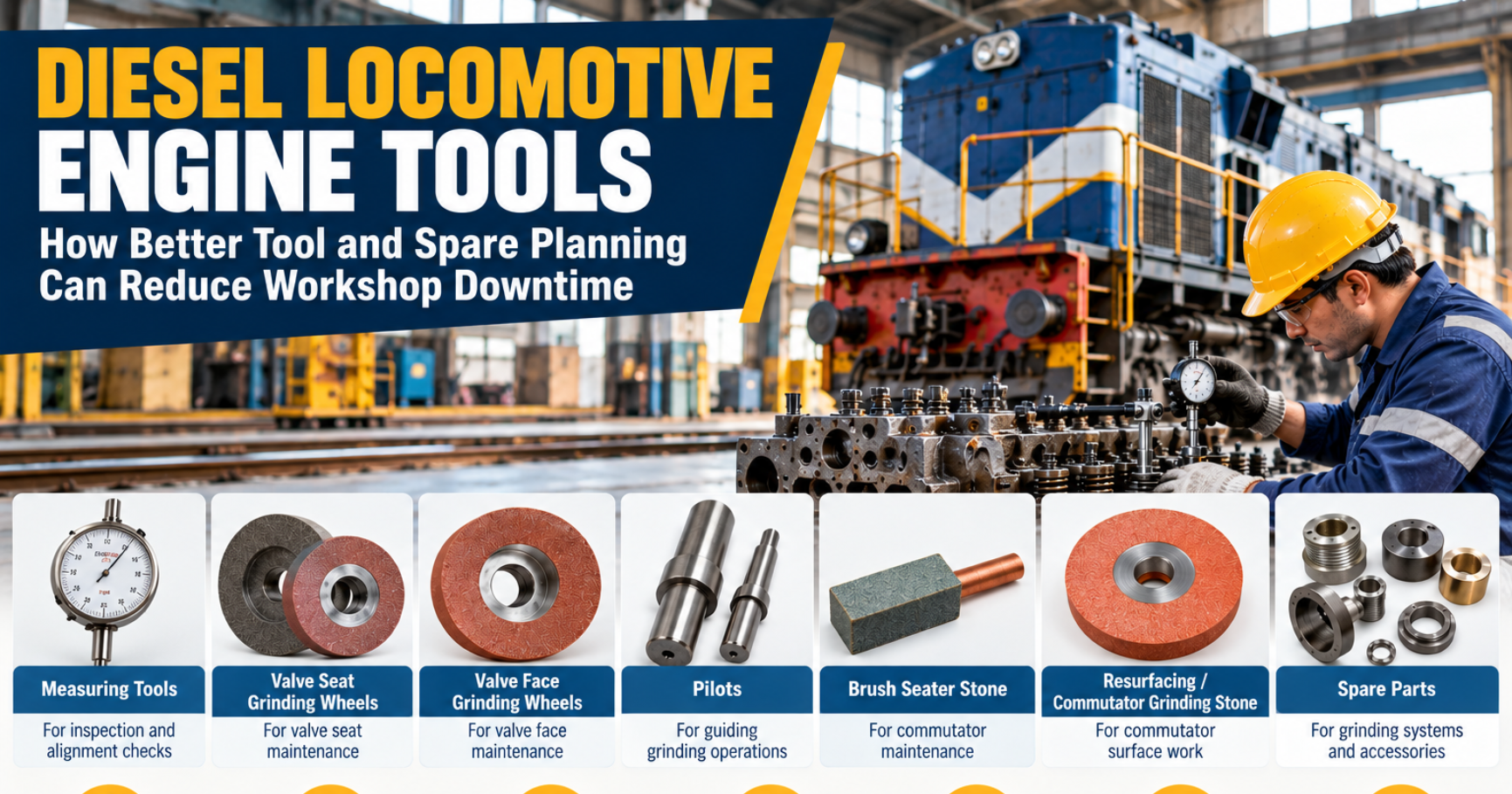
Inspection and Measurement
This section can include measuring instruments such as dial indicators used for checking alignment or concentricity.
Valve Grinding Work
Keep valve-seat grinding wheels, valve-face grinding wheels, pilots and related accessories together.
Commutator Maintenance
Store brush seater stones and resurfacing or commutator grinding stones in their own section.
Grinding-System Spare Parts
Replacement components for specific grinding systems should be stored separately and clearly labelled.
This simple grouping helps technicians find what they need more quickly.
2. Label Tools by Machine or System
One of the easiest workshop mistakes is assuming that similar-looking accessories are interchangeable.
They may not be.
A grinding wheel or pilot should be connected with the machine or grinding system it is intended to support.
A useful label may include:
Tool Type: Valve Seat Grinding Wheel
Machine/System: [Relevant machine or system]
Application: Valve seat work
Status: Ready / Inspect / Replace
This reduces confusion when several similar tools are available.
Technicians should not have to guess which accessory belongs to which setup.
3. Keep Measuring Tools Easy to Access
Inspection should normally happen before machining.
For that reason, measuring instruments should not be hidden at the back of the workshop.
They should be easy to reach and kept in a protected area.
Before a grinding operation begins, the technician may need to check:
-
alignment,
-
runout,
-
concentricity,
-
or general component condition.
If measuring tools are always available, technicians are more likely to inspect first instead of immediately starting machining.
This supports a more controlled maintenance workflow.
4. Separate Ready-to-Use Tools From Worn Tools
A common workshop problem is keeping worn and usable accessories together.
For example, a grinding wheel that needs replacement may accidentally return to the same storage location as a ready-to-use wheel.
A simple solution is to create three storage sections:
Ready to Use
Needs Inspection
Replace / Do Not Use
This can apply to:
-
grinding wheels,
-
pilots,
-
abrasive stones,
-
holders,
-
and spare components.
Clear separation prevents technicians from repeatedly checking the same worn tool.
5. Store Abrasive Tools Carefully
Grinding wheels and abrasive stones need proper handling.
Do not throw them together with heavy metal tools.
Protect them from unnecessary impact and contamination.
A simple storage system may use individual sections for:
-
valve-seat grinding wheels,
-
valve-face grinding wheels,
-
brush seater stones,
-
and commutator resurfacing stones.
Each group should remain clearly identified.
This also makes inventory checking easier.
6. Maintain a Small Compatibility Record
Workshops often rely too much on memory.
One technician may know exactly which pilot or grinding wheel works with a certain setup, but another technician may not.
A simple compatibility sheet can solve this.
It could include:
|
Equipment / System |
Tool Required |
Application |
Notes |
|
Grinding System A |
Pilot Type A |
Valve-seat setup |
Inspect before use |
|
Grinding System B |
Wheel Type B |
Valve-face work |
Keep spare available |
|
Commutator Work |
Brush Seater Stone |
Brush seating |
Store separately |
The exact information depends on the workshop.
The important point is to document what belongs where.
7. Keep Frequently Used Spare Parts Available
If a workshop repeatedly uses the same equipment, some replacement items may be worth keeping in stock.
This can reduce delays when a component becomes worn.
Instead of waiting until a breakdown happens, review which items are used most often.
Ask:
-
Which grinding wheels are replaced regularly?
-
Which pilots are used frequently?
-
Which holders or accessories wear over time?
-
Which replacement parts are difficult to obtain quickly?
Inventory planning should follow actual workshop usage.
8. Record Tool Condition After Each Job
A tool may be ready before a job and worn after it.
That is why condition checks should not happen only before use.
After completing the work, inspect the tool again.
A quick note may say:
Ready for next job
or
Inspect before reuse
or
Replacement required
This small habit improves tool control.
It also helps the next technician understand the condition of the accessory without starting from zero.
9. Build a Job Kit Before Maintenance Starts
For regular maintenance jobs, workshops can prepare a complete set before beginning work.
For example, a valve-related job kit might include:
-
measuring instrument,
-
pilot,
-
grinding wheel,
-
holder,
-
cleaning items,
-
and inspection tools.
A commutator job kit may include:
-
brush seater stone,
-
resurfacing stone,
-
measuring items,
-
and supporting tools.
Preparing the complete kit before starting reduces interruptions during the job.
10. Review Inventory Regularly
Tool organization is not something done once.
Create a simple monthly or periodic review.
Check:
-
missing tools,
-
worn accessories,
-
low-stock items,
-
damaged grinding wheels,
-
unlabelled parts,
-
and unnecessary duplicates.
This makes the tool room easier to manage.
It also prevents a technician from discovering a missing component only when maintenance work has already started.
Choosing Tools for the Actual Workshop Requirement
Professionals reviewing DIESEL LOCOMOTIVE ENGINE TOOLS should consider the maintenance operation, existing equipment and compatibility requirements before selecting an item.
A product category can help identify available tool types, but the workshop still needs to match the tool with the actual job.
The useful sequence is:
Identify Job → Check Machine → Select Tool → Verify Condition → Perform Work → Record Condition
Final Thoughts
Good maintenance does not depend only on owning the right tools.
It also depends on knowing where those tools are, what they are used for and whether they are ready for the next job.
A well-organized locomotive maintenance tool system can save time, reduce confusion and make workshop work more consistent.
Keep measuring tools accessible.
Separate abrasive tools by application.
Label accessories by machine or system.
Track worn parts.
Prepare job kits.
And review inventory regularly.
A simple organization system can turn a crowded tool room into a much more practical maintenance resource.

 English
 Arabic
 French
 Spanish
 Portuguese
 Deutsch
 Turkish
 Dutch
Dutch
 Italiano
 Russian
 Portuguese (Brazil)
 Greek
Greek
 Bengali