


How Sustainable Materials Are Changing Product Innovation in the Handbag Market
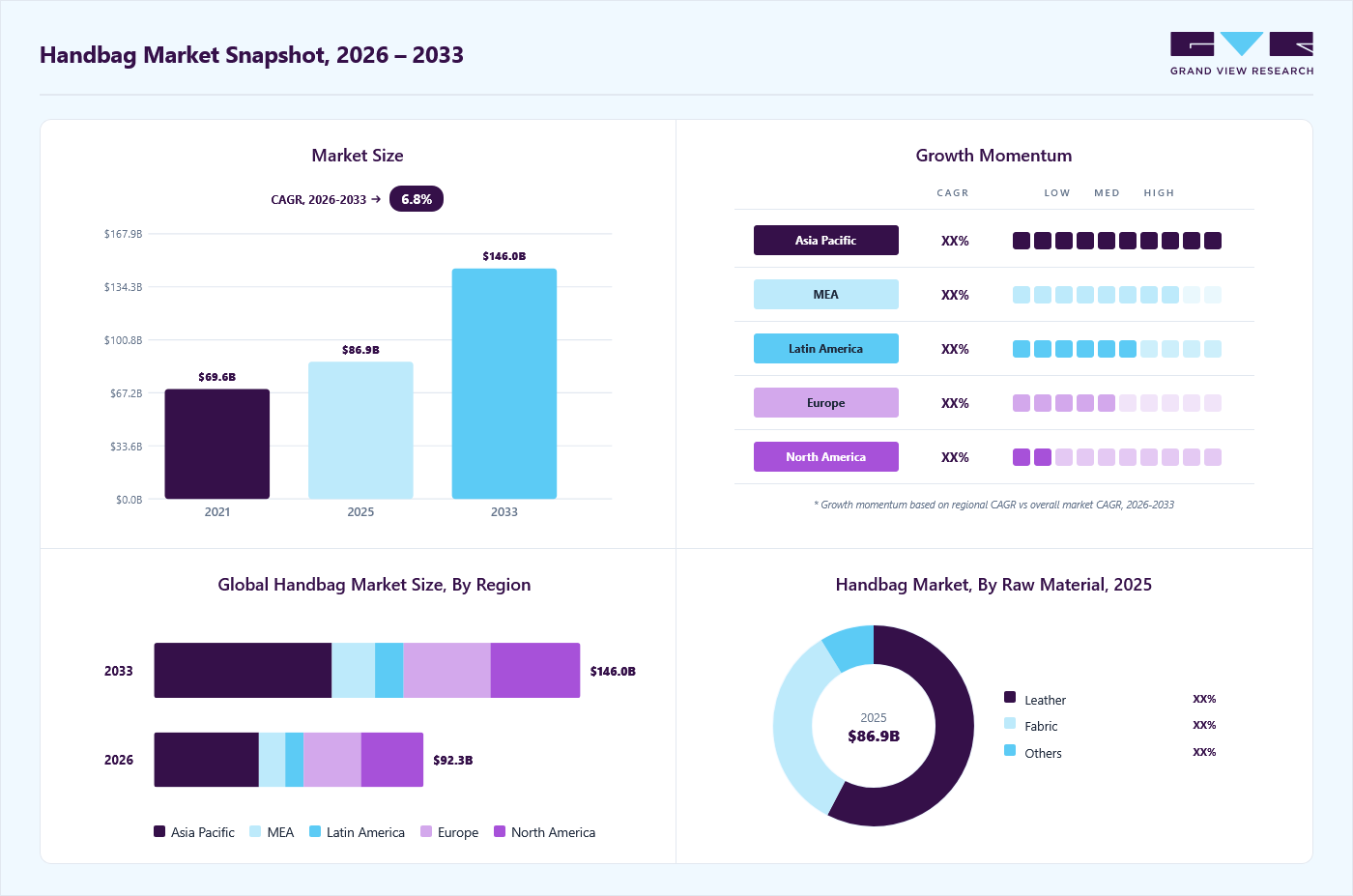
The handbag market is expanding as handbags increasingly combine fashion, personal expression, everyday functionality, and convenience. The market was valued at USD 86.9 billion in 2025 and is estimated to reach USD 92.3 billion in 2026, before growing to USD 146.0 billion by 2033 at a 6.8% CAGR from 2026 to 2033. Growing fashion awareness, rising disposable income, changing lifestyles, and demand for versatile accessories are creating new opportunities across product categories, materials, and retail channels.
When Fashion Meets Everyday Functionality
Handbags are increasingly being used across work, travel, social occasions, shopping, and everyday activities. Urban lifestyles and longer commuting hours are encouraging demand for products that combine organization, durability, and visual appeal.
Modern consumers are also looking for bags that transition between professional and casual settings. Features such as laptop sleeves, technology pockets, secure closures, adjustable straps, and organized compartments are becoming increasingly relevant as manufacturers adapt products to changing daily routines.
Multifunctional formats are also gaining visibility. Convertible backpacks, crossbody-tote hybrids, and modular handbags allow users to adjust straps, compartments, or sizes according to different requirements.
Tote Bags Set the Product Benchmark
Tote bags accounted for the largest product share at 40.3% of revenue in 2025. Their spacious interiors, straightforward silhouettes, and everyday usability make them suitable for work, shopping, travel, and casual activities.
Their availability across fashion retailers, department stores, supermarkets, and online marketplaces further supports demand. Standardized designs, high-volume manufacturing, and cost-efficient materials also allow brands to offer tote bags across different price points.
Satchels, meanwhile, are projected to register the fastest growth, with an 8.0% CAGR from 2026 to 2033. Their structured appearance and storage capacity make them relevant for professional and casual use, while minimalist and classic fashion trends are supporting their appeal.
Leather Maintains Its Premium Position
Leather remained the leading material, holding a 57.5% revenue share in 2025. Durability, perceived quality, sophistication, and long-term value continue to make leather attractive to fashion-conscious and premium consumers.
Luxury positioning is also influencing the segment. Handbags can function as symbols of craftsmanship, status, and personal identity, with buyers placing emphasis on premium materials, distinctive designs, heritage branding, and iconic silhouettes.
At the same time, fabric handbags are projected to grow at a 5.8% CAGR from 2026 to 2033. Their lightweight construction, foldability, ease of maintenance, and suitability for travel and daily use are contributing to their demand.
Sustainability Is Influencing New Product Development
Sustainability is becoming an increasingly visible part of handbag innovation. Manufacturers are experimenting with recycled leather, plant-based alternatives, recycled fabrics, and lower-impact production methods.
This trend is appearing across both contemporary and established brands. Consumers are increasingly considering material choices and durability when evaluating products, while brands are using sustainable materials as part of broader product-development and positioning strategies.
The emphasis on longevity is particularly relevant to premium products, where consumers may view handbags as longer-term purchases rather than short-cycle fashion accessories.
Online Discovery Is Changing the Purchase Journey
Offline channels still dominated the market, accounting for 76.5% of revenue in 2025. Physical stores allow consumers to assess material quality, craftsmanship, weight, size, compartment layout, and overall construction before purchasing.
However, online handbag sales are projected to grow at an 8.5% CAGR from 2026 to 2033. E-commerce platforms provide wider product selections and convenient purchasing, while social media campaigns and influencer partnerships increase product visibility.
Digital content is particularly important for demonstrating practical characteristics such as storage capacity, comfort, durability, and styling. Free shipping, easy returns, personalization, and loyalty programs can further support online conversion.
Regional Fashion Exposure Is Expanding Demand
Asia Pacific accounted for 38.5% of revenue in 2025 and is projected to grow at a 7.8% CAGR from 2026 to 2033. Growing middle-class populations, exposure to fashion trends, digital media, e-commerce, and celebrity-led styling are supporting regional demand.
China represented a 34.0% revenue share in 2025, with consumers showing demand for novelty, variety, and differentiated designs. India is expected to grow at an 8.9% CAGR from 2026 to 2033, supported by rising exposure to fashion trends, professional participation, branded accessories, online retail, and frequent new product launches.
North America accounted for 23.5% of revenue in 2025, while Europe represented 21.41%. Premium accessories, luxury products, fashion cycles, tourism, designer collaborations, and online retail are contributing to demand across these markets.
Market Size & Forecast
The handbag market is projected to increase from USD 92.3 billion in 2026 to USD 146.0 billion by 2033, representing a 6.8% CAGR from 2026 to 2033. Product versatility, material innovation, premiumization, sustainability, fashion awareness, and expanding digital commerce are expected to remain important themes shaping market development.
FAQs
What is driving the handbag market?
Growing fashion awareness, rising disposable income, urban lifestyles, demand for versatile designs, sustainability considerations, and expanding online shopping are supporting market growth.
Which handbag segment currently holds the largest market share?
Tote bags led the product category with a 40.3% revenue share in 2025, while leather held a 57.5% share by material and offline channels accounted for 76.5% of revenue.
Key Handbag Companies:
· Louis Vuitton
· Hermès
· Michael Kors
· Fossil Group
· Guccio Gucci S.p.A.
· PRADA
· Burberry Group Plc
· Tapestry, Inc.
· Chanel
· Compagnie Financière Richemont SA
About us:
Grand View Research, a market research and consulting company, provides syndicated research reports, customized research reports, and consulting services. Grand View Research database is used by the world's renowned academic institutions and Fortune 500 companies to understand the global and regional business environment. Our database features thousands of statistics and in-depth analysis on 46 industries in 25 major countries worldwide.

 English
 Arabic
 Spanish
 Portuguese
 Deutsch
 Turkish
 Dutch
Dutch
 Italiano
 Russian
 Romaian
 Portuguese (Brazil)
 Greek
Greek
 Bengali