


Retail Automation Market Revenue to Reach US$41.59 Billion by 2034
Retail automation solutions can help businesses reduce repetitive manual tasks. Automating routine activities allows employees to spend more time assisting customers, maintaining stores, and managing complex operations.
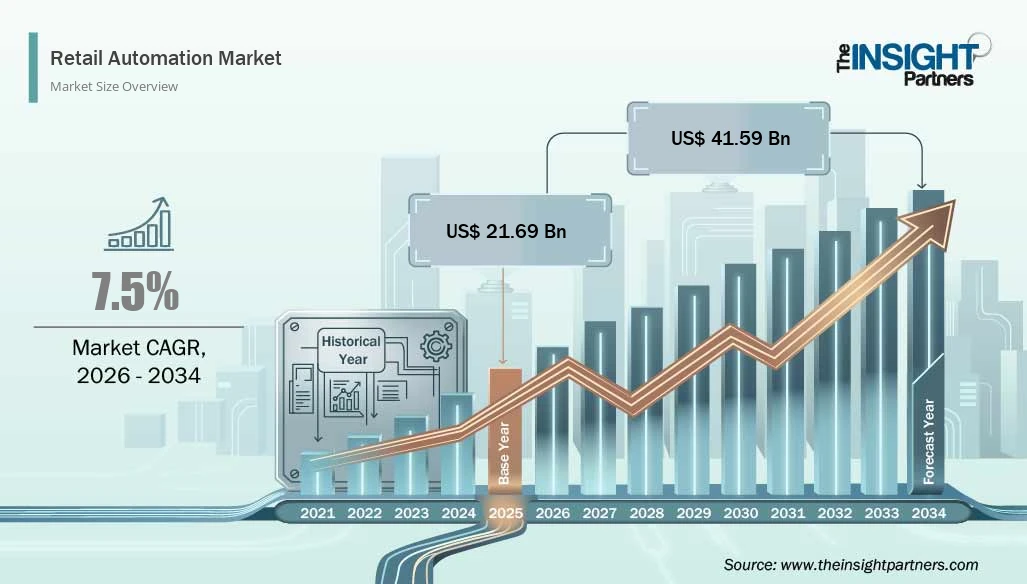
The retail automation market is transforming the way retailers manage stores, inventory, checkout, pricing, and customer interactions. Automation technologies help retailers reduce manual processes, improve operational efficiency, increase inventory accuracy, and deliver faster shopping experiences. The retail automation market was valued at US$ 21.69 Billion in 2025 and is projected to reach US$ 41.59 Billion by 2034, registering a CAGR of 7.50% during 2026–2034. The market is being supported by growing demand for self-checkout, smart point-of-sale systems, RFID, electronic shelf labels, robotics, and AI-powered analytics.
Retail automation covers a broad range of technologies used across stores, warehouses, and fulfillment operations. Self-checkout systems can reduce transaction times, while RFID and barcode solutions improve product identification and inventory visibility. Electronic shelf labels enable retailers to update prices digitally, and automated warehouse technologies can support picking, sorting, replenishment, and order fulfillment. Industry research also highlights AI, robotics, IoT, and computer vision as important technologies shaping the development of retail automation.
Retail Automation Market Trends
One of the major retail automation market trends is the increasing adoption of self-service and contactless shopping technologies. Consumers increasingly expect convenient checkout experiences, while retailers are looking for ways to improve staff productivity and manage operating costs. AI-enabled computer vision is also being incorporated into checkout, inventory monitoring, and loss-prevention applications.
Another important trend is the integration of automation with omnichannel retailing. Retailers need accurate, real-time inventory information across physical stores, warehouses, and online channels to support services such as click-and-collect and ship-from-store. Cloud software, connected devices, RFID, and real-time analytics can help retailers create a more integrated operational environment.
Electronic shelf labels are also gaining importance because they allow centralized price management and reduce the manual effort associated with changing traditional paper labels. Meanwhile, autonomous robots and automated fulfillment systems are being used to support inventory scanning, movement of goods, picking, and replenishment.
Get a PDF Sample: https://www.theinsightpartners.com/sample/TIPEL00002152
Key Players in the Retail Automation Market
The retail automation market key players include:
- Fujitsu Limited
- Honeywell International Inc.
- KUKA Aktiengesellschaft
- Toshiba Corporation
- Datalogic S.p.A.
- ZIH Corp.
- Future Way Technical Services LLC
- Pricer AB
- Teraoka Seiko Co., Ltd.
- Display Data Limited
These companies participate across different areas of the retail automation ecosystem, including robotics, automatic identification and data capture, electronic shelf labels, retail systems, printing and identification technologies, and integrated automation solutions.
Growth Drivers
The growing need for operational efficiency is a key factor supporting the retail automation market growth. Retailers face pressure to improve service speed while managing labor costs and maintaining accurate inventory. Automation can address these requirements by reducing repetitive manual tasks and providing real-time operational data.
The expansion of e-commerce and omnichannel retail is another growth factor. Automated warehouses, inventory tracking, and fulfillment systems help retailers respond to increasing order volumes and faster delivery expectations. At the same time, advances in artificial intelligence, machine learning, computer vision, and IoT are expanding the range of retail processes that can be automated.
Future Outlook
The future outlook for the retail automation market remains focused on greater integration between hardware, software, artificial intelligence, and cloud-based platforms. Retailers are expected to increasingly connect POS systems, inventory databases, electronic shelf labels, payment technologies, warehouses, and customer analytics into unified ecosystems.
AI-powered forecasting, computer vision, automated inventory monitoring, smart shelves, autonomous mobile robots, and cashierless or self-checkout technologies are likely to remain important areas of development. Software and managed services may also gain greater importance as retailers seek scalable automation without replacing all existing infrastructure at once.
Overall, the combination of rising digital retail adoption, omnichannel fulfillment, demand for faster customer service, and advances in AI and robotics is expected to create sustained opportunities for the retail automation market through 2034.
Related Reports:
Water Automation and Instrumentation Market
Programmable Automation Controller Market
Contact Us:
If you have any queries about this report or if you would like further information, please contact us:
Contact Person: Ankit Mathur
Email: sales@theinsightpartners.com
Phone: +1-646-491-9876
Also Available in : Korean | German | Japanese | French | Chinese | Italian | Spanish

 English
 Arabic
 French
 Spanish
 Portuguese
 Turkish
 Dutch
Dutch
 Italiano
 Russian
 Romaian
 Portuguese (Brazil)
 Greek
Greek
 Bengali