


Food Waste Bio-CNG Plant Raw Material & Feedstock Supply Chain in India
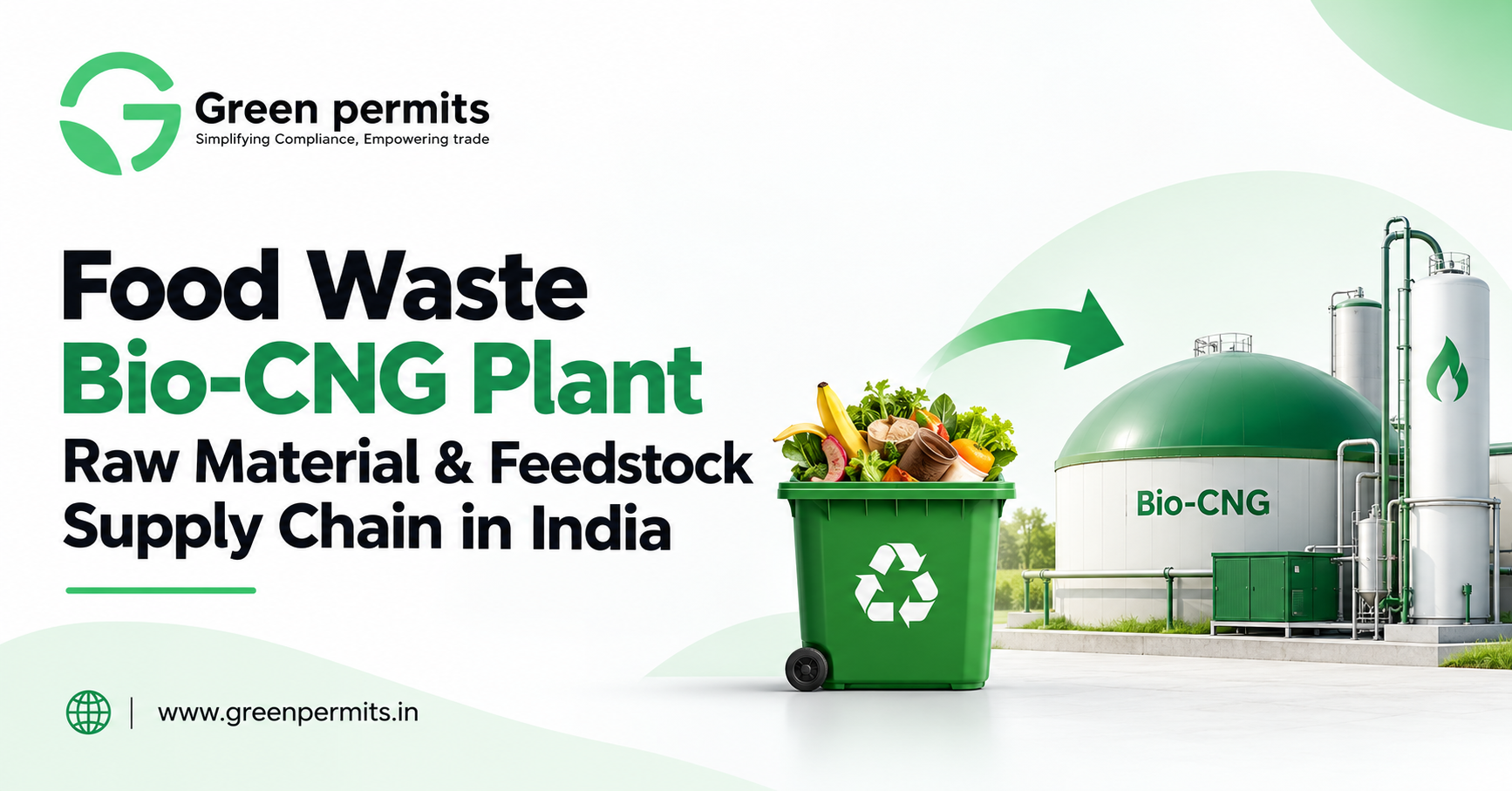
A Food Waste Bio-CNG Plant converts biodegradable food waste into biogas through anaerobic digestion and then upgrades the gas into Bio-CNG. For investors, municipalities, hotels, food processors and waste-management companies, the project can create value from a waste stream that would otherwise require collection, transport and disposal.
However, the success of the project depends heavily on the raw material and feedstock supply chain. Food waste is highly variable in moisture, contamination, composition and collection pattern. A Bio-CNG plant can operate efficiently only when the promoter has a reliable system for sourcing, segregating, transporting and storing suitable biodegradable waste.
Before deciding plant capacity, the project should therefore evaluate daily waste availability, source segregation, collection radius, contamination level, gas yield, logistics cost and long-term feedstock agreements.
Green Permits Consulting supports investors with Food Waste Bio-CNG feasibility studies, feedstock mapping, DPR preparation, machinery planning, CAPEX and OPEX modelling and complete project implementation support.
Where Does Food Waste Feedstock Come From?
Food waste can be generated from many commercial and institutional sources. Large restaurants, hotels, food courts, canteens, hospitals, hostels, residential societies, vegetable markets, food-processing industries and institutional kitchens can all produce biodegradable organic waste.
The feedstock available from each source is different. A hotel may generate relatively clean kitchen waste, while municipal wet waste may contain plastics, glass, packaging and other contaminants. Food-processing factories can sometimes provide more consistent material because their waste composition remains relatively predictable.
For this reason, a project should not consider all wet waste as equal Bio-CNG feedstock.
The correct study should identify:
Source → Daily Quantity → Composition → Contamination → Distance → Delivered Feedstock Cost
This gives a much clearer picture of the material actually available for the plant.
Source Segregation is Critical
A Food Waste Bio-CNG Plant performs much better when the incoming material is segregated at source.
If food waste is mixed with plastic, metal, glass, cloth or packaging, additional sorting and pre-treatment are required before digestion. This increases labour, machinery requirements and rejection quantity.
High contamination can also damage pumps, shredders and digesters.
For this reason, feedstock contracts should ideally include clear segregation requirements. Hotels, restaurants, canteens and commercial kitchens can be provided with separate collection bins so that only suitable biodegradable material enters the supply chain.
The stronger model is:
Source Segregation → Dedicated Collection → Plant Inspection → Pre-Treatment → Digestion
A project based entirely on mixed waste generally has a more complex and costly pre-processing requirement.
Feedstock Quantity Should Decide Plant Capacity
One of the biggest mistakes in Bio-CNG project planning is selecting plant capacity first and searching for waste later.
A 50 TPD plant needs a reliable quantity of usable feedstock throughout the year. If the plant receives only 25 to 30 tonnes on many days, digester loading falls and project economics can weaken.
The feasibility study should therefore map actual daily generation from each supplier and apply realistic collection efficiency.
For example, a source may generate 5 tonnes of food waste per day, but only 4 tonnes may be recoverable after segregation and collection losses.
The plant should be designed around usable annual feedstock, not only the total waste reported by suppliers.
A practical sequence is:
Feedstock Mapping → Usable Quantity → Gas Yield → Annual Bio-CNG Output → Plant Capacity
Food Waste Quality and Gas Yield
Food waste generally contains a high biodegradable fraction, but gas yield can vary significantly depending on composition.
Waste rich in cooked food, carbohydrates, oils or fats may behave differently from vegetable-market waste or highly diluted canteen waste. Moisture content, oil content, pH and organic loading can influence digestion performance.
The project should therefore conduct representative feedstock testing before finalising gas-yield assumptions.
A proper feasibility study should estimate:
Feedstock Quantity × Organic Content × Biogas Yield × Methane Recovery = Bio-CNG Output
Using one fixed gas-yield number for every food-waste project can create unrealistic financial projections.
The actual feedstock mix should determine the digester design and expected production.
Collection and Transportation Network
Food waste has to be collected regularly because it decomposes quickly and can create odour, leachate and hygiene problems.
The collection network therefore becomes a major part of the business model.
Waste may be collected through dedicated vehicles from hotels, restaurants, markets and institutions. Route planning is important because a poorly designed collection network can increase fuel, labour and vehicle costs.
The feasibility study should calculate:
Collection Vehicle Cost + Labour + Route Distance + Daily Trips + Handling = Logistics Cost
A plant located close to a dense cluster of food-waste generators may have much stronger economics than a plant collecting the same quantity from a wide geographic area.
This is why a cheap land parcel far from major waste sources may not actually reduce total project cost.
Feedstock Agreements with Waste Generators
Long-term supply arrangements are important because Bio-CNG plants require continuous feedstock.
The promoter should identify anchor suppliers before financial closure. These may include large hotels, food-processing industries, institutional kitchens, vegetable markets or municipal bodies.
Supply agreements can define expected quantity, segregation standards, collection responsibility and commercial terms.
Some waste generators may pay a tipping or waste-management fee for collection, while in other cases the Bio-CNG plant may need to arrange the material at its own cost.
The financial model should clearly distinguish between these two situations because they create very different economics.
A diversified supplier base is generally safer than relying entirely on one large source.
Pre-Treatment Before Anaerobic Digestion
Food waste usually requires pre-treatment before entering the digester.
Incoming material may pass through inspection, manual or mechanical sorting, shredding, pulping and contaminant removal. Water or recycled liquid may then be added to prepare a suitable slurry.
The process may follow:
Food Waste Receiving → Sorting → Shredding / Pulping → Slurry Preparation → Anaerobic Digestion
The purpose is to create a consistent organic feed while removing materials that could damage equipment.
Pre-treatment machinery should therefore be selected after understanding the contamination level of the incoming waste. A clean hotel-food-waste project may need a simpler system than a plant receiving mixed municipal wet waste.
Storage and Daily Feed Management
Unlike dry agricultural biomass, food waste should generally not be stored for long periods.
The plant needs enough receiving and buffer capacity to manage daily variations, weekends and collection delays, but excessive storage can increase odour and decomposition.
Receiving pits, covered storage, slurry tanks and leachate management should therefore be included in the plant layout.
The project should also maintain a daily feedstock balance.
If too much high-strength material enters the digester suddenly, biological performance may become unstable. Consistent feeding is usually more important than simply maximising daily tonnage.
Co-Digestion with Other Organic Feedstocks
A Food Waste Bio-CNG Plant may also evaluate co-digestion with other suitable biodegradable materials.
These can include cattle dung, selected agro-industrial residues or other compatible organic waste depending on the project.
Co-digestion can help stabilise the feed mix or provide additional material when food-waste supply fluctuates.
However, each additional feedstock should be technically assessed before use. Different materials have different solids content, nutrient balance and gas yield.
The project should therefore develop a controlled feed recipe rather than mixing available organic waste without analysis.
Digestate and Residue Management
After anaerobic digestion, a significant quantity of digestate remains.
The plant needs a proper plan for solid-liquid separation, storage and utilisation or disposal of the digestate depending on its quality and applicable requirements.
If the incoming food waste contains significant contamination, the plant can also generate rejects during sorting and pre-treatment.
These residues must be included in the material balance.
A complete project calculation should therefore be:
Incoming Food Waste = Bio-CNG + Digestate + Recyclable / Reject Material + Process Loss
This prevents the project from focusing only on gas production while ignoring the remaining material.
Financial Impact of Feedstock Supply
Feedstock economics can vary significantly between projects.
Some plants may receive food waste at little or no purchase cost, while others may need to pay collection and transport expenses. In certain commercial models, waste generators may pay the operator for collection and treatment services.
The financial model should calculate the delivered cost per tonne of usable feedstock, including sorting and collection losses.
This should then be linked to actual Bio-CNG output.
If collection cost rises or contamination increases, the effective cost per unit of gas can increase quickly.
Feedstock security and logistics should therefore be treated as core financial variables, not just operational details.
DPR for Food Waste Bio-CNG Plant
A professional Food Waste Bio-CNG Plant DPR should combine feedstock availability, gas yield, machinery and financial feasibility.
The study should cover generator mapping, collection routes, usable feedstock quantity, contamination, pre-treatment, digester capacity, purification system, Bio-CNG output, digestate handling, CAPEX, OPEX and working capital.
The practical project sequence should be:
Waste Generator Mapping → Feedstock Testing → Collection Planning → Capacity → DPR → Offtake → Approvals → Plant Setup
This approach ensures that machinery and plant size are based on a real supply chain rather than assumptions.
How Green Permits Helps
Green Permits Consulting supports investors, waste-management companies and industrial developers with Food Waste Bio-CNG Plant feasibility studies, feedstock mapping, DPR preparation, machinery planning, CAPEX and OPEX modelling and project implementation support.
The objective is to ensure that the proposed Bio-CNG plant has enough segregated organic waste, practical collection logistics and realistic gas-production potential before major investment is committed.
Learn More About Food Waste Bio-CNG Plant Setup
If you are planning a Food Waste Bio-CNG project, the first stage should evaluate waste generators, daily feedstock availability, contamination, collection cost, gas yield and offtake before deciding plant capacity.
Read more about plant setup and DPR consulting services here:
👉 https://www.greenpermits.in/09/food-waste-bio-cng-feedstock-study-supply-cost/
📞 Get Expert Assistance for Food Waste Bio-CNG Projects
If you are planning a Food Waste Bio-CNG Plant in India, Green Permits Consulting can assist with feedstock mapping, feasibility study, DPR preparation, machinery planning and project implementation.
🌐 Website: www.greenpermits.in
📞 Phone: +91 78350 06182
📧 Email: wecare@greenpermits.in

 English
 Arabic
 French
 Spanish
 Portuguese
 Turkish
 Dutch
Dutch
 Italiano
 Russian
 Romaian
 Portuguese (Brazil)
 Greek
Greek
 Bengali