


Advanced Phase Change Materials Market Size, Share, and Emerging Trends
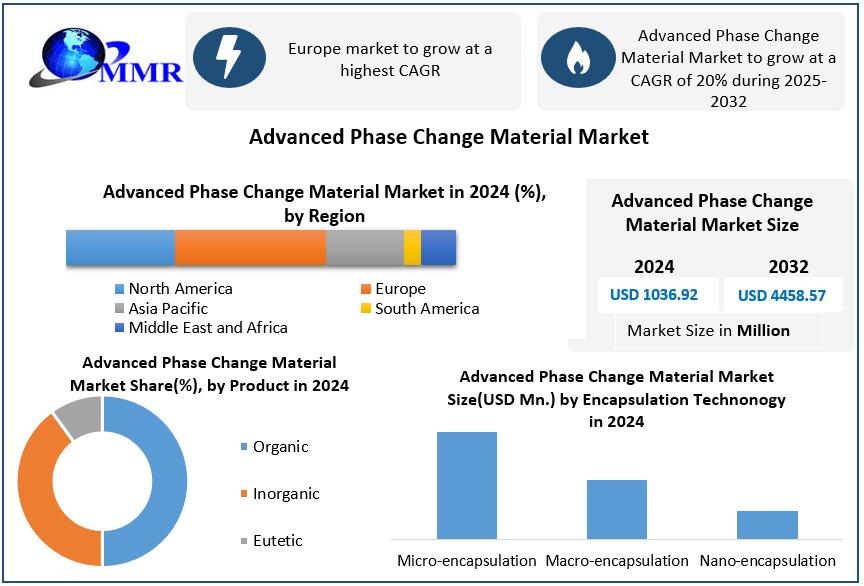
Advanced Phase Change Materials Market Set to Reach USD 4,458.57 Million by 2032
The Advanced Phase Change Materials Market is entering a growth phase as industries seek efficient ways to store, release, and manage thermal energy. According to Maximize Market Research, the market was valued at USD 1,036.92 million in 2024 and is projected to grow at a CAGR of 20% from 2025 to 2032, reaching nearly USD 4,458.57 million by 2032. APCMs absorb and release heat at controlled temperature thresholds, supporting thermal management across buildings, HVAC systems, cold-chain logistics, electronics, textiles, transportation, and renewable energy.
Market Estimation, Growth Drivers and Opportunities
Growth is supported by energy-efficient buildings, sustainability objectives, temperature-sensitive pharmaceutical and food logistics, and renewable-energy deployment. PCMs reduce thermal fluctuations and can shift heating and cooling loads. Their use in buildings, HVAC, packaging, electronics, textiles, and energy storage is widening the market.
Opportunities are emerging from bio-based, shape-stabilized, and encapsulated materials. Encapsulation can improve containment, cycling stability, and flexibility. APCMs are also gaining relevance in data centers, EV components, medical logistics, and textiles. High investment, manufacturing complexity, compatibility issues, and supply-chain constraints remain barriers.
U.S. Market Trends and Investment
The United States is an important innovation center for thermal energy storage, computing, electronics, buildings, and cold-chain applications. In 2025, the U.S. Department of Energy highlighted an Oak Ridge National Laboratory innovation using 5% anisotropic carbon fibers in PCMs, reducing melting time from more than 8,000 seconds to 1,260 seconds. The result demonstrates how improved conductivity can make PCM systems more practical. U.S. programs are also examining PCM compatibility with heat exchangers and heat pumps, performance optimization, and corrosion mitigation. Commercial activity is expanding around thermal interface materials for AI servers, GPUs, EVs, and electronics. The DOE’s 2025 recognition of the ORNL work signals continuing federal interest in improving PCM performance. Honeywell is positioning its PCM thermal-interface materials for AI chips, high-performance computing, EVs, and consumer electronics, while Phase Change Solutions continues developing plant-based BioPCM formulations for temperature-control applications.
Request a Sample of the Full Market Report : https://www.maximizemarketresearch.com/request-sample/46299/
Market Segmentation: Largest Share
By product, Organic APCMs held the dominant position because of versatility, compatibility, and lower cost. They are widely used in construction, textiles, electronics, and thermal storage.
By application, Building & Construction dominated the market in 2024. Demand for energy-efficient buildings and green construction supports PCM integration into walls, roofs, floors, and other building materials. They absorb excess heat and release it as temperatures fall, improving comfort and reducing heating and cooling needs.
Competitive Analysis
The landscape is fragmented and innovation-driven. Five prominent companies identified in the market study are Rubitherm Technologies GmbH, Outlast Technologies LLC, BASF SE, Pluss Advanced Technologies Pvt. Ltd., and Entropy Solutions LLC. The market assessment does not publish comparable percentage shares for each company, so individual market-share rankings should not be inferred.
Rubitherm develops organic and inorganic PCM solutions, including macroencapsulated salt-hydrate products for heating and cooling. Its focus includes cycling stability, thermal-storage density, and application-specific formulations.
Outlast Technologies focuses on microencapsulated PCM technology for temperature-regulating textiles. Its Thermocules platform supports thermal comfort in apparel, bedding, footwear, and other products.
BASF has a PCM platform associated with Micronal, using microencapsulated wax-based materials in building products. Its sustainability strategy emphasizes lower-carbon and bio-derived materials.
Pluss Advanced Technologies is expanding PCM applications through thermal-management products. Its BrrrF PLUSS wearable cooling technology addresses heat-stress management for workers and outdoor applications.
Entropy Solutions supports temperature-controlled packaging through PureTemp technology. Its formulations support pharmaceutical, food, and other cold-chain requirements.
Regional Analysis: United States, UK, Germany, France, Japan and China
The United States is a major market because of its research ecosystem, electronics industry, data centers, EV development, and thermal-storage investment. Government-supported research is addressing PCM conductivity and system integration.
Germany remains strategically significant because of advanced manufacturing, energy-efficient construction, thermal-storage research, and Rubitherm. Energy-efficiency priorities support adoption.
The UK and France are supported by sustainability objectives, green-building activity, and efficient heating and cooling demand. Europe held the highest regional share in 2024, according to the market assessment.
China benefits from urbanization, infrastructure expansion, electronics manufacturing, renewable energy, and cold-storage networks. Japan’s electronics, automotive, healthcare, and energy-efficiency applications create opportunities for high-performance PCMs.
Key Players
Key players include Outlast Technologies LLC, Phase Change Energy Solutions Inc., Entropy Solutions LLC, Laird Technologies, Honeywell International Inc., Rubitherm Technologies GmbH, BASF SE, Croda International Plc, Phase Change Material Products Ltd., Advansa BV, Salca BV, Climator Sweden AB, Morgan Advanced Materials plc, PCM Energy P. Ltd., Pluss Advanced Technologies Pvt. Ltd., and TEAP Energy Pvt. Ltd.
Why This Market Matters Now
Advanced PCMs are moving from specialized thermal-control applications toward broader energy-efficiency and thermal-management systems. Demand for efficient buildings, resilient cold chains, AI and electronics cooling, EV thermal management, and renewable-energy integration is increasing demand for precise thermal storage. In 2025, U.S. research demonstrated faster PCM heat transfer using carbon-fiber enhancement. Improved conductivity, durability, encapsulation, sustainability, and scalability can expand APCM adoption.
Explore More Related Reports:
Global Liquid Roofing Market https://www.maximizemarketresearch.com/market-report/global-liquid-roofing-market/97330/
Paint Stripper Market https://www.maximizemarketresearch.com/market-report/paint-stripper-market/215892/
About Maximize Market Research
Maximize Market Research Pvt. Ltd. (MMR) is a global market research and consulting company providing reliable, data-focused, and practical business insights. The firm serves healthcare, pharmaceuticals, technology, automotive, electronics, chemicals, personal care, and consumer goods. Through market forecasts, competitive analysis, strategic consulting, and industry impact assessments, MMR helps organizations understand changing markets, identify opportunities, and make informed business decisions.
Contact Us
2nd Floor, Navale IT Park Phase 3
Pune Banglore Highway, Narhe
Pune, Maharashtra 411041, India
+91 9607365656
sales@maximizemarketresearch.com

 English
 Arabic
 French
 Spanish
 Portuguese
 Deutsch
 Turkish
 Dutch
Dutch
 Italiano
 Romaian
 Portuguese (Brazil)
 Greek
Greek
 Bengali