


Membrane Bioreactor (MBR) Market Growth: Wastewater Treatment Demand & Industry Trends 2026-2034
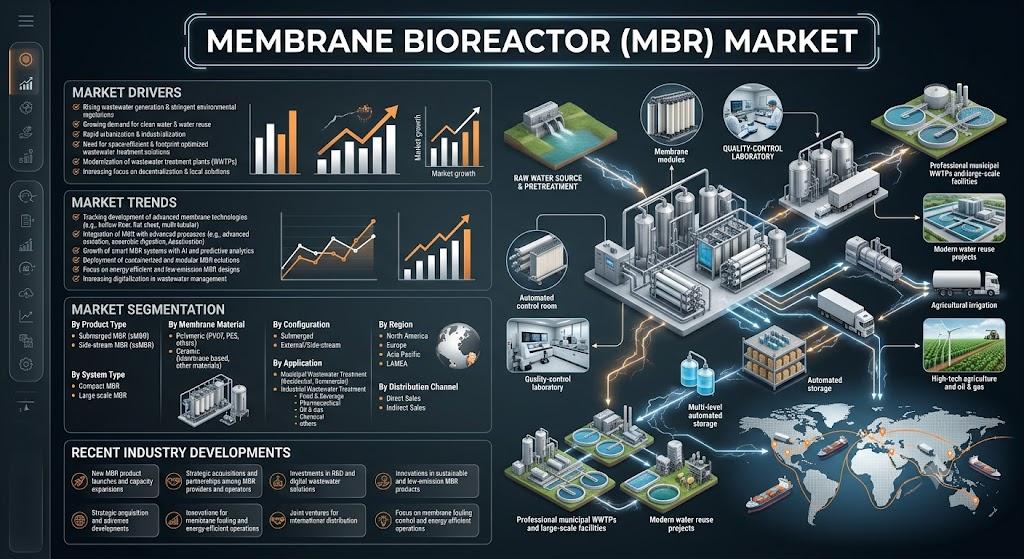
Market Overview:
According to IMARC Group's latest research publication, "Membrane Bioreactor (MBR) Market: Global Industry Trends, Share, Size, Growth, Opportunity and Forecast 2026-2034", The global membrane bioreactor (MBR) market size was valued at USD 4.7 Billion in 2025. Looking forward, IMARC Group estimates the market to reach USD 9.3 Billion by 2034, exhibiting a CAGR of 7.70% during 2026-2034.
This detailed analysis primarily encompasses industry size, business trends, market share, key growth factors, and regional forecasts. The report offers a comprehensive overview and integrates research findings, market assessments, and data from different sources. It also includes pivotal market dynamics like drivers and challenges, while also highlighting growth opportunities, financial insights, technological improvements, emerging trends, and innovations. Besides this, the report provides regional market evaluation, along with a competitive landscape analysis.
How AI and Technology Are Reshaping the Membrane Bioreactor (MBR) Market
- AI-powered monitoring and IoT-based diagnostics are being integrated into MBR systems to enable real-time process control and predictive maintenance, helping reduce operational downtime and lower energy consumption across municipal and industrial wastewater facilities.
- In March 2025, Sumitomo Electric received its largest-ever order for PTFE POREFLON membrane modules for Jakarta's Sewage Improvement Project, with the MBR-based plant designed to treat 240,000 m3/day and serving approximately 1.24 million people while achieving 30% savings in both space and energy.
- Saudi Arabia announced a USD 4 Billion investment in 96 projects under its National Water Strategy, targeting the reuse of 70% of treated water by 2030, directly accelerating demand for advanced MBR-based wastewater treatment infrastructure.
- Asia Pacific dominates the global market with a share of 45.3% in 2025, driven by rapid urbanization, industrial growth, and government-backed wastewater modernization programs in China, India, Japan, and South Korea.
- The submerged MBR configuration leads with approximately 66.5% of market share in 2025, favored for its compact design, low energy demand, and ability to deliver high effluent quality suitable for water reuse applications.
Download a sample PDF of this report: https://www.imarcgroup.com/membrane-bioreactor-market/requestsample
Key Trends in the Membrane Bioreactor (MBR) Market
- Growing Demand for Advanced Water Treatment Solutions: Declining freshwater resources and increasing demand for safe, chemical-free drinking water are accelerating the adoption of MBR systems globally. The UNEP has reported that freshwater ecosystems are degraded in half of the world's countries, and river flow has decreased in 402 basins globally, a fivefold increase since 2000, driven by climate change and land use. MBR systems combine biological treatment with membrane filtration, delivering high-quality effluent suitable for reuse in irrigation, cooling systems, and potable applications. In water-stressed nations including India, Saudi Arabia, and South Africa, governments and utilities are increasingly deploying MBRs as part of strategic water reuse plans.
- Rising Environmental Concerns Around Wastewater Disposal: The UN reported that in 2022, 42% of household wastewater globally was not safely treated before discharge, leading to 113 billion m3 of untreated wastewater released into the environment each year. Traditional treatment methods often fail to remove micro-pollutants, antibiotics, and endocrine-disrupting compounds, which accumulate in natural water bodies and drinking water sources. MBR systems deliver superior contaminant removal, achieving low biochemical oxygen demand (BOD), chemical oxygen demand (COD), and total suspended solids (TSS) levels in line with stringent global discharge benchmarks. Their compact design and minimal sludge production further reduce the environmental footprint of wastewater facilities, making them increasingly attractive in ecologically sensitive zones.
- Technological Innovation and Process Integration: An industry report reveals that traditional wastewater treatment processes manage 330 billion cubic meters of water annually but contribute 3 to 4% of global energy use and 300 million tons of carbon emissions. Innovative MBR technologies could help reuse 50 billion cubic meters of water yearly and save 20 TWh of energy. Low-fouling membranes, energy-optimized aeration systems, and AI-based IoT monitoring tools are reshaping MBR operations across municipal, industrial, and decentralized settings. Industrial players in food processing, pharmaceuticals, and textiles are leveraging these integrated systems to comply with zero-liquid-discharge mandates and circular economy goals.
- Expanding Urbanization Driving Decentralized Treatment Needs: It is estimated that approximately 7 billion people will reside in urban areas by 2050, placing immense pressure on centralized wastewater infrastructure. Decentralized MBR systems offer a practical solution by enabling efficient treatment at or near the point of wastewater generation, without requiring physical expansion of existing facilities. In Latin America, 82% of the population currently lives in urban areas, significantly higher than the global average of 58%, creating sustained demand for scalable and space-saving wastewater technologies.
- Government Programs and Regulatory Push Fueling Adoption: Washington State's Department of Ecology has set aside USD 309 Million for 136 water quality projects under its Water Quality Combined Funding Program, disbursing over 90% of funds directly to local communities. India's Namami Gange programme is channeling investments into sewage treatment modernization, while China has launched multiple large-scale MBR-based municipal projects under national water pollution control schemes. The European Environment Agency has reported that about 38% of EU citizens experienced water scarcity, with half of Europe's river basins expected to face water stress by 2030, intensifying regulatory pressure on advanced treatment adoption.
The membrane bioreactor (MBR) market report provides a comprehensive overview of the industry. This analysis is essential for stakeholders aiming to navigate the complexities of the biochar market and capitalize on emerging opportunities.
Growth Factors in the Membrane Bioreactor (MBR) Market
- Escalating Water Scarcity Across Regions: The Asian Development Bank has reported that over 75% of Asia is water insecure, with countries housing more than 90% of the region's population already facing an imminent water crisis. Agriculture is the largest water consumer in the region, using 70% of Asia's water resources for food production. This acute scarcity is compelling governments and industries to invest in efficient water recycling systems, with MBR technology being a preferred choice for delivering reusable-quality effluent in both urban and agricultural applications.
- Hollow Fiber Membrane Dominance and Cost-Effectiveness: Hollow fiber membranes account for approximately 61.5% of market share in 2025, owing to their high surface area-to-volume ratio, minimal footprint, and efficient solid-liquid separation performance. Their durability and flexibility make them the preferred choice for large-scale wastewater treatment projects, particularly in regions with strict discharge regulations and growing water reuse requirements. As global water reuse priorities intensify, hollow fiber membrane adoption is expected to increase further.
- Municipal Wastewater Treatment as the Largest Application Segment: Municipal wastewater treatment leads the application segment with approximately 47.6% of market share in 2025. Municipal authorities favor MBR technology for its ability to deliver high-quality effluent compliant with regulatory discharge and reuse standards, and for its scalability and ability to retrofit existing facilities. With population growth and urban expansion continuing globally, the role of municipal wastewater treatment in driving MBR market growth is increasingly robust.
- Industrial Sector Expansion Generating Complex Wastewater Streams: Industrial sectors including pharmaceuticals, food processing, and textiles generate complex effluents that conventional treatment methods cannot adequately address. MBR systems, with their ability to handle high organic loads and deliver consistently treated output, are becoming the solution of choice in these sectors. In Europe, growth in industrial wastewater treatment demand is supported by stringent EU regulations on wastewater discharge and water quality standards.
- Strategic Investments and Capacity Expansion in MEA: Saudi Arabia's USD 4 Billion investment across 96 water reuse projects under its National Water Strategy aims to reuse 70% of treated water by 2030. In Bahrain, VA Tech WABAG secured a seven-year operation and maintenance contract for the Industrial Wastewater Treatment Plant at BAPCO refinery, using MBR technology to treat 4,400 gallons per minute. These investments reflect a regional shift toward long-term, performance-based wastewater management using membrane bioreactor systems.
Leading Companies Operating in the Global Membrane Bioreactor (MBR) Industry:
- Alfa Laval
- Aquatech
- DuPont de Nemours, Inc.
- Kovalus Separation Solutions
- KUBOTA Corporation
- Mann + Hummel
- Mitsubishi Chemical Corporation
- Pentair
- Reynolds Culligan
- SIGMADAF
- Suez SA
- Toray Industries, Inc.
- Veolia Water Technologies, Inc.
- Xylem Inc.
Membrane Bioreactor (MBR) Market Report Segmentation:
Breakup By System Configuration:
- Submerged
- Side Stream
Submerged accounts for the majority of market share with approximately 66.5% in 2025, owing to its compact design, lower energy requirements, and high effluent quality output that suits water reuse applications across both municipal and industrial sectors.
Breakup By Membrane Type:
- Hollow Fiber
- Flat Sheet
- Multi-Tubular
- Others
Hollow fiber dominates the market with approximately 61.5% of market share in 2025, driven by its high surface area-to-volume ratio, efficient solid-liquid separation capabilities, and cost-effectiveness for large-scale wastewater treatment installations.
Breakup By Application:
- Municipal Waste-Water Treatment
- Industrial Waste-Water Treatment
- Others
Municipal wastewater treatment leads the market with around 47.6% of market share in 2025, fueled by rising urbanization, population growth, and the need to comply with increasingly stringent discharge and reuse regulations globally.
Breakup By Region:
- North America (United States, Canada)
- Asia Pacific (China, Japan, India, South Korea, Australia, Indonesia, Others)
- Europe (Germany, France, United Kingdom, Italy, Spain, Russia, Others)
- Latin America (Brazil, Mexico, Others)
- Middle East and Africa
Asia Pacific currently holds the leading position with over 45.3% market share in 2025, supported by fast-paced urbanization, growing industrial activity, and government-driven wastewater infrastructure investments across China, India, Japan, and South Korea.
Recent News and Developments in the Membrane Bioreactor (MBR) Market
- March 2025: Sumitomo Electric received its largest-ever order for PTFE POREFLON membrane modules for Jakarta's Sewage Improvement Project. The MBR-based plant will treat 240,000 m3/day, serving 1.24 million people, while delivering 30% savings in both space and energy, supporting Indonesia's urban wastewater management goals.
- February 2025: xAI and CERAFILTEC partnered to build a ceramic membrane bioreactor for wastewater reuse, supporting cooling operations at xAI's supercomputing data center in Memphis. The project aims to conserve drinking water, reduce environmental impact, and establish sustainability benchmarks for data center infrastructure.
- January 2025: VA Tech WABAG secured a USD 14 Million, seven-year operation and maintenance contract for managing the Industrial Wastewater Treatment Plant at Bahrain's BAPCO refinery. Using MBR technology, the plant treats 4,400 gallons per minute, reinforcing MBR adoption across the Middle East's industrial sector.
Note: If you require specific details, data, or insights that are not currently included in the scope of this report, we are happy to accommodate your request. As part of our customization service, we will gather and provide the additional information you need, tailored to your specific requirements. Please let us know your exact needs, and we will ensure the report is updated accordingly to meet your expectations.
About Us:
IMARC Group is a global management consulting firm that helps the world's most ambitious changemakers to create a lasting impact. The company provides a comprehensive suite of market entry and expansion services. IMARC offerings include thorough market assessment, feasibility studies, company incorporation assistance, factory setup support, regulatory approvals and licensing navigation, branding, marketing and sales strategies, competitive landscape and benchmarking analyses, pricing and cost research, and procurement research.
Contact Us:
IMARC Group
134 N 4th St. Brooklyn, NY 11249, USA
Email: sales@imarcgroup.com
Tel No: (D) +91 120 433 0800
United States: +1-201-971-6302

 English
 Arabic
 French
 Spanish
 Portuguese
 Deutsch
 Turkish
 Dutch
Dutch
 Italiano
 Romaian
 Portuguese (Brazil)
 Greek
Greek
 Bengali