


Brownfield Plant Debottlenecking in India: How to Increase Capacity Without Building a New Plant
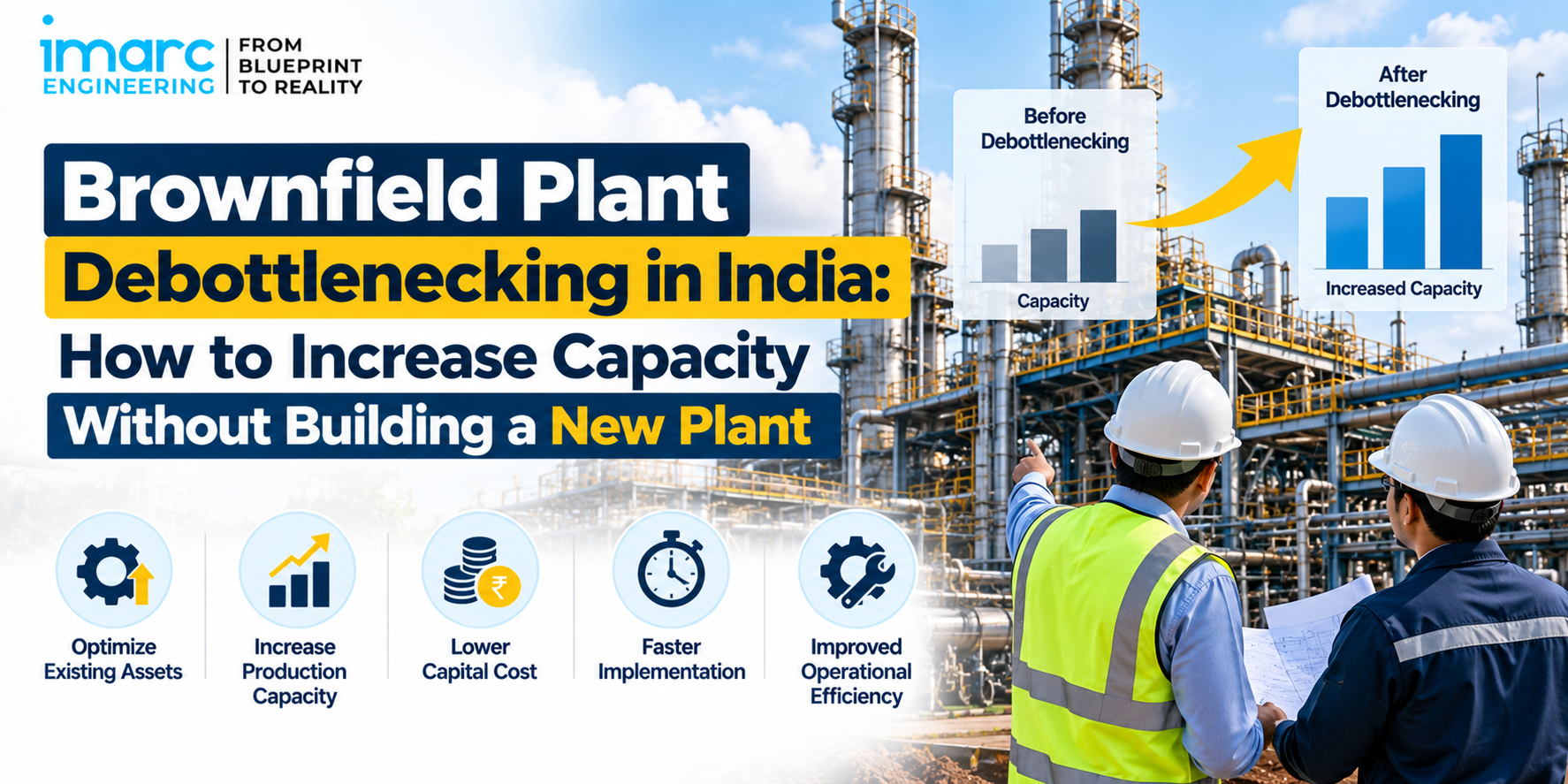
When demand rises, the first response is often to plan a new plant or a major expansion block. In many factories, a significant share of additional output is still locked inside the current facility: constrained by one process step, weak utilities, poor material flow, long changeovers or unstable yields. Building new capacity without releasing those constraints can mean paying twice—once for underused existing assets and again for fresh capital.
Brownfield plant debottlenecking in India focuses on increasing dependable capacity within the operating plant. The objective is to identify true constraints, remove them in a controlled sequence and raise output without immediately constructing a new facility. For a detailed approach to Brownfield Project Management, manufacturers can assess existing plant constraints, utilities, layout and execution requirements before committing to major expansion.
Why Debottlenecking Matters Before New-Plant Investment
A brownfield plant already has land, buildings, people, approvals and market relationships. If those can support higher throughput with targeted intervention, returns can improve faster than a full greenfield cycle.
Debottlenecking becomes relevant when:
- Orders are being deferred despite installed machines
- One section runs overloaded while others wait
- Utilities limit production more than process equipment
- Changeovers and material movement consume effective capacity
- Quality losses reduce saleable output below theoretical rates
India’s manufacturing sector continues to expand under policy support and investment momentum:
- Manufacturing growth is estimated at around 7% at constant prices in FY 2025-26 (MoSPI First Advance Estimates).
- FDI into manufacturing rose 18% in FY 2024-25 to US$19.04 billion (Ministry of Commerce & Industry / DPIIT).
- PLI cumulative investment has exceeded ₹2.16 lakh crore, with cumulative production and sales surpassing ₹20.41 lakh crore as of December 2025 (PIB).
- Logistics costs have improved to an estimated 7.97% of GDP (DPIIT-NCAER study).
As volumes grow, many manufacturers need capacity quickly. Debottlenecking is often the fastest route to usable output when constraints are internal.
What Debottlenecking Is—and What It Is Not
Debottlenecking is a structured process to increase the output of an existing system by relieving the limiting steps.
It is not:
- Random equipment addition without flow analysis
- Pushing operators to “run faster” without process control
- Ignoring safety, quality and compliance boundaries
- Assuming nameplate ratings equal dependable capacity
Effective debottlenecking improves the rate of saleable production the plant can sustain under real operating conditions.
Step 1: Establish Dependable Current Capacity
Before redesigning anything, define what the plant actually delivers.
Review:
- Historical output by product family
- Yield, rejection and rework losses
- Planned and unplanned downtime
- Changeover time and frequency
- Shift patterns and effective operating hours
- Seasonality and product-mix effects
Nameplate capacity is a reference. Dependable capacity is the baseline for improvement.
Step 2: Identify the True Constraint
The visible queue is not always the real bottleneck.
Common constraint types include:
- Process equipment with insufficient cycle capacity
- Utility limits such as power, steam, cooling or compressed air
- Material feeding and internal logistics delays
- Inspection, packing or dispatch bottlenecks
- Manpower or skill constraints on critical operations
- Quality variability that forces slower running rates
Map flow from receipt to dispatch. Measure where work-in-process accumulates and where downstream resources wait. The constraint is where additional release of throughput is blocked.
Step 3: Separate Quick Wins from Structural Changes
Not every capacity gain needs major CapEx.
Quick-win levers often include:
- Reducing changeover losses on the constraint
- Improving material presentation and kitting
- Stabilising process parameters to raise yield
- Recovering capacity lost to micro-stops and minor breakdowns
- Rebalancing shifts around the true limiting step
- Clearing aisle and staging congestion that starves the line
Structural levers may include:
- Targeted equipment upgrade at the constraint
- Utility reinforcement for peak demand
- Layout changes to shorten material movement
- Parallel processing at a limited bottleneck step
- Automation of repetitive constraint tasks
Sequence matters. Quick wins improve baseline control and often reduce the size of later capital interventions.
Step 4: Check Utilities Before Adding Process Machines
In brownfield plants, utilities are frequent hidden bottlenecks.
Validate:
- Power availability and distribution at peak load
- Cooling and HVAC performance under simultaneous demand
- Steam or hot-water capacity and pressure stability
- Compressed air pressure and quality at point of use
- Water and wastewater system headroom
Adding process equipment onto weak utilities can create new trips, quality drifts and downtime without lasting capacity gain.
Step 5: Protect Quality, Safety and Compliance While Raising Output
Capacity that increases scrap, incidents or consent risk is not usable growth.
Any debottlenecking plan should confirm:
- Process capability remains controlled at higher rates
- Safety access, machine guarding and emergency routes remain intact
- Environmental systems can handle higher throughput
- Maintenance access is not compromised by denser layouts
- Documentation and change control capture process modifications
Brownfield acceleration without control creates later shutdowns that erase the gain.
Step 6: Build a Phased Debottlenecking Roadmap
A practical roadmap usually follows this order:
- Measure dependable capacity and loss structure.
- Confirm the primary constraint.
- Implement low-disruption operating improvements.
- Reinforce utilities or flow paths if they limit the constraint.
- Execute targeted equipment or layout changes.
- Re-measure capacity and identify the next constraint.
- Decide whether residual demand still requires greenfield or major expansion.
Debottlenecking is iterative. When one constraint is removed, the next limiting step becomes visible.
Cost Logic: Why Debottlenecking Can Defer New-Plant CapEx
Compared with building a new plant, brownfield debottlenecking can offer:
- Shorter time to additional output
- Lower capital intensity per incremental unit
- Use of existing land, buildings and approvals
- Faster learning on actual demand response
It is not always sufficient. When market demand exceeds what the current site can safely and compliantly support, new capacity remains necessary. The point is to avoid overbuilding before internal potential is used.
Common Debottlenecking Mistakes
- Adding machines before identifying the true constraint
- Ignoring utilities and material flow
- Chasing theoretical cycle times without yield control
- Implementing too many changes at once during live production
- No before-and-after measurement of dependable capacity
- Weak change control on process modifications
- Assuming every capacity problem needs civil expansion
These mistakes increase spend without proportional output gain.
Practical Debottlenecking Checklist
- Dependable capacity baseline is established.
- Primary bottleneck is evidenced by data, not opinion.
- Product-mix effects are understood.
- Utility headroom is verified.
- Quality and safety limits are defined.
- Quick wins are separated from structural CapEx.
- Implementation sequence minimises production disruption.
- Post-change capacity is remeasured.
- Next constraint is identified.
- Residual demand is compared with new-plant options only after internal potential is tested.
If several points are missing, expansion decisions remain premature.
How IMARC Engineering Can Help
IMARC Engineering supports manufacturers who need practical capacity improvement inside existing facilities. Brownfield debottlenecking works best when process flow, utilities, layout and operating losses are analysed together before major capital is committed.
Support may include:
- Operational and capacity-constraint assessment
- Process and layout inputs for brownfield improvement
- Utility readiness review linked to higher throughput
- Advisory across pharmaceuticals, food and beverage, chemicals, auto components, electronics, FMCG and discrete manufacturing
If your plant needs to increase capacity without building a new facility, IMARC Engineering can help structure a brownfield debottlenecking approach around real constraints and controlled execution: https://www.imarcengineering.com/contact?service=brownfield-project-management
Conclusion
Brownfield plant debottlenecking in India is a disciplined way to increase capacity without immediately building a new plant. By establishing dependable baseline output, identifying true constraints and relieving them in sequence—through operating improvements, utility reinforcement and targeted upgrades—manufacturers can unlock throughput already embedded in existing assets.
New plants remain necessary when demand exceeds what a site can safely and efficiently support. Until that point, debottlenecking remains one of the most capital-efficient routes to growth.
Capacity is not only what you can install. It is what your current system can sustainably deliver.
Contact Us:
IMARC Engineering
Phone: +91-120-433-0800
Email: sales@imarcengineering.com
India: C-130, Sector 2, Noida, Uttar Pradesh 201301
LinkedIn: https://www.linkedin.com/showcase/imarc-engineering/

 English
 Arabic
 French
 Spanish
 Portuguese
 Deutsch
 Turkish
 Dutch
Dutch
 Italiano
 Russian
 Romaian
 Greek
Greek
 Bengali