


Plastic Recycling Plant Site Selection in India
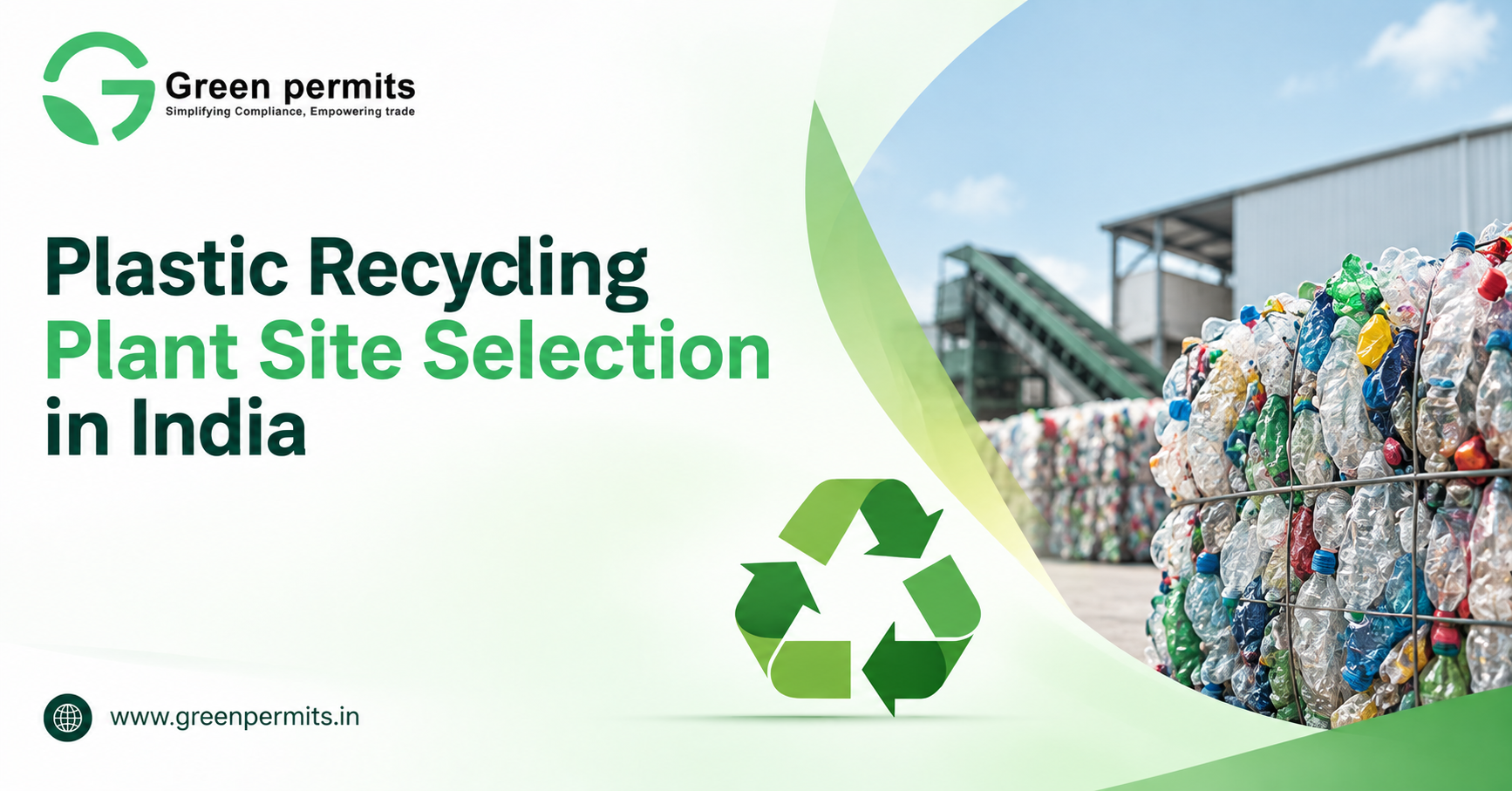
Choosing the right location for a Plastic Recycling Plant is one of the most important decisions in the entire project. A good site can reduce feedstock transportation cost, improve access to buyers, simplify utility planning and make environmental approvals easier to manage. A poor location can create long-term problems even if the land itself is cheap.
For investors, site selection should not be based only on land price. A recycling plant depends on a continuous supply of plastic waste, reliable power, water where required, road connectivity, storage space, labour, pollution-control infrastructure and access to downstream buyers. The correct location should balance all of these factors together.
Green Permits Consulting supports investors with Plastic Recycling Plant feasibility studies, DPR preparation, site assessment, feedstock mapping, CAPEX and OPEX modelling, approval planning and complete project implementation support.
Why Site Selection Matters for a Plastic Recycling Plant
Plastic recycling is a logistics-driven business. Waste plastic usually has relatively low value before processing and can occupy a large volume during transportation. If the plant is located far from major waste-generation centres, the cost of collection and transport can quickly reduce operating margins.
At the same time, the facility needs enough land for receiving, segregation, processing, storage of raw material, finished goods, utility systems and internal vehicle movement. An undersized site can create operational congestion, while an oversized site can unnecessarily increase project investment.
The right location should therefore balance:
Feedstock Availability + Land + Utilities + Logistics + Approvals + Buyer Access
This gives a much better picture of project viability than land cost alone.
Plastic Waste Availability Should Come First
The first factor to evaluate is the availability of plastic waste around the proposed site. The plant should understand what type of plastic is available, how much can be collected and whether the supply is stable throughout the year.
Potential sources can include municipal dry waste, packaging waste, industrial scrap, warehouses, commercial establishments, manufacturing rejects and collection networks. Depending on the project, feedstock may include PET, HDPE, LDPE, PP or other suitable plastic streams.
The study should not consider total plastic waste generation as automatically available to the plant. Existing recyclers, aggregators and waste traders may already be purchasing the same material.
A better approach is to calculate:
Available Waste → Recoverable Plastic → Collection Radius → Delivered Feedstock Cost
The site should ideally be located where enough material can be sourced at a commercially workable delivered cost.
Distance from Waste Generators
Transportation cost can have a major impact on recycling economics because loose plastic waste has low bulk density.
A truck carrying uncompacted bottles, films or mixed plastics may reach its volume limit before reaching its weight limit. This makes long-distance collection expensive.
Locating the plant closer to large urban centres, industrial areas, packaging manufacturers or waste aggregation hubs can reduce transport costs. However, land closer to cities is generally more expensive.
The project should therefore compare the additional land cost against the savings in feedstock transportation.
Compaction, baling or pre-processing at collection points can also help reduce logistics cost, but this requires a stronger supply-chain system.
Industrial Area vs Standalone Land
For many recycling projects, an established industrial area can provide advantages because electricity, roads and other utilities may already be available.
Industrial land can also make it easier to plan factory buildings and heavy vehicle movement compared with unsuitable residential or agricultural locations.
Standalone land may appear less expensive, but the investor needs to examine land-use permissions, road development, electricity connection, drainage and other infrastructure costs.
The correct comparison should therefore be:
Land Price + Development Cost + Utility Connection + Approval Risk
A cheaper plot is not always a cheaper project after all infrastructure requirements are included.
Land Area and Plant Layout
Land requirement depends on plant capacity and the recycling process.
A basic dry-processing plant may require less space than a facility that includes washing, drying, granulation and wastewater treatment.
The layout should provide separate areas for incoming plastic waste, sorting, processing machinery, finished granules or flakes, rejected material and utility equipment. Adequate space should also be available for truck movement and fire access.
An integrated plant may follow:
Waste Receiving → Sorting → Washing → Shredding → Drying → Granulation → Finished Material Storage
The site should allow this material flow without unnecessary cross-movement. Poor layout can increase labour, handling cost and safety risks.
Space for future expansion should also be considered if the promoter plans to increase capacity later.
Water Availability and Wastewater Management
Water requirement depends heavily on the recycling process.
A dry recycling operation may use relatively little process water, while a washing-based plastic recycling facility can require substantial water for cleaning contaminated plastics.
The project should estimate water demand before finalising the location.
Where wastewater is generated, suitable treatment and recycling systems may be required. The feasibility study should determine whether water can be sourced legally and whether the site has enough area for treatment infrastructure.
A location with limited water availability may create serious operating problems for a washing-intensive plant.
This is why the recycling process should be defined before land is purchased.
Power Supply and Utility Requirement
Plastic recycling equipment can require significant electrical power, particularly shredders, grinders, dryers, extruders and pelletising systems.
The proposed site should have access to a reliable electrical connection with sufficient sanctioned load.
A plant located in an area with unstable supply may need additional backup arrangements, which increase production cost.
The DPR should estimate connected load and actual operating consumption according to plant capacity and operating hours.
Other utilities can include compressed air, cooling systems, fire-water systems and ventilation.
The site should therefore be evaluated for the complete utility requirement rather than only checking whether an electricity line exists nearby.
Road Connectivity and Logistics
A plastic recycling facility has continuous movement of waste material and finished products.
Good road connectivity reduces transportation time and makes it easier for collection vehicles, trailers and goods carriers to reach the facility.
The plant should also consider distance to major highways, industrial clusters and finished-product buyers.
If the project manufactures recycled granules, buyers may include plastic product manufacturers located in industrial clusters. For PET flakes or specialised recycled material, the buyer network may be spread across multiple states.
The strongest location often sits between the feedstock source and the customer market.
The site-selection model should therefore evaluate:
Waste Source → Recycling Plant → Buyer
instead of focusing only on one side of the supply chain.
Environmental and Regulatory Suitability
Plastic recycling plants may require environmental and industrial approvals depending on the nature of the activity, state and process configuration.
A project may need to assess requirements such as Consent to Establish, Consent to Operate, applicable Plastic Waste Management registration, fire compliance and other local or factory-related approvals.
Where the process includes washing, wastewater generation or other emissions, pollution-control systems need to be planned accordingly.
The site should also be assessed for surrounding land use and environmental sensitivity.
Choosing land first and checking regulatory suitability later can result in delays, redesign or additional costs. It is safer to complete a basic regulatory assessment before final acquisition.
Storage, Fire Safety and Internal Movement
Plastic waste and finished recycled products can require significant storage space.
Incoming waste may arrive in loose, baled or segregated form, while finished products may be stored as flakes, granules or manufactured products.
The layout should maintain appropriate separation between raw material, processing areas and finished-goods storage.
Fire safety is also an important consideration because large quantities of plastic can create a significant combustible load.
The site should provide adequate access for fire systems, emergency movement and safe storage arrangements.
These requirements need to be considered at the site-selection stage, not after machinery installation.
Buyer Access and Finished Product Market
The best feedstock location is not automatically the best plant location if finished-product buyers are too far away.
A plastic recycling plant may sell washed flakes, granules, compounds or recycled products depending on its business model.
Each output has different buyers and transport economics.
For example, a granule manufacturer should understand where injection molding, extrusion or packaging manufacturers are located. A PET recycler may have a different customer network.
The project should therefore identify buyers before finalising the site.
This helps calculate the complete logistics cost rather than only the cost of bringing waste into the plant.
Site Selection Cost Comparison
A proper site-selection study should compare several locations using the same criteria.
The total cost should consider:
Land + Development + Feedstock Transport + Power + Water + Finished Product Logistics + Compliance Cost
For example, Site A may have cheaper land but require longer feedstock transportation and expensive power. Site B may cost more initially but provide better waste supply, industrial infrastructure and buyer access.
Over 10 or 15 years of operation, the second site may provide much stronger economics.
This is why lifecycle operating cost is more important than initial land price.
DPR and Site Selection Study for Plastic Recycling Plant
A professional Plastic Recycling Plant Site Selection Study and DPR should evaluate feedstock availability, land, utilities, logistics, plant layout, approvals, CAPEX and operating cost together.
The project-development sequence should be:
Feedstock Study → Site Screening → Utility Assessment → Logistics Comparison → Regulatory Check → DPR → Land Finalisation → Plant Setup
This approach reduces the risk of selecting land that later becomes expensive or difficult to operate.
How Green Permits Helps
Green Permits Consulting supports investors and recyclers with Plastic Recycling Plant Site Selection Studies, feasibility reports, feedstock mapping, DPR preparation, CAPEX and OPEX modelling, environmental approval planning and complete project implementation support.
Read more about recycling plant and DPR consulting services here:
👉 https://www.greenpermits.in/09/plastic-recycling-site-selection-in-india-key-factors/
📞 Get Expert Assistance for Plastic Recycling Plant Site Selection
If you are planning a Plastic Recycling Plant in India, Green Permits Consulting can assist with site selection, feedstock analysis, feasibility study, DPR preparation, approvals and project implementation.
🌐 Website: www.greenpermits.in
📞 Phone: +91 78350 06182
📧 Email: wecare@greenpermits.in

 English
 Arabic
 French
 Spanish
 Portuguese
 Deutsch
 Turkish
 Dutch
Dutch
 Italiano
 Russian
 Romaian
 Portuguese (Brazil)
 Bengali