


Law Enforcement And Military Clothing Market: European Defense Modernization Trends
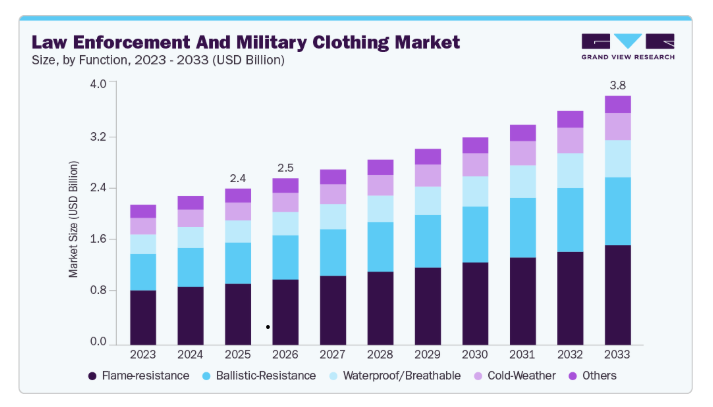
The global Law Enforcement And Military Clothing Market was valued at USD 2.4 billion in 2025 and is projected to grow from USD 2.5 billion in 2026 to USD 3.8 billion by 2033, registering a CAGR of 5.9% from 2026 to 2033. Increasing force modernization programs, rising security concerns, and the need for clothing that combines protection, mobility, and operational performance are supporting market growth.
Force Modernization → Advanced Protective Apparel → Specialized Functional Clothing → Defense & Law Enforcement Demand → Market Growth
Key Market Highlights
- Market Size: USD 2.4 billion in 2025, projected to reach USD 3.8 billion by 2033.
- Growth Rate: CAGR of 5.9% from 2026 to 2033.
- Regional Leader: Asia Pacific accounted for 30.6% of global revenue in 2025.
- By Material: Cotton fibers held the largest market share in 2025.
- By Function: Flame-resistant clothing accounted for 39.2% of revenue in 2025.
- By End Use: Defense represented 71.3% of the market in 2025.
- Fast-Growing Material: Aramid is projected to expand at a 7.7% CAGR.
Download a free sample report or claim your copy of this full market intelligence report
Modernization Is Changing the Role of Military Clothing
Military and law enforcement clothing is increasingly moving beyond conventional uniforms toward modular, mission-specific apparel. Defense and security agencies are upgrading personnel systems to integrate clothing with protective equipment and electronic technologies. This shift is creating demand for garments that can provide protection while supporting mobility and operational requirements.
Rising geopolitical tensions and security concerns are also contributing to procurement activity. Governments are investing in advanced combat uniforms, flame-resistant garments, ballistic-protective apparel, and other clothing designed for high-risk environments.
Material Innovation Is Creating Performance Differences
Cotton fibers maintained the largest market share in 2025, supported by their breathability, comfort, and cost-effectiveness. Cotton is commonly used in NYCO blends for standard-duty uniforms and training clothing, where comfort needs to be combined with improved durability.
Aramid is emerging as an important high-performance material segment and is expected to grow at a CAGR of 7.7%. Para-aramid is used for lightweight ballistic protection, while meta-aramid provides inherent flame resistance. These characteristics make aramid suitable for garments requiring protection against multiple operational threats.
Flame Resistance Remains a Major Functional Requirement
The flame-resistant segment accounted for 39.2% of revenue in 2025, making it the leading function category. Military personnel and specialized law enforcement units require clothing capable of protecting against fire and heat hazards during combat, training, and emergency-response situations.
Waterproof and breathable clothing is expected to register the fastest growth among functional categories. Increasing regulatory attention toward PFAS-free materials is encouraging manufacturers to develop alternatives that can provide weather protection while meeting evolving environmental requirements.
Defense Creates the Largest End-Use Base
Defense accounted for 71.3% of the Law Enforcement And Military Clothing Market in 2025. Military modernization programs and continued investment in personnel protection are supporting demand for high-performance combat apparel.
Defense clothing increasingly needs to combine durability, camouflage, ballistic protection, flame resistance, and adaptability to different environments. Law enforcement also represents a significant opportunity as police and tactical units upgrade clothing for patrol, emergency response, and specialized operations.
Smart Textiles Are Moving Into Tactical Apparel
Smart textiles are creating a new dimension within military and law enforcement clothing. Conductive fibers can enable power and data transmission, while biosensors can support real-time physiological monitoring. Nanotechnology is also being used to develop self-cleaning, antimicrobial, and signature-management fabrics.
These innovations are turning uniforms into more technologically integrated components of personnel equipment. As a result, collaboration between traditional textile manufacturers and defense technology companies is becoming increasingly relevant.
Regional Demand Reflects Different Security Priorities
Asia Pacific held the largest regional share at 30.6% in 2025, with China representing the largest country market. Rising defense budgets, modernization programs, and investments in domestic manufacturing are supporting demand across the region. India is also seeing increasing requirements for durable, cost-effective, and climate-adaptive apparel.
North America benefits from the U.S. defense budget, established law enforcement infrastructure, and domestic sourcing requirements such as the Berry Amendment. Europe is being shaped by defense modernization, border security, and growing interest in sustainable and recyclable military textiles.
In Latin America, internal security and public safety requirements are supporting tactical apparel demand, while the Middle East & Africa market is influenced by military modernization, counterterrorism activities, and the need for clothing suitable for harsh environments.
Market Opportunities and Challenges
High product costs, budget limitations, lengthy procurement cycles, strict testing requirements, and specialized raw-material needs can restrict market expansion. Supply chain disruptions can also affect production and availability.
At the same time, opportunities are emerging around smart uniforms, female-specific tactical apparel, PFAS-free materials, recyclable fabrics, and multi-threat protective clothing. These developments are expected to broaden the role of clothing within modern defense and law enforcement equipment systems.
Key Companies
Safariland, LLC, Point Blank Enterprises, Inc., Ballistic Body Armour (Pty) Ltd., Lenzing AG, Kermel, and Craig International Ballistics Pty. Ltd. are among the companies profiled in the market. Manufacturers are focusing on R&D, advanced materials, long-term procurement relationships, product development, and specialized protective solutions.
About us:
Grand View Research, a market research and consulting company, provides syndicated research reports, customized research reports, and consulting services. Grand View Research database is used by the world's renowned academic institutions and Fortune 500 companies to understand the global and regional business environment. Our database features thousands of statistics and in-depth analysis on 46 industries in 25 major countries worldwide.

 English
 Arabic
 French
 Portuguese
 Deutsch
 Turkish
 Dutch
Dutch
 Italiano
 Russian
 Romaian
 Portuguese (Brazil)
 Greek
Greek
 Bengali