


Global Bicycle Market Growth and Future Trends Through 2032
Future Growth of the Global Bicycle Market Explained
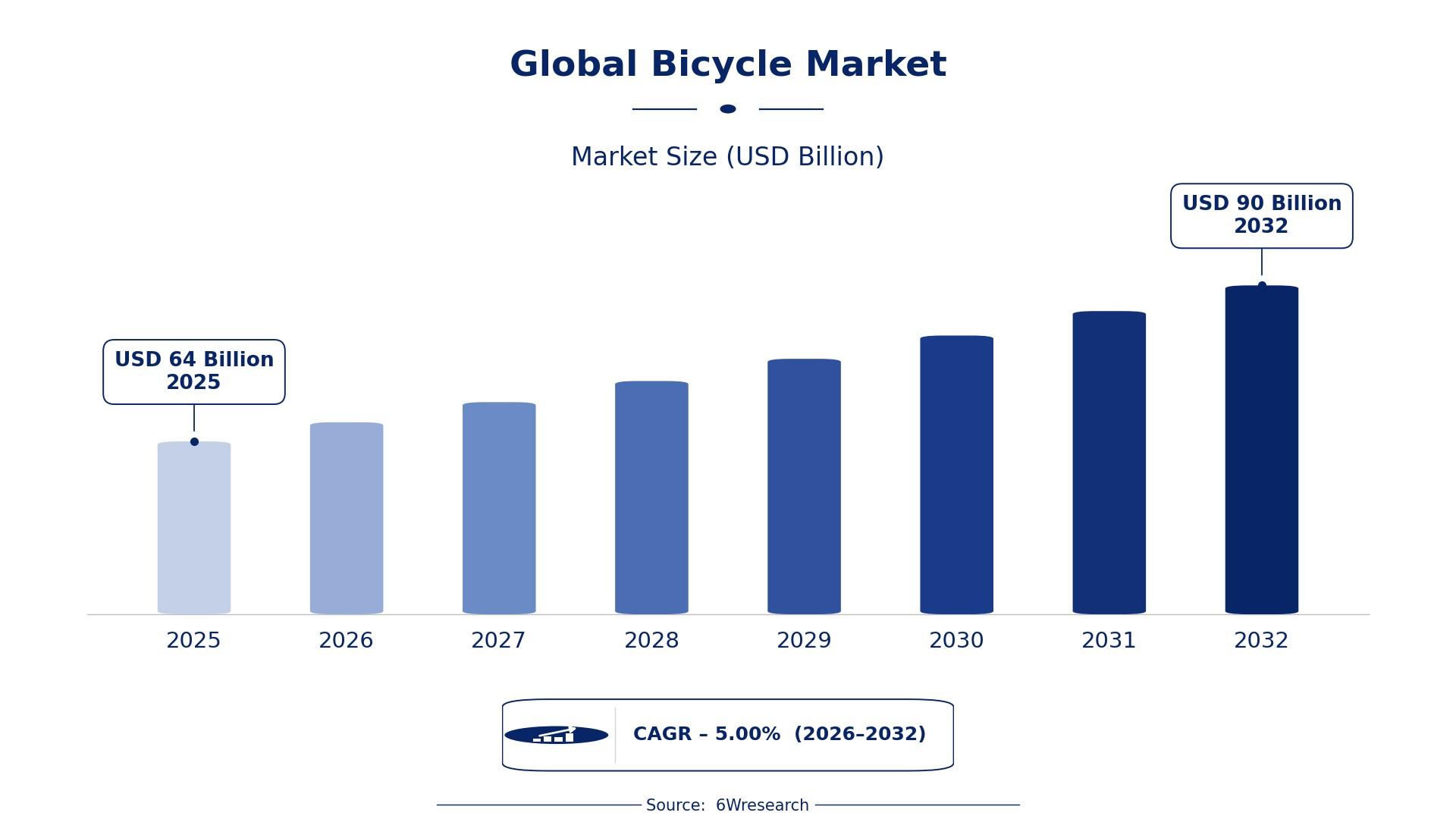
The Global bicycle market is entering a new phase as bicycles increasingly move beyond recreation and become part of everyday mobility, fitness, and sustainable transportation. According to 6Wresearch, the market was valued at USD 64 billion in 2025 and is projected to reach USD 90 billion by 2032, expanding at a 5.00% CAGR from 2026 to 2032. Asia Pacific currently represents the largest regional market, while North America is projected to be the fastest-growing region.
Why Investing in the Global Bicycle Market Can Create New Opportunities
The future expansion of the Global bicycle market is creating opportunities across bicycle manufacturing, electric mobility, components, retail, digital commerce, rental services, and supporting infrastructure. As consumers become more conscious of transportation costs, environmental impact, and personal health, bicycles are gaining relevance in both developed and emerging markets.
The opportunity is particularly significant because the market is no longer dependent on a single type of consumer. Mountain bikes remain the largest product segment, while electric bikes are experiencing much faster growth. According to the 6Wresearch report, mountain bikes accounted for around 40% of the market in 2025, whereas electric bikes are projected to record strong growth through 2032. This diversification allows businesses to address different needs, ranging from outdoor recreation to daily urban commuting.
For investors and businesses, this creates room to develop differentiated products, improve distribution networks, introduce connected technologies, and build services around the growing cycling ecosystem.
Why People Are Choosing Bicycles for Future Mobility
Consumer preferences are changing as cities become more crowded and transportation needs become more flexible. Bicycles offer a practical option for short-distance travel while also supporting fitness and environmentally conscious lifestyles.
The Global bicycle market is benefiting from the shift toward electric bicycles because e-bikes can make cycling more accessible to consumers who may find conventional cycling difficult over longer distances or challenging terrain. Battery improvements and better electric-assist systems are also helping transform bicycles into practical commuting solutions.
The report projects electric bikes to grow at a significantly faster pace than the overall market. This suggests that future demand will increasingly come from consumers looking for a combination of convenience, mobility, performance, and sustainability rather than simply traditional cycling.
How Search Visibility Can Strengthen Bicycle Businesses
As bicycle purchasing becomes increasingly research-driven, digital visibility is becoming an important part of the customer journey. Consumers can compare bicycle types, specifications, prices, technologies, accessories, and reviews before visiting a retailer or completing an online purchase.
Businesses operating within the Global bicycle market can use this changing behavior to provide informative digital experiences. Content covering electric bicycles, mountain bikes, commuting solutions, maintenance, safety, cycling accessories, and product comparisons can help brands connect with consumers at different stages of the buying process.
Online retail is also becoming an increasingly important distribution channel. While offline stores continue to dominate because customers often want to physically inspect and test bicycles, the 6Wresearch report projects online distribution to grow at a 10.0% CAGR from 2026 to 2032. This creates opportunities for businesses that combine strong products with convenient digital purchasing experiences.
Demand Is Rising Through Multiple Consumer Benefits
The demand for bicycles is supported by a combination of transportation, health, economic, and environmental benefits. Cycling can provide an affordable way to travel while also incorporating physical activity into daily routines.
For urban consumers, bicycles can help address short-distance mobility challenges and provide an alternative to congested roads. For recreational users, they offer opportunities for outdoor activities and adventure. For environmentally conscious consumers, bicycles can represent a lower-impact transportation choice.
This combination of applications gives the Global bicycle market a broader demand base. Instead of depending exclusively on recreational cycling, manufacturers and retailers can serve commuters, fitness users, outdoor enthusiasts, families, children, and consumers interested in electric mobility.
Technology Is Enhancing the Bicycle User Experience
Technology is becoming one of the strongest factors influencing the future direction of the Global bicycle market. Manufacturers are introducing lighter materials, improved gear systems, electric assistance, smart connectivity, tracking features, and other technologies designed to make cycling more convenient and personalized.
Electric bicycles are especially important because they bridge the gap between traditional cycling and motor-assisted transportation. Improvements in battery performance can support longer journeys, while connectivity features can provide information related to navigation, fitness, security, and bicycle performance.
The result is a changing perception of what a bicycle can offer. Instead of being viewed only as a mechanical transportation product, modern bicycles can increasingly function as technology-enabled mobility solutions.
Lifestyle Changes Are Supporting Long-Term Bicycle Adoption
Cycling is becoming closely connected with modern lifestyle trends. Growing interest in health, outdoor recreation, sustainable living, and active transportation is helping bicycles maintain relevance among different age groups and consumer categories.
The Global bicycle market can benefit from this lifestyle connection because cycling can serve several purposes within the same household. One person may use a bicycle for commuting, another for fitness, while children may use bicycles for recreation and outdoor activities.
The report also identifies kids' bicycles as a fast-growing end-user category, with projected growth of 8.5% CAGR from 2026 to 2032. This indicates that demand is not restricted to adult consumers and that family-oriented cycling can contribute to future market development.
Infrastructure Development Can Accelerate Market Growth
Infrastructure will play a major role in determining how quickly cycling becomes integrated into everyday transportation. Dedicated bicycle lanes, safer road designs, cycling parking, bike-sharing systems, and connections between cycling routes and public transportation can make bicycle use more practical.
Governments and cities are increasingly considering cycling as part of broader sustainable mobility strategies. The 6Wresearch report highlights government initiatives, cycling infrastructure investment, electric bicycle incentives, and bike-sharing programs as factors supporting market development.
Regional development is also creating different opportunities. Asia Pacific held approximately 46% of the market in 2025, supported by population density and demand in markets including China and India. North America, meanwhile, is projected to be the fastest-growing region, with a forecast CAGR of 7.5% between 2026 and 2032.
What the Next Decade Could Mean for the Global Bicycle Market
The future of the Global bicycle market is likely to be shaped by a combination of product innovation, electric mobility, digital retail, infrastructure development, and changing consumer expectations. Conventional bicycles will remain important, but electric models and connected technologies are expected to capture increasing attention.
At the same time, the industry will need to address challenges such as raw material costs, pricing pressure, regulatory requirements, and competition from other forms of urban mobility. The report notes that fluctuations in materials such as aluminum and steel can put pressure on manufacturers and affect pricing strategies.
This means future growth will depend not only on selling more bicycles but also on developing products and services that provide clear value to consumers. Businesses that understand regional demand, invest in innovation, and respond to sustainability expectations can find new opportunities as the market evolves.
Wrapping Up
The Global bicycle market is moving toward a broader future where cycling combines transportation, technology, fitness, recreation, and sustainable living. With the market expected to increase from USD 64 billion in 2025 to USD 90 billion by 2032, the outlook points toward continued opportunities for manufacturers, retailers, technology providers, investors, and mobility businesses.
The growing adoption of electric bicycles, expanding digital sales, improving cycling infrastructure, and changing consumer lifestyles are creating multiple pathways for future development. For businesses looking to enter or expand within this industry, understanding these trends now can help them respond to demand before the market reaches its projected 2032 scale. The combination of rising demand and technological innovation makes the present period an important time to explore opportunities across the evolving bicycle ecosystem.
Who We Are
About 6Wresearch
6Wresearch is a commercial strategy and growth advisory firm founded in 2011 and headquartered in New Delhi, India, with partners across Southeast Asia and the Middle East & Africa. The firm has delivered over 20,000 commercial engagements for over 2,000 organizations, including Fortune 500 companies, government agencies, and multilateral institutions such as the World Bank and the Asian Development Bank. Backed by proprietary market research and advanced analytics, 6Wresearch combines sector expertise with data-driven intelligence to help organizations navigate market complexity and drive sustainable growth. These capabilities explain why organizations trust 6Wresearch Global Market Research & Consulting Firm for reliable commercial insights and confident decision-making.
Our Proprietary Platform: 6W Export GTM
6W Export GTM is 6Wresearch’s proprietary trade intelligence and go-to-market platform, built on UN Comtrade data and enhanced with 6Wresearch’s in-house analytical and simulation models, including system dynamics-based forecasting. Unlike broad, sector-level market sizing tools, 6W Export GTM operates at the individual product level down to specific HS codes and micro-segments to identify precise, actionable export opportunities by country and product pair, including markets where trade currently does not exist. This granular, simulation-driven approach allows 6W Export GTM to surface opportunities that sector-wide analysis typically misses, positioning it among a small number of platforms globally offering this depth of product-and-country-specific export intelligence.
Read More..

 English
 Arabic
 French
 Spanish
 Portuguese
 Deutsch
 Turkish
 Italiano
 Russian
 Romaian
 Portuguese (Brazil)
 Greek
Greek
 Bengali