


Mexico Photonic Integrated Circuit Market Size Projected to Reach USD 803.6 Million by 2034 with a CAGR of 16.41%
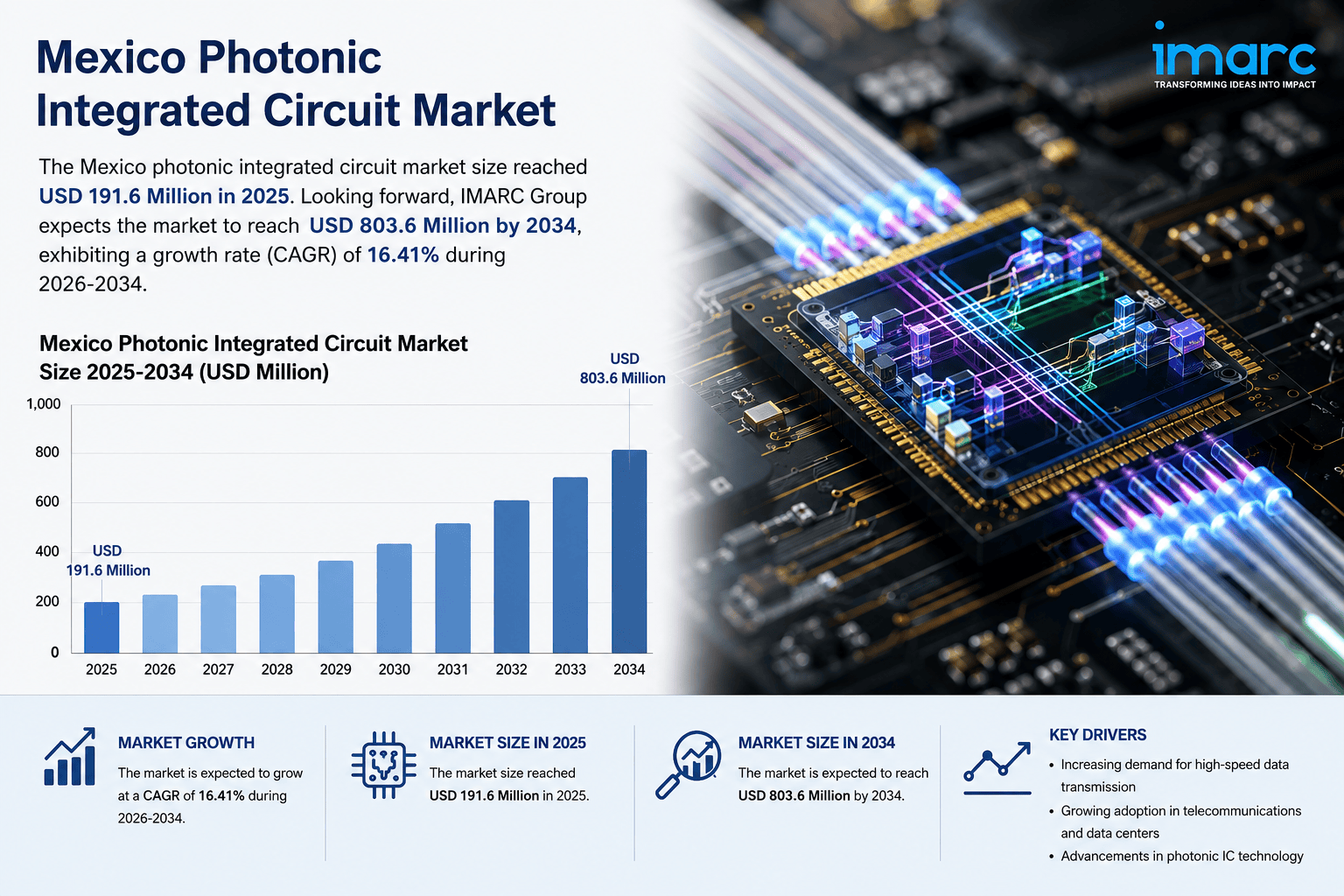
The Mexico photonic integrated circuit (PIC) market reached USD 191.6 Million in 2025 and is projected to reach USD 803.6 Million by 2034, growing at a CAGR of 16.41% during 2026–2034, according to IMARC Group. Photonic integrated circuits microchips that use photons rather than electrons as their primary information carrier deliver dramatically higher data transmission speeds, lower energy consumption, and superior bandwidth density compared to conventional electronic circuits, making them foundational components in next-generation telecommunications, AI data centre interconnects, medical diagnostics, and quantum computing infrastructure.
Mexico's rapid digital transformation, expanding 5G mobile network rollout, growing data centre ecosystem, and government-led semiconductor development initiatives are collectively establishing the country as an emerging regional hub for PIC adoption and photonics-enabled technology deployment.
Key Statistics at a Glance
- Base Year: 2025
- Historical Years: 2020–2025
- Forecast Years: 2026–2034
- Market Size in 2025: USD 191.6 Million
- Market Forecast in 2034: USD 803.6 Million
- Market Growth Rate (2026–2034): 41% CAGR
- Mexico Broadband Subscribers: 121+ Million active (one of Latin America's largest telecom markets)
- Mexico Telecom Revenue Forecast (2023): Exceeding MXN 577 billion (~USD 34 billion)
- Mexico 5G Mobile Connections (2025–2030): Growing from 16.9 million to 87 Million
- Mexico Data Centres (April 2025): 170+ facilities with ~32 colocation providers
- Mexico Smart Cities Market (2025): USD 943.2 Million, CAGR 11.54% through 2029
- Leading Application: Optical Fiber Communication
- Leading Raw Material: Indium Phosphide (InP)
- Leading Integration Type: Monolithic Integration
Latest News: Mexico PIC Market (2025–2026)
February 2025 Mexico Launches Kutsari Semiconductor Initiative to Strengthen Domestic PIC Capabilities
Mexico launched the Kutsari Project in February 2025, a landmark three-phase government initiative designed to strengthen the country's semiconductor sector through enhanced chip design capabilities, revised patent legislation, and the establishment of dedicated research and development centres. The initiative includes a National Semiconductor Design Center and targets significant reduction of Mexico's historical dependence on semiconductor imports, directly supporting the development of enabling technologies including photonic integrated circuits for domestic telecom, defence, and healthcare applications. The Kutsari Project positions Mexico strategically within the nearshoring-driven semiconductor supply chain realignment occurring across North America, as the US CHIPS Act ecosystem encourages regional semiconductor capability development among allied manufacturing partners.
January 2025 Quantinuum Announces Photonics Research Centre to Advance Quantum PIC Development
Quantinuum announced plans to open a dedicated photonics research centre in January 2025, targeting advances in photonic technologies essential for next-generation quantum computing architectures. The centre is designed to leverage specialised expertise from leading national laboratories and will focus specifically on developing photonic integrated circuits critical to scalable quantum computing, quantum communications, and quantum sensing applications. This investment reflects the growing global recognition of PICs as the foundational interconnect technology for fault-tolerant quantum computing systems, a sector in which Mexico's research institutions and nearshoring electronics manufacturing ecosystem are positioned to play an increasingly important supporting role.
Get Insights on the Mexico Photonic Integrated Circuit Market- Access the IMARC Sample Report: https://www.imarcgroup.com/mexico-photonic-integrated-circuit-market/requestsample
June 2025 Pasqal Acquires Aeponyx to Accelerate PIC-Enabled Quantum Computing
Quantum computing company Pasqal completed its acquisition of Aeponyx in June 2025, a move that underscored the accelerating integration of photonic integrated circuits into scalable, fault-tolerant quantum computing systems. Aeponyx's silicon nitride PIC platform which enables low-loss optical routing and beam-splitting functions essential for photonic quantum gates is expected to significantly advance Pasqal's neutral-atom quantum computing architecture. The acquisition reflects a broader global trend of quantum computing companies securing PIC design and manufacturing capabilities as the industry moves from laboratory demonstration toward commercially deployable quantum systems, a trajectory that creates growing demand for PIC components across Latin American technology procurement channels.
2026 AI Data Centres Driving 3.2 Tbps PIC Transceiver Demand; Co-Packaged Optics Gaining Traction
AI data centre infrastructure is driving unprecedented demand for high-speed PIC transceivers globally in 2026, with 3.2 Tbps transceiver modules expected to enter the market as AI accelerator clusters require increasingly higher-performance optical interconnects to sustain training and inference workloads at scale. Nvidia's H200 server units each requiring approximately 2.5 units of 800G optical transceivers per GPU according to IDTechEx research illustrate the structural linkage between AI compute expansion and PIC transceiver demand. Mexico's rapidly expanding data centre ecosystem, which already encompasses 170+ facilities as of April 2025 and is growing to support nearshoring-driven cloud and enterprise compute demand, is creating direct domestic procurement demand for high-bandwidth PIC-based optical interconnect components.
2025–2026 Silicon Photonics Biosensors Advancing Healthcare PIC Adoption in Mexico
Researchers are advancing silicon photonics-based biosensor platforms that can detect multiple biomarkers simultaneously on a single PIC chip, significantly improving early disease detection accuracy and reducing diagnostic turnaround times in clinical settings. These multiplexed biosensor PICs are gaining traction in Mexico's healthcare sector, aligning with government goals for technological modernisation of public health infrastructure and improved patient outcomes across urban and regional medical facilities. The integration of PIC-based diagnostic tools into Mexico's healthcare ecosystem represents one of the highest-growth application vectors for the country's photonic integrated circuit market, operating independently of telecommunications infrastructure investment cycles.
2026 Outlook: Key Growth Drivers
5G Expansion Creating Structural Telecom PIC Demand
Mexico's 5G mobile network rollout projected to grow from 16.9 million connections in 2025 to 87 million by 2030 is the most powerful near-term demand driver for photonic integrated circuits in the country's telecommunications infrastructure. Each 5G base station and fronthaul/backhaul optical link requires PIC-based transceivers to handle the dramatically higher data volumes and lower latency requirements of 5G compared to 4G LTE infrastructure. Telecom operators including Telcel, AT&T México, and Movistar are accelerating their 5G capital expenditure programmes in 2026, creating sustained and multi-year procurement demand for PIC transceiver modules across Mexico's national mobile network infrastructure.
Data Centre Expansion Driving High-Speed PIC Interconnect Adoption
Mexico's data centre ecosystem, already encompassing 170+ facilities with approximately 32 colocation providers as of April 2025, is expanding rapidly to serve nearshoring-driven enterprise compute demand, growing cloud adoption, and AI workload deployment across the country's manufacturing, financial services, and digital media sectors. PIC-based optical interconnects are increasingly specified for high-density data centre switching fabrics and server-to-server communication links as AI workloads require bandwidth densities that copper cable cannot cost-effectively provide beyond short reach distances. The co-packaged optics (CPO) architecture which integrates PIC dies directly with switching ASICs within the same semiconductor package is gaining significant traction in hyperscale data centre designs in 2026, creating premium-priced PIC demand that extends beyond traditional pluggable transceiver modules.
Smart City and IoT Connectivity Infrastructure Amplifying PIC Demand
Mexico's Smart Cities market is projected to reach USD 943.2 million by 2025 and grow at a CAGR of 11.54% through 2029, with PIC-enabled high-performance communication systems underpinning smart infrastructure applications spanning intelligent transportation, public safety surveillance, connected utilities, and urban environmental monitoring. The rapid proliferation of IoT devices across Mexico's smart city programmes necessitates robust, high-speed optical connectivity backbone infrastructure where PICs provide the bandwidth density and energy efficiency advantages over electronic alternatives. Mexico City, Guadalajara, and Monterrey are among the primary smart city investment zones where PIC-enabled network infrastructure is being specified by municipal governments and private infrastructure concessionaires.
Mexico Photonic Integrated Circuit Market Segment Analysis
By Component
- Lasers: The foundational active component in every PIC system, generating the coherent optical signals that carry data across photonic waveguides. Distributed feedback (DFB) and vertical-cavity surface-emitting laser (VCSEL) designs dominate telecom and data centre PIC applications in Mexico.
- MUX/DEMUX: Wavelength multiplexers and demultiplexers enable dense wavelength division multiplexing (DWDM) the technology that allows a single optical fibre to carry dozens of simultaneous high-speed data channels making them essential in Mexico's long-haul and metro fibre network infrastructure.
- Optical Amplifiers: Erbium-doped waveguide amplifiers and semiconductor optical amplifiers boost optical signal strength across long-distance fibre routes, directly supporting Mexico's broadband network expansion into less densely served regions.
- Modulators: High-speed electro-optic modulators convert electronic data signals into optical signals at the speed required for 100G, 400G, and emerging 800G telecom and data centre links, representing one of the highest-value PIC component categories by average selling price.
- Detectors and Attenuators: Photodetectors convert incoming optical signals back to electronic form at network receive points, while variable optical attenuators manage signal power levels across networks to maintain transmission quality.
By Raw Material
- Indium Phosphide (InP): The leading raw material platform for high-performance PIC fabrication, offering direct bandgap properties that enable efficient laser emission and photodetection at the 1310nm and 1550nm telecom wavelengths critical to Mexico's optical fibre network infrastructure.
- Silicon: The fastest-growing PIC substrate material, leveraging established CMOS semiconductor manufacturing infrastructure to produce large-wafer PICs at significantly lower cost than InP making silicon photonics the dominant platform for high-volume data centre transceiver applications.
- Gallium Arsenide (GaAs): A compound semiconductor platform used for high-frequency and high-power PIC applications including RF photonics and certain VCSEL-based optical interconnect designs targeting data centre and 5G fronthaul applications.
- Lithium Niobate (LiNbO3) and Silica-on-Silicon: Lithium niobate offers exceptional electro-optic modulation performance for ultra-high-speed modulators, while silica-on-silicon provides low-loss passive waveguide platforms ideal for wavelength routing and splitting applications in telecom access networks.
By Integration Type
- Monolithic Integration: The leading integration approach, fabricating all active and passive photonic components on a single semiconductor substrate achieving the highest component density, lowest manufacturing cost at volume, and best optical coupling efficiency for high-volume telecom and data centre PIC applications.
- Hybrid Integration: Combines components fabricated on different material platforms such as InP lasers bonded to silicon photonic waveguide chips enabling performance combinations not achievable on any single substrate, at the cost of higher assembly complexity and manufacturing yield challenges.
- Module Integration: Packages multiple discrete PIC dies and associated electronic ICs within a single optical module housing, representing the dominant form factor for pluggable transceiver products deployed in Mexico's data centre and telecom network equipment.
By Application
- Optical Fiber Communication: The dominant application, encompassing long-haul, metro, and access network PIC transceivers, amplifiers, and wavelength management components that form the backbone of Mexico's national broadband infrastructure serving 121+ million active subscribers.
- Optical Fiber Sensors: A growing application across Mexico's oil and gas infrastructure monitoring, structural health monitoring for bridges and buildings, perimeter security for industrial facilities, and environmental sensing all leveraging PICs' immunity to electromagnetic interference and ability to operate across long sensing distances.
- Biomedical: An emerging high-growth application driven by silicon photonics biosensor development for point-of-care diagnostics, lab-on-chip medical testing, and optical coherence tomography imaging systems being adopted across Mexico's public and private healthcare networks.
- Quantum Computing: The most nascent but strategically significant application, with PIC-based photonic quantum gates, entanglement sources, and qubit interconnects positioning photonic platforms as a leading candidate for scalable quantum computing architectures directly supported by the Quantinuum research centre announcement of January 2025.
By Region
- Northern Mexico (Monterrey, Tijuana, Juárez): The leading PIC market region, anchored by Mexico's most advanced electronics manufacturing and nearshoring ecosystem, high-density industrial IoT connectivity requirements, and proximity to US technology supply chains driving adoption of advanced optical communication components.
- Central Mexico (Mexico City, Guadalajara, Querétaro): The largest data centre concentration in the country and home to Mexico's primary financial services, technology, and government ICT infrastructure driving the highest absolute demand for PIC-based data centre interconnects, smart city optical networks, and telecom backbone equipment.
- Southern Mexico: An emerging PIC market region where federal infrastructure investment in broadband expansion and smart government services is creating new demand for optical networking components in historically underserved connectivity markets.
Key Market Trends
- AI-Driven Transceiver Demand Accelerating PIC Adoption: The global transition to AI-scale data centres is the most powerful structural demand driver for PIC transceivers, with Nvidia's AI accelerator platforms requiring approximately 2.5 units of 800G optical transceivers per GPU a demand profile that directly flows into Mexico's expanding data centre procurement pipelines.
- Silicon Photonics Cost Reduction Expanding Addressable Market: Silicon photonics platforms leveraging standard CMOS wafer fabrication are progressively reducing PIC manufacturing costs, making high-performance optical interconnects commercially viable across a broader range of applications beyond premium long-haul telecom including enterprise data centres, medical diagnostics, and industrial sensing in Mexico.
- Kutsari Initiative Creating Domestic Design Capabilities: Mexico's Kutsari semiconductor initiative is building domestic PIC design capability through a National Semiconductor Design Center, reducing long-term import dependence and positioning Mexico as a regional contributor to photonics innovation rather than a pure technology consumer.
- Co-Packaged Optics Emerging as Next-Generation Data Centre Architecture: CPO technology integrating PIC transceiver dies directly within switch ASIC packages is gaining significant traction in 2026 as the approach offers dramatically lower power consumption and higher bandwidth density than pluggable optical modules, with direct implications for Mexico's hyperscale and enterprise data centre equipment procurement strategies.
- Quantum Computing PIC Investment Creating Long-Term Market Foundation: Early-stage quantum computing infrastructure investment including the Pasqal-Aeponyx acquisition and the Quantinuum photonics research centre is building the global PIC ecosystem for quantum applications that will increasingly draw on Latin American manufacturing and research capacity through the 2030s.
Frequently Asked Questions (FAQs)
Q1. What was the size of the Mexico photonic integrated circuit market in 2025?
According to IMARC Group, the Mexico photonic integrated circuit market reached USD 191.6 Million in 2025. The market is driven by the country's rapid digital transformation, expanding 5G network rollout targeting 87 million connections by 2030, growing data centre infrastructure encompassing 170+ facilities, and government-led semiconductor development initiatives including the Kutsari Project launched in February 2025.
Q2. What is the projected CAGR and forecast value of the Mexico PIC market through 2034?
The Mexico PIC market is projected to grow at a CAGR of 16.41% during 2026–2034, reaching USD 803.6 Million by 2034. This high-growth trajectory reflects the compounding effect of 5G infrastructure investment, AI data centre expansion, smart city development programmes, healthcare digitalisation, and the Kutsari semiconductor initiative building domestic design and manufacturing capabilities across the forecast period.
Q3. What is the Kutsari Project and how does it affect Mexico's PIC market?
Launched in February 2025, Mexico's Kutsari Project is a three-phase government semiconductor development initiative that includes the establishment of a National Semiconductor Design Center, revised patent legislation to encourage photonics and semiconductor IP development, and new R&D centres targeting reduced import dependence. The initiative directly supports PIC market development by building domestic design capabilities, attracting foreign semiconductor investment through nearshoring alignment, and supporting the development of enabling technologies for telecom, defence, and healthcare applications.
Q4. Which application segment leads the Mexico PIC market?
Optical fiber communication leads as the dominant application for PICs in Mexico, encompassing long-haul backbone, metro ring, and access network transceivers and amplifiers serving the country's 121+ million broadband subscribers. Biomedical applications including silicon photonics biosensors for multi-biomarker simultaneous detection are the fastest-growing application segment, followed by quantum computing as an emerging long-term growth vector supported by global research investment.
Q5. Which raw material platform dominates the Mexico PIC market?
Indium Phosphide (InP) is the leading raw material platform for high-performance PIC fabrication in Mexico's telecom-focused applications, offering direct bandgap properties enabling efficient laser operation at the 1310nm and 1550nm wavelengths used in optical fibre networks. Silicon photonics is the fastest-growing platform, leveraging CMOS manufacturing cost advantages to penetrate high-volume data centre transceiver and short-reach interconnect applications across Mexico's expanding data centre ecosystem.
Author IMARC Group
IMARC Group is a global management consulting firm that helps the world's most ambitious changemakers to create a lasting impact. The company provide a comprehensive suite of market entry and expansion services. IMARC offerings include thorough market assessment, feasibility studies, company incorporation assistance, factory setup support, regulatory approvals and licensing navigation, branding, marketing and sales strategies, competitive landscape and benchmarking analyses, pricing and cost research, and procurement research.
Contact Us
IMARC Group,
134 N 4th St. Brooklyn, NY 11249, USA,
Email: sales@imarcgroup.com,
United States: +1-201971-6302

 English
 Arabic
 French
 Spanish
 Portuguese
 Deutsch
 Turkish
 Dutch
Dutch
 Italiano
 Russian
 Romaian
 Greek
Greek
 Bengali