


Static-Shielding Mylar Bags: What They Protect Against and Who Actually Needs Them
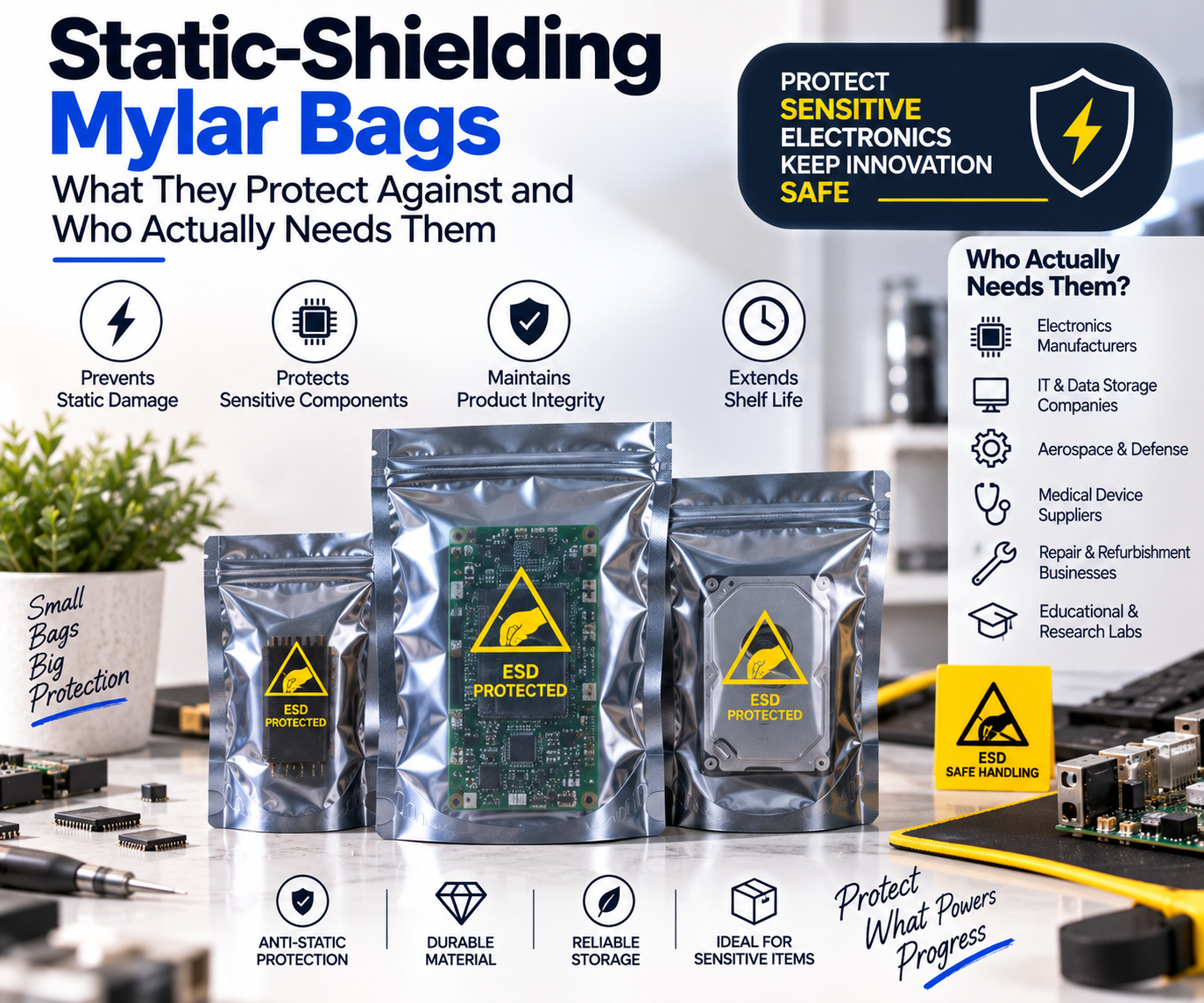
A tiny static spark, too small to even feel, can destroy a memory chip in an instant. Electronics move through dozens of hands before reaching a customer, and every touch carries a risk of static buildup. Suppliers like premium mylar bags offer a specialized version of the material built specifically for this problem. Here's how these bags actually work, what makes them different from standard packaging, and who genuinely needs them.
How Static Shielding Bags Actually Work
These bags rely on a principle called the Faraday cage effect. A conductive layer inside the bag redirects electrical charge around the outside surface instead of letting it pass through to the contents.
- Static touches the bag's outer surface first, not the electronics inside
- The conductive metal layer spreads that charge across the bag rather than absorbing it
- The charge travels around the packaging and dissipates, never reaching the sensitive component
- This works for both static generated from handling and external electrostatic discharge from another source
Engineers often compare this to how a car protects passengers during a lightning strike. The charge moves along the outer shell rather than through the interior.
What's Actually Inside the Bag
Static shielding bags use a layered construction, similar in concept to food-grade mylar but engineered for a completely different purpose.
- Outer layer — polyester with a static-dissipative coating that removes external electrical charges
- Middle layer — aluminum or another conductive metal, acting as the actual Faraday shield
- Inner layer — static-dissipative polyethylene that touches the electronics directly without generating its own charge
- Surface resistivity control — engineered into the coating to keep charge distribution uniform across the entire bag
This four-layer setup does two jobs at once. It blocks external ESD, and it prevents the bag itself from generating static against the product inside.
Static Shielding vs. Anti-Static vs. Conductive Bags
These three terms get used interchangeably, but they don't offer the same level of protection.
| Bag Type | Blocks Internal Static Buildup | Blocks External ESD | Common Use |
|---|---|---|---|
| Anti-static bag | Yes | No | Low-risk components, short-term storage |
| Conductive bag | Yes | Partial | Mid-sensitivity components |
| Static shielding bag | Yes | Yes | High-sensitivity electronics, shipping and storage |
An anti-static bag stops the bag from generating static on its own, but it does nothing to block an outside static event from reaching the contents. A static shielding bag handles both directions of protection.
What These Bags Actually Protect Against
Static discharge causes real, often invisible damage that shows up later rather than immediately.
- Instant destruction of sensitive components like memory chips and processors
- Latent damage that weakens a component without destroying it outright, causing failure weeks or months later
- Data loss on hard drives and memory cards exposed to a discharge during handling
- Circuit board failures traced back to handling during shipping rather than a manufacturing defect
That second point matters more than most people realize. A component can survive an ESD event and still fail prematurely, making the original cause difficult to trace after the fact.
Who Actually Needs These Bags
Not every product needs this level of protection, but several groups rely on it as a standard part of their process.
- Electronics manufacturers packaging PCBs, ICs, and assembled boards before they leave the factory
- Repair shops and technicians handling components pulled from one device before installing them in another
- Data recovery specialists transporting hard drives and memory cards that carry irreplaceable data
- Resellers of used electronics shipping components between buyers and sellers
- Hobbyists building custom electronics, particularly with static-sensitive parts like microcontrollers
A general consumer shipping a fully assembled laptop rarely needs this level of shielding, since the device's own casing already offers some protection. Bare components and open circuit boards are where the real risk lives.
When a Standard Mylar Bag Isn't Enough
Food-grade mylar and static shielding mylar share some construction similarities, but they solve entirely different problems.
- Food-grade mylar focuses on blocking oxygen, light, and moisture, with no engineered static-dissipative coating
- Static shielding bags focus on surface resistivity and charge redirection, not long-term food preservation
- Using a food-storage bag for sensitive electronics offers no meaningful ESD protection, despite looking similar
- Using a static shielding bag for food storage wastes its specialized coating on a job it wasn't designed for
Matching the bag type to its intended use matters here more than with most packaging decisions, since the wrong choice doesn't just underperform. It can lead to a damaged, expensive component.
Industry Standards That Define Real Shielding Performance
Not every bag labeled "anti-static" or "ESD-safe" meets the same technical bar. A handful of recognized standards exist specifically to separate genuine shielding performance from vague marketing language.
- ANSI/ESD S541 defines testing and performance requirements for ESD-protective packaging
- EIA 625 (now largely folded into newer standards) originally set handling guidelines for static-sensitive devices
- ANSI/ESD S20.20 covers a broader ESD control program rather than packaging alone, but often gets referenced alongside packaging specs
- Surface resistivity measurements, typically in the range of 10⁵ to 10¹¹ ohms per square, indicate whether a bag actually dissipates charge as claimed
Checking whether a supplier references these standards, rather than just using the word "anti-static" on a listing, gives a much clearer signal of whether a bag performs as advertised.
Sizing and Sealing Considerations
Getting the size and seal right matters as much as the material itself, since a poorly fitted or improperly closed bag undermines the shielding regardless of layer quality.
- Choose a bag sized close to the product's actual dimensions, since excess empty space adds no protective value
- Fully seal the opening, whether through a zip closure or a heat seal, rather than folding the top over loosely
- Avoid overstuffing a bag beyond its intended capacity, which can stress and crack the conductive layer at the seams
- Pad sharp-edged components separately before placing them in the bag, since a puncture from the inside defeats the shielding just as easily as one from the outside
A quick visual check for creases or thin spots before use catches most weak points before they become a problem during shipping.
Choosing the Right Protective Bag for the Job
Buyers comparing protective packaging options for different product types can look at mylar bags by functionality to see how shielding, barrier, and closure features vary across the lineup, rather than assuming one bag style covers every protective need.
Common Mistakes When Using Static Shielding Bags
A handful of avoidable errors reduce or eliminate the protection these bags are supposed to provide.
- Puncturing the bag, which breaks the continuous conductive layer and ruins the Faraday cage effect
- Leaving the bag unsealed, since an open bag offers no meaningful shielding at all
- Using metal staples or standard tape to close the bag, which can introduce their own static risk
- Reusing a bag that's been torn or heavily creased along the seams, weakening its shielding performance
- Assuming a clear anti-static bag offers the same protection as a proper static shielding bag
Getting Protection That Actually Matches the Risk
Static shielding bags exist because ESD damage is often invisible until a component fails long after the fact. The layered construction, from the dissipative outer coating to the conductive middle layer, does a specific job that ordinary packaging simply isn't built for. Matching the right protective bag to the actual sensitivity of the product inside, rather than assuming any plastic bag will do, is what separates electronics that arrive working from ones that fail without an obvious cause.

 Arabic
 French
 Spanish
 Portuguese
 Deutsch
 Turkish
 Dutch
Dutch
 Italiano
 Russian
 Romaian
 Portuguese (Brazil)
 Greek
Greek
 Bengali