


Custom Gear Racks for Industrial Automation
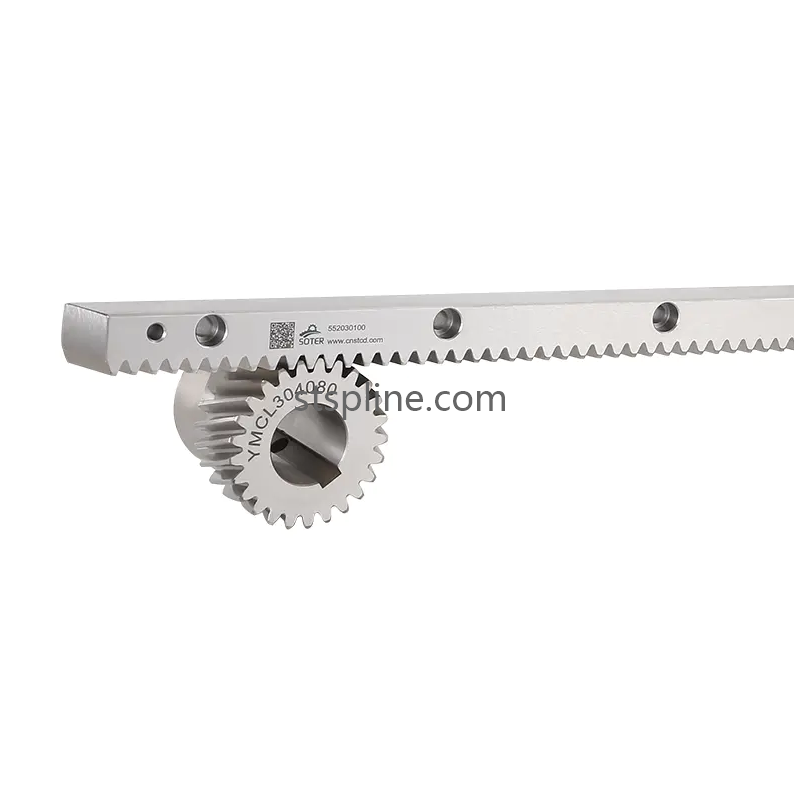
Modern machinery often requires transmission components that fit a specific structure rather than a standard configuration. A Custom Gear Rack can be manufactured around the mechanical requirements of the equipment, including tooth geometry, rack length, mounting arrangement, reference surfaces, and integration with the corresponding pinion. This approach is useful for CNC machines, industrial robots, laser equipment, automated production lines, material handling systems, and specialized machinery requiring controlled linear movement.
A rack and pinion mechanism converts rotational input into linear travel through direct tooth engagement. The pinion receives movement from a motor or gearbox and transfers the driving force to the rack. As the pinion rotates, it travels along the toothed rack while carrying the connected machine assembly. The rack therefore becomes an important part of the complete motion system, working together with the drive, guide, carriage, and supporting structure.
Material selection is an important starting point for customized rack manufacturing. Engineering steels and other suitable metal materials can be selected according to the intended application and production process. Material characteristics influence machinability, dimensional stability, surface properties, and resistance to repeated mechanical contact. The selected material should also be compatible with the pinion and the expected operating environment so that the two transmission components can work together effectively.
Tooth geometry requires precise control because it directly determines the contact relationship between rack and pinion. Tooth spacing, profile shape, depth, and surface condition should remain consistent along the working length. CNC-controlled machining and other precision production methods can help maintain these characteristics. For long racks, consistent geometry becomes increasingly important because small variations may affect transmission behavior over an extended travel distance.
Customization can involve more than changing rack length. Depending on the machine structure, manufacturers may produce specific mounting holes, positioning surfaces, sectional configurations, or other interface features. These details allow the rack to be integrated into equipment with an existing mechanical layout. Drawing-based production can be particularly useful when the rack must correspond closely with a customer's carriage, guide rail, motor arrangement, or installation frame.
Long-axis applications may require several rack sections installed in sequence. In this situation, each section must maintain appropriate dimensional relationships with the next section. The tooth alignment at connection points is especially important because the pinion needs to move continuously from one rack section to another. Proper reference surfaces and carefully controlled mounting features can make sectional installation more manageable while supporting consistent transmission across the complete travel path.
The guide system should be considered at the same time as the rack. A rack transmits the driving force, but guide rails, rollers, linear bearings, or other support components determine the movement path of the carriage. Correct alignment between the rack, pinion, and guide structure helps maintain appropriate tooth contact. If these components are positioned incorrectly, unwanted side forces may develop and influence movement or accelerate wear.
Manufacturing may include several stages from raw material preparation to final inspection. Rough machining establishes the basic shape, while more controlled processes form the teeth and functional reference surfaces. Depending on the required application, milling, gear shaping, grinding, heat treatment, or surface finishing may be incorporated. Each process must be coordinated because changes during one manufacturing stage can influence dimensions and geometry in subsequent stages.
Quality inspection is particularly important for customized components. Manufacturers can inspect rack length, tooth spacing, tooth profile, mounting dimensions, reference surfaces, and overall surface condition. When production is based on technical drawings or samples, inspection against the approved design helps verify that the finished rack matches the intended machine structure. Consistent inspection procedures can also help maintain quality when customized components are produced repeatedly.
Installation requires attention to both mechanical positioning and alignment. The rack should be securely mounted against the intended reference surface, while adjacent sections should be aligned carefully when the transmission path is extended. The pinion should engage the rack appropriately throughout its travel range. After assembly, the machine can be moved through the complete working path to identify any resistance, uneven engagement, or alignment issues.
Maintenance also contributes to stable transmission performance. Rack teeth and pinion surfaces should be inspected periodically for contamination, abnormal wear, or surface damage. Fasteners and mounting points can be checked to identify changes caused by vibration or repeated operation. Suitable lubrication should be applied according to the machine's operating conditions and component requirements, while exposed transmission surfaces should be kept reasonably clean.
For machinery manufacturers and automation integrators, selecting a Custom Gear Rack requires consideration of material, tooth geometry, machining technology, mounting structure, guide alignment, rack length, and operating environment. A manufacturer with precision machining and inspection capabilities can support application-specific rack configurations based on engineering drawings or samples. Further information about rack and linear transmission products is available at https://www.stspline.com/product/straight-teeth-rack/.

 English
 French
 Spanish
 Portuguese
 Deutsch
 Turkish
 Dutch
Dutch
 Italiano
 Russian
 Romaian
 Portuguese (Brazil)
 Greek
Greek
 Bengali