


Meat Substitutes Market to Reach USD 20.1 Billion by 2035, Driven by Rising Health Awareness and Adoption of Flexitarian and Plant-based Diets at 9.4% CAGR
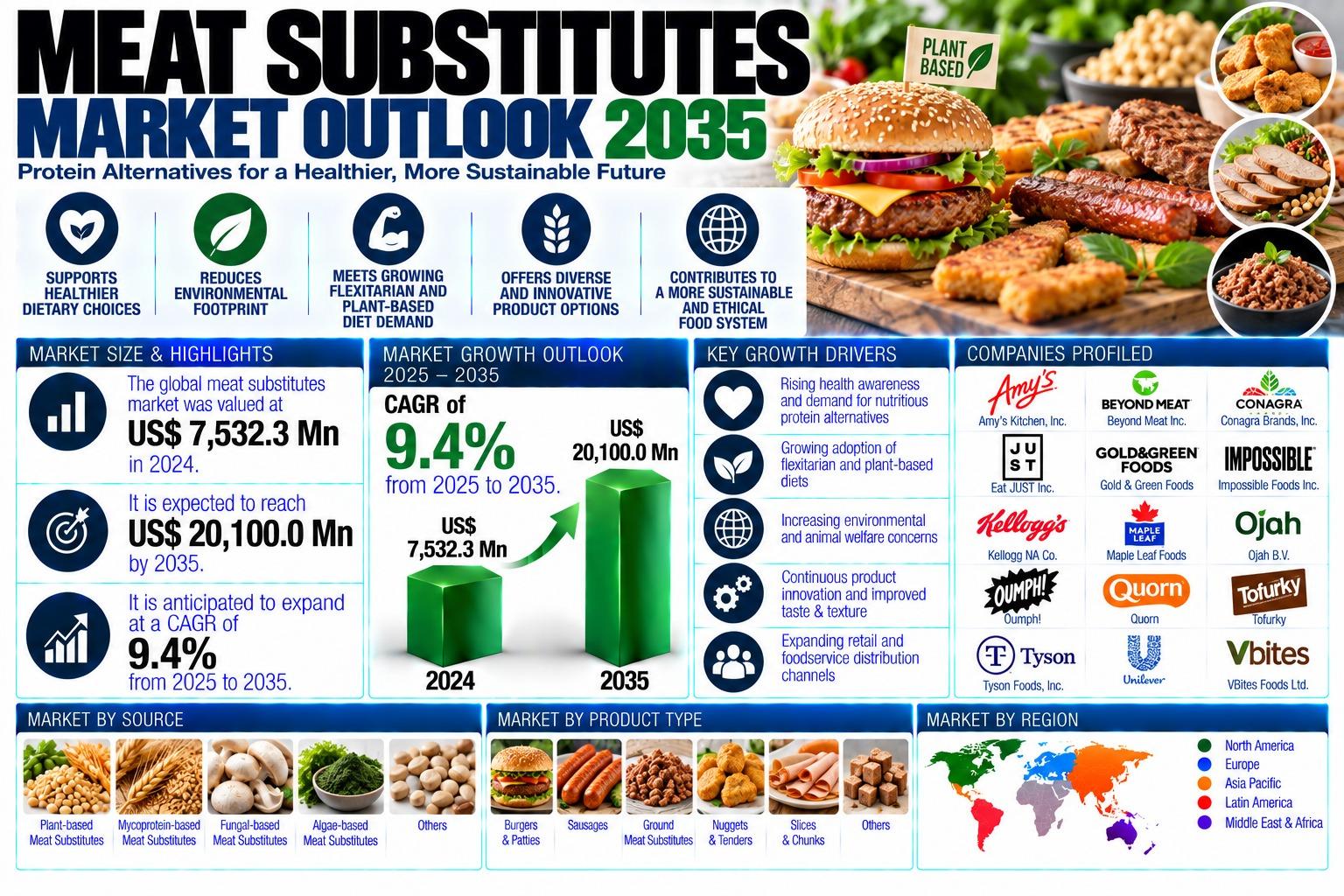
The global meat substitutes market was valued at US$ 7,532.3 Mn in 2024 and is projected to reach US$ 20,100.0 Mn by 2035, expanding at a CAGR of 9.4% from 2025 to 2035. Rising health awareness and growing adoption of flexitarian and plant-based diets are supporting the expansion of the market.
The meat substitutes industry is becoming an increasingly organized segment of the global food sector, supported by advances in product formulation, broader commercial availability, and growing consumer acceptance. Improvements in flavor, texture, appearance, and nutritional profiles are helping meat alternatives become increasingly integrated into everyday meals.
Product diversification is also contributing to market development. Meat substitutes are available in fresh, frozen, ready-to-cook, and ready-to-eat formats and are distributed through retail and foodservice channels. Plant-based meat substitutes represent the leading source category, supported by established production capabilities, technological development, and increasingly integrated supply chains.
Meat Substitutes Market Overview
The meat substitutes market encompasses the production, processing, distribution, and marketing of products designed to replicate the taste, texture, appearance, and, in some cases, nutritional characteristics of conventional meat without using animal-based ingredients.
Meat substitutes are generally produced using plant proteins such as pea, soy, wheat protein or seitan, rice, lentils, chickpeas, and beans. Mycoprotein and other protein-dense ingredients are also used. At the same time, precision fermentation and alternative protein technologies are emerging as additional approaches to producing meat alternatives.
The product landscape includes burgers, sausages, nuggets, meatballs, mince, strips, and deli-style slices. These products are available in both ready-to-cook and ready-to-eat formats and reach consumers through supermarkets, hypermarkets, specialty food stores, online channels, restaurants, cafés, and institutional catering.
Meat analogues can provide protein levels comparable to animal-based meat, although their fat, carbohydrate, fiber, vitamin, and mineral composition varies depending on ingredients and processing methods. The market includes both branded and private-label products and serves vegetarian, vegan, and flexitarian consumers across global markets.
Rising Health Awareness Driving Meat Substitutes Market Growth
Increasing awareness of nutrition and the relationship between dietary choices and long-term health is a major factor supporting demand for meat substitutes. Consumers are increasingly evaluating protein sources based on characteristics such as fat content, cholesterol, and overall nutritional composition.
According to the supplied source, the World Health Organization has identified non-communicable diseases such as heart disease, diabetes, cancer, and respiratory diseases as major health challenges. The source also notes that diets high in salt, sugars, and saturated fats, combined with inadequate consumption of fruits and vegetables, are important modifiable risk factors.
The WHO dietary guidance cited in the source recommends consuming at least 400 grams, or five portions, of fruits and vegetables per day, while limiting high-risk dietary components. Such guidance has contributed to greater public awareness of the relationship between everyday food choices and long-term health.
Governments and public health organizations are also placing greater emphasis on nutrition education, food labeling, and preventive healthcare. This has increased consumer attention toward the nutritional characteristics of different protein sources.
As health-conscious consumers seek balanced diets and greater control over their consumption of red and processed meat, meat substitutes are gaining acceptance as an alternative protein option. Increasing health literacy and awareness of preventive nutrition are therefore contributing to changes in food consumption patterns and supporting market demand.
Growing Adoption of Flexitarian and Plant-based Diets Propels Market Expansion
The growing adoption of flexitarian and plant-based diets is another major factor supporting the meat substitutes market. Flexitarian diets allow limited consumption of meat while emphasizing plant-based foods, offering consumers an approach that combines dietary flexibility with increased consumption of plant-derived foods.
The supplied source cites the UK Government's National Diet and Nutrition Survey, which indicates that approximately 25% of the population has been making efforts to reduce or eliminate meat, dairy, and other animal products. This reflects increasing interest in plant-based eating even among consumers who do not completely eliminate animal products.
Dietary guidelines in the UK and other markets are increasingly emphasizing diverse protein sources and greater consumption of plant-based foods. Legumes, pulses, whole grains, and vegetables are being incorporated into balanced-diet recommendations, contributing to greater familiarity and acceptance of plant-based protein sources.
Lifestyle changes are also supporting demand. Busy work schedules and exposure to global food trends are contributing to the mainstream adoption of plant-based products that replicate familiar meat formats.
Flexitarian eating can provide consumers with a gradual approach to reducing meat consumption while maintaining familiar food choices. The availability of meat substitutes in familiar formats such as burgers, sausages, nuggets, and mince is therefore helping bridge the gap between conventional meat consumption and plant-based dietary preferences.
Plant-based Meat Substitutes Dominate the Market
Plant-based meat substitutes accounted for 70.5% of the global meat substitutes market in 2024, making them the leading source category.
The strong position of plant-based meat substitutes is supported by their early market development, technological advancement, production capacity, and comparatively established commercial ecosystem. Plant-based alternatives have achieved broader consumer and regulatory acceptance compared with some emerging alternative protein categories.
The development of protein texturization technologies, flavor systems, and fat analogues has improved the sensory characteristics of plant-based meat alternatives. These advances have helped products more closely replicate the taste, texture, and appearance of conventional meat.
Plant-based meat substitutes are also widely available through retail and foodservice channels. Their presence in supermarkets, hypermarkets, specialty stores, restaurants, and quick-service outlets has increased product visibility and accessibility.
A broad product range, competitive pricing, and continued investment by established food companies and start-ups are further supporting the category. These factors collectively reinforce the leading position of plant-based meat substitutes within the global alternative protein market.
Europe Leads the Meat Substitutes Market
Europe dominated the global meat substitutes market in 2024, accounting for 37.1% of market revenue. The region's leading position is supported by strong consumer acceptance of plant-based foods, established retail infrastructure, product innovation, and the widespread adoption of vegetarian, vegan, and flexitarian diets.
Countries such as the UK, the Netherlands, and Germany have developed strong plant-based food cultures, with alternative proteins increasingly integrated into mainstream consumption patterns.
Europe also benefits from an established regulatory framework for food products. Harmonized food safety standards, labeling requirements, and sustainability-focused regulations provide a structured environment for the commercialization of plant-based products.
The region's mature retail infrastructure is another important factor. Supermarkets and hypermarkets provide substantial shelf space for meat substitutes, offering consumers access to both branded and private-label products.
Foodservice operators, including quick-service restaurants and casual dining chains, are also increasing the visibility of plant-based menu options. Greater availability across restaurants and retail outlets is supporting consumer familiarity and contributing to the broader acceptance of meat substitutes.
Competitive Landscape
The global meat substitutes market includes established food manufacturers and specialized alternative-protein companies. Prominent players include Amy's Kitchen, Inc., Beyond Meat Inc., Conagra Brands, Inc., Eat JUST Inc., Gold & Green Foods, Impossible Foods Inc., Kellogg NA Co., Maple Leaf Foods, Ojah B.V., Oumph!, Quorn, Tofurky, Tyson Foods, Inc., Unilever, and VBites Foods Ltd.
Companies operating in the market are focusing on product development, formulation improvements, portfolio expansion, and greater penetration across retail and foodservice channels.
Innovation in taste, texture, nutritional characteristics, and product formats remains an important competitive focus. Manufacturers are also expanding beyond traditional burger products into poultry-style products, snacks, ready-to-cook products, and other familiar food formats.
Key Developments in the Meat Substitutes Market
In November 2025, Maple Leaf Foods launched its Mighty Protein Meat Sticks, a new on-the-go protein snack line designed to address consumer demand for convenient, high-protein, plant-forward food options. The launch expanded the company's portfolio within the alternative protein category.
In May 2025, Beyond Meat introduced Beyond Chicken Pieces nationwide, launching the product across more than 1,900 Kroger stores in the United States. The product expanded the company's plant-based poultry-style portfolio and provided consumers with an alternative to traditional burger products.
These developments reflect the industry's broader shift toward product diversification, convenient formats, and expansion into new eating occasions.
Meat Substitutes Market Segmentation
The global meat substitutes market can be segmented based on source, product form, end-use, and distribution channel. By source, the market comprises plant-based meat substitutes, cell-based or cultured/lab-grown meat, fungi-based meat substitutes, and other novel sources.
The plant-based category includes soy-based products, pea protein-based products, wheat protein or seitan, and other plant proteins. Cell-based meat includes poultry, beef, pork, seafood, and other products such as duck.
Based on product form, the market is segmented into ready-to-cook, prepared and processed, frozen, and dried products.
By end-use, the market includes household/retail, commercial, foodservice facilities, travel facilities, and other facilities. Foodservice facilities include quick-service restaurants, full-service restaurants, hotels and cafés, and other foodservice establishments.
Based on distribution channel, the market is divided into business-to-business (B2B) and business-to-consumer (B2C) channels. B2C distribution includes online channels, supermarkets and hypermarkets, convenience stores, specialty stores, and other retail stores.
Future Outlook for the Meat Substitutes Market
The global meat substitutes market is projected to increase from US$ 7,532.3 Mn in 2024 to US$ 20,100.0 Mn by 2035, expanding at a 9.4% CAGR from 2025 to 2035. Rising health awareness, growing adoption of flexitarian diets, and increasing acceptance of plant-based foods are expected to remain key factors supporting market development.
Product formulation improvements are likely to remain central to industry growth. Advances in protein texturization, flavor systems, fat analogues, and alternative protein technologies are improving the sensory characteristics of meat substitutes and broadening consumer acceptance.
The expansion of retail and foodservice distribution is also expected to support market penetration. Wider availability through supermarkets, online channels, restaurants, cafés, and quick-service establishments is making meat alternatives increasingly accessible to consumers.
Plant-based meat substitutes are expected to maintain their significant position due to established production infrastructure, broad consumer acceptance, and continued product innovation. Meanwhile, cell-based, fungi-based, and other novel protein technologies represent additional areas of development within the broader alternative protein landscape.
Europe is expected to remain an important market due to its established plant-based food culture, retail infrastructure, regulatory framework, and strong consumer acceptance. As food manufacturers continue to diversify product portfolios and address changing dietary preferences, meat substitutes are expected to become an increasingly established component of the global food industry.

 English
 Arabic
 French
 Spanish
 Portuguese
 Deutsch
 Turkish
 Dutch
Dutch
 Italiano
 Russian
 Romaian
 Greek
Greek
 Bengali