


Manufacturing Regulatory Compliance Audit: A Complete Guide to GMP, ISO and BIS Readiness
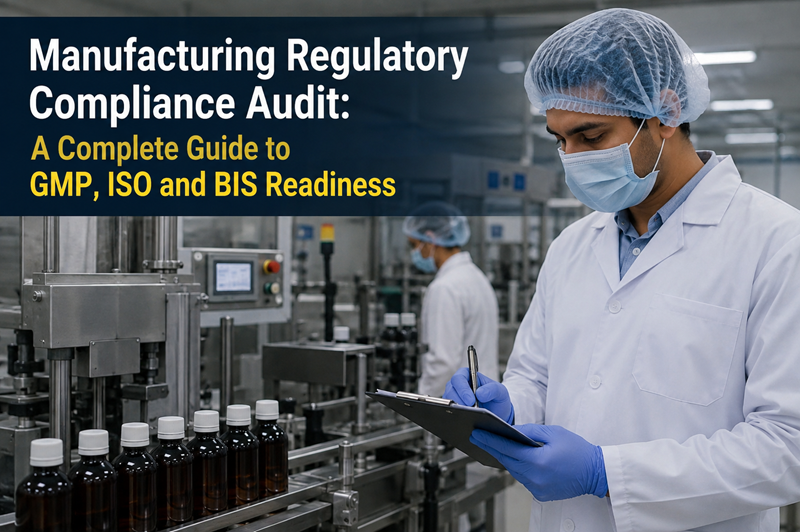
A manufacturing plant can hold valid certificates and still have compliance gaps. Procedures may no longer match shop-floor practices, calibration may be overdue, product requirements may have changed, or a new production line may have introduced risks that were never included in the original assessment. A manufacturing regulatory compliance audit addresses this gap by comparing applicable requirements with what actually happens across the facility.
For manufacturers working with GMP, ISO and BIS requirements, the objective is not simply to collect documents. It is to establish whether the plant can demonstrate consistent compliance through its facilities, processes, people, equipment, records and controls.
What Is a Manufacturing Regulatory Compliance Audit?
A structured assessment of a facility against the regulatory, quality, product and management-system requirements applicable to its operations.
Depending on the industry, the audit may examine:
-
Manufacturing processes and production controls
-
Facility layout and infrastructure
-
Equipment, calibration and maintenance
-
Utilities and environmental conditions
-
Quality-management systems
-
Documentation and records
-
Supplier and material controls
-
Product testing and traceability
-
Employee competency and training
-
Licences, approvals and statutory requirements
-
GMP, ISO and BIS obligations
It is important to distinguish a compliance audit from certification. ISO 19011:2026 provides guidance for auditing management systems, including audit principles, audit-programme management and audit execution, but it is itself not a certification standard.
The practical question is therefore: Can the manufacturer demonstrate that its requirements are not only documented, but consistently implemented?
Why Compliance Audits Matter More During Plant Changes
Compliance risk often increases when a plant changes.
Capacity expansion, machinery replacement, new suppliers, product additions, layout modifications and process changes can all create gaps between an existing compliance system and current operations.
A useful audit should therefore be triggered by events such as:
-
New manufacturing-line installation
-
Brownfield expansion
-
Introduction of a new product
-
Major equipment replacement
-
Change in raw-material suppliers
-
Regulatory or standard revisions
-
Repeated audit findings
-
New BIS Quality Control Order (QCO) applicability
-
Upcoming certification or regulatory inspection
This is particularly relevant in 2026. ISO 9001:2026 was published on 16 September 2026, replacing ISO 9001:2015. ISO says the new edition strengthens clarity around leadership, quality culture, accountability, risks and opportunities, while improving alignment with other management-system standards.
Similarly, ISO 14001:2026 was published in April 2026, with greater emphasis on environmental performance, leadership, governance, climate-related considerations, biodiversity and resource efficiency.
These changes make periodic compliance reassessment more useful than treating an old audit report as a permanent statement of readiness.
What Should a Manufacturing Compliance Audit Cover?
A strong audit should move beyond a document review and examine the relationship between requirements, implementation and evidence.
1. Regulatory and Legal Requirements
Start by identifying which requirements actually apply to the facility.
Review:
-
Manufacturing licences and registrations
-
Applicable statutory approvals
-
Product-specific requirements
-
Regulatory correspondence
-
Environmental and safety obligations
-
Applicable Indian Standards and QCOs
-
Customer or contractual requirements
The audit should distinguish between requirements that are legally mandatory and standards adopted voluntarily or contractually.
2. Facility and Infrastructure
The physical plant can reveal gaps that documents cannot.
Inspect:
-
Production areas
-
Warehouses
-
Material and personnel movement
-
Segregation arrangements
-
Ventilation and HVAC
-
Utilities
-
Emergency systems
-
Storage conditions
-
Housekeeping and maintenance
For pharmaceutical facilities, the assessment may need deeper GMP controls around contamination prevention, environmental conditions, utilities and facility design.
3. Equipment and Utilities
Check whether equipment is appropriately identified, maintained and controlled.
Evidence can include:
-
Calibration records
-
Preventive-maintenance schedules
-
Breakdown history
-
Qualification records where applicable
-
Equipment status identification
-
Utility monitoring records
-
Inspection reports
A certificate or maintenance schedule has limited value if the physical equipment condition contradicts the documented system.
4. Production and Quality Controls
Auditors should follow actual production flows rather than examining departments in isolation.
Assess:
-
Process parameters
-
Work instructions
-
Inspection points
-
Batch or production records
-
Rework and rejection controls
-
Traceability
-
Deviations
-
Nonconforming products
-
Change control
-
Corrective and preventive actions
One useful test is to select a completed production record and trace it backward through materials, equipment, operators, inspections and approvals.
GMP Compliance Audit: What Pharmaceutical Plants Should Check
For pharmaceutical manufacturers, GMP assessment requires particular attention to the relationship between facility design, manufacturing controls and documented evidence.
Key areas include:
-
Premises and personnel/material flow
-
Equipment qualification and maintenance
-
HVAC and environmental controls
-
Water and other critical utilities
-
Cleaning and sanitation
-
Raw-material controls
-
Production documentation
-
Laboratory controls
-
Validation and qualification
-
Deviations and CAPA
-
Change control
-
Complaints and recalls
-
Supplier qualification
-
Data integrity
India's revised Schedule M requirements make this especially relevant. Government documentation concerning revised Schedule M compliance has required manufacturers to undertake gap analysis covering areas such as plant, equipment, laboratory equipment, HVAC, utilities, technical staff and documentation.
This means a GMP audit should not stop at checking whether an SOP exists. It should determine whether the facility and operating practices can consistently support the procedure.
ISO Compliance Audit: What Manufacturers Need to Reassess
ISO 9001:2026
An ISO 9001 audit should examine how the quality-management system operates across actual business processes.
Review:
-
Quality objectives
-
Leadership and accountability
-
Customer requirements
-
Process controls
-
Risks and opportunities
-
Supplier management
-
Performance measurement
-
Nonconformity and corrective action
-
Internal audits
-
Management review
-
Continual improvement
The 2026 edition makes this a timely reassessment area for manufacturers. Existing ISO 9001:2015-certified organizations have until 30 September 2029 to complete transition to ISO 9001:2026 under the published transition guidance.
ISO 14001:2026
For environmental management, examine:
-
Environmental aspects and impacts
-
Legal requirements
-
Waste management
-
Energy and resource use
-
Water consumption
-
Emissions
-
Environmental objectives
-
Operational controls
-
Emergency preparedness
-
Monitoring and measurement
The 2026 edition strengthens the connection between environmental management and measurable performance.
ISO 45001
Where occupational health and safety is within scope, review:
-
Hazard identification
-
Risk assessment
-
Machine safety
-
PPE
-
Emergency preparedness
-
Contractor controls
-
Incident investigation
-
Worker participation
-
Training
-
Corrective action
BIS Compliance Audit and QCO Readiness
BIS requires a different audit perspective because product conformity is central.
BIS certification is generally voluntary, but the Central Government can make compliance compulsory for specified products through QCOs. For products covered by compulsory requirements, manufacturers must meet the applicable conformity-assessment requirements.
A BIS readiness audit should therefore establish:
-
Is the product covered by a QCO?
-
Which Indian Standard applies?
-
Which conformity-assessment scheme is relevant?
-
Does the manufacturing process consistently produce conforming products?
-
Are testing and quality-control arrangements adequate?
-
Are records sufficient to demonstrate conformity?
This area requires continuous monitoring. BIS currently lists QCOs with implementation dates extending through 2026 and 2027, including requirements affecting electrical appliances, aluminium products, digital television receivers and other product categories.
Therefore, BIS readiness should be treated as a product-and-regulation tracking exercise, not simply a one-time certification task.
A Practical Manufacturing Compliance Audit Process
A useful audit can follow seven stages:
1. Define the Scope
Identify the plant, products, processes, locations and applicable requirements.
2. Build a Compliance Matrix
Map each requirement to evidence, responsible personnel, current status and risk.
3. Review Documents
Examine licences, SOPs, certificates, records, test reports, calibration, training and previous audit findings.
4. Inspect the Facility
Compare documented procedures with actual physical and operating conditions.
5. Interview and Trace
Speak with production, quality, engineering, maintenance, procurement and other relevant personnel. Trace selected records from raw material to finished product.
6. Classify Findings
Prioritize findings according to potential impact, likelihood and regulatory significance.
7. Verify Corrective Action
A finding is not truly closed merely because an action has been recorded. Verify implementation and, where appropriate, whether the corrective action has been effective.
The Compliance Gap Most Audits Miss
One of the most valuable checks is the document-to-floor comparison.
Consider a maintenance procedure requiring scheduled inspection of critical equipment. The document may be approved, training may be recorded and previous audit reports may show compliance. But an inspection of the actual equipment may reveal overdue maintenance, incomplete identification or missing records.
This creates three separate questions:
1. What does the requirement say?
2. What does the procedure say?
3. What is actually happening?
A mature compliance audit reconciles all three.
Consult With An Expert: https://www.imarcengineering.com/contact?service=regulatory-compliance-services
How to Prioritize Compliance Findings
Not every finding requires the same response.
A practical risk-based model can classify findings as:
-
Critical: Potentially significant impact on safety, product quality or regulatory conformity
-
Major: Material weakness that could affect controlled operations or audit readiness
-
Minor: Limited deficiency that does not indicate a significant system failure
Corrective action should then identify the root cause, rather than simply correcting the visible symptom.
A useful CAPA record should establish:
Finding → Root cause → Corrective action → Responsible owner → Deadline → Evidence → Effectiveness verification
This turns an audit report into an implementation roadmap.
Manufacturing Compliance Audit Checklist
Before an external inspection or certification assessment, manufacturers should verify:
-
Applicable regulations have been identified
-
Licences and approvals are current
-
SOPs reflect actual practices
-
Critical equipment is maintained and calibrated
-
Required validation/qualification is current
-
Employees have appropriate training
-
Supplier controls are documented
-
Product specifications are current
-
Testing records are traceable
-
Deviations and CAPA are controlled
-
Change controls are documented
-
Previous findings have been effectively closed
-
BIS/QCO applicability has been reassessed
-
ISO transition requirements have been reviewed where applicable
-
GMP facility and process controls remain effective
How IMARC Engineering Can Help
IMARC Engineering can support manufacturers with independent regulatory compliance audits covering facility, equipment, utilities, production controls, documentation and implementation gaps. The assessment can be structured around applicable GMP, ISO and BIS requirements, followed by a prioritized gap report and corrective-action roadmap. For new plants and brownfield expansions, the review can also connect compliance findings with engineering, layout, utility, equipment and commissioning requirements, helping manufacturers address practical implementation issues rather than treating compliance as a documentation exercise.
Conclusion
A manufacturing regulatory compliance audit is most useful when it shows how requirements translate into real operating conditions. GMP, ISO and BIS address different aspects of manufacturing conformity, but all depend on reliable evidence and consistent implementation. With regulatory and standards changes continuing in 2026, manufacturers should periodically reassess their compliance position, prioritize material gaps and verify corrective actions. A well-structured audit therefore becomes more than an inspection exercise: it becomes a practical roadmap for maintaining a controlled, documented and inspection-ready manufacturing operation.
Contact Us:
IMARC Engineering
Phone: +91-120-433-0800
Email: sales@imarcengineering.com
India: C-130, Sector 2, Noida, Uttar Pradesh 201301
LinkedIn: https://www.linkedin.com/showcase/imarc-engineering/

 English
 Arabic
 Spanish
 Portuguese
 Deutsch
 Turkish
 Dutch
Dutch
 Italiano
 Russian
 Romaian
 Portuguese (Brazil)
 Greek
Greek
 Bengali