


Approvals Required for Bio CNG Plant in India: Pollution NOC, Factory License and DPR
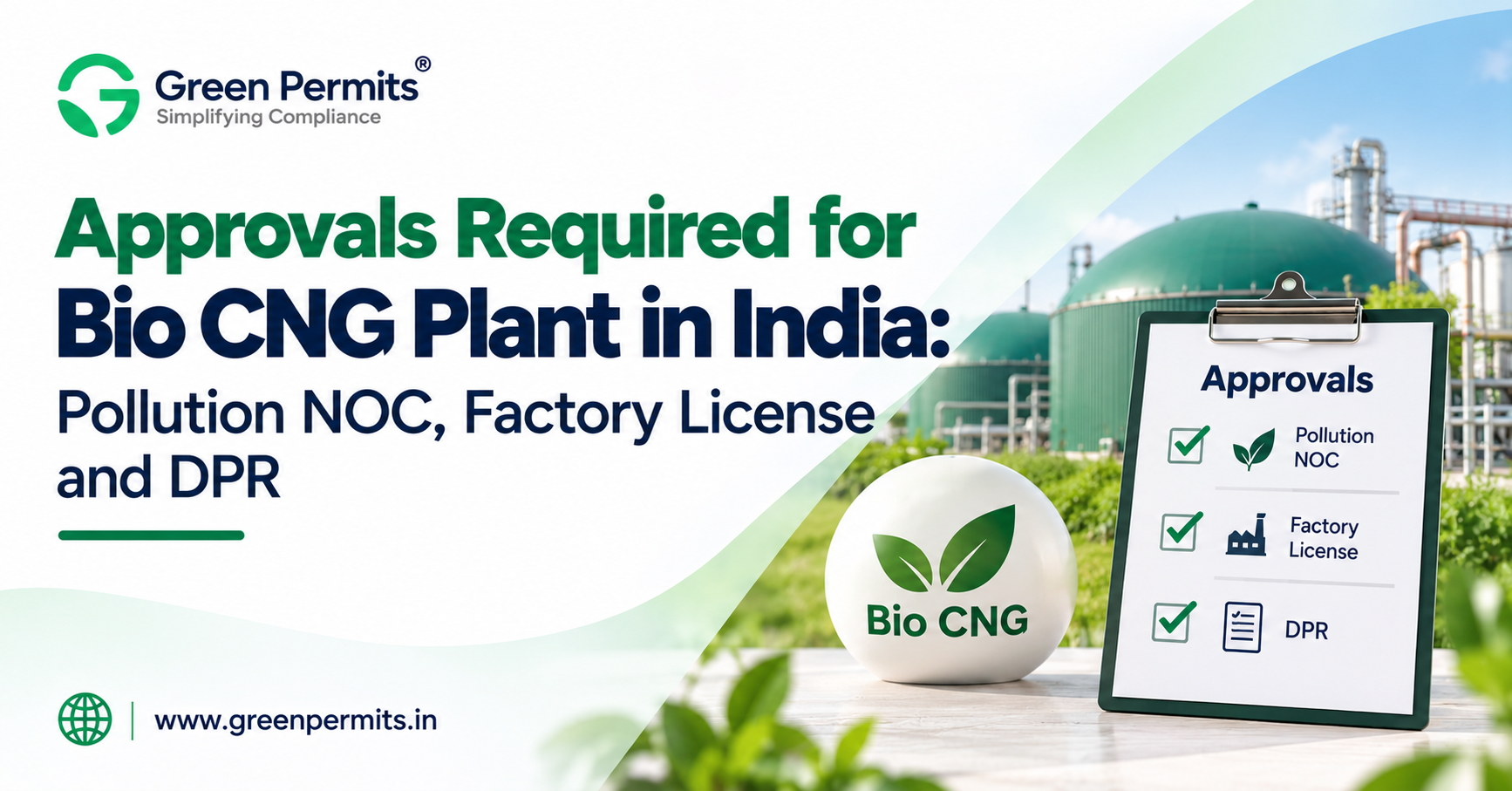
India's Bio CNG and Compressed Bio Gas sector is creating opportunities for entrepreneurs, farmers, waste management companies, sugar mills, dairy businesses and clean-energy investors.
A commercial Bio CNG plant can convert cattle dung, press mud, agricultural residue, food waste, poultry waste and other biodegradable feedstock into purified compressed biogas.
However, setting up the plant involves much more than purchasing digesters and gas purification equipment.
Before construction and commercial operation, the project may require several environmental, industrial, safety and local approvals. The exact approval requirement depends on the plant's location, capacity, feedstock, storage arrangement and technology.
For anyone planning a Bio CNG project, understanding the approval sequence at the beginning can prevent costly delays later.
This guide explains the major approvals required for a Bio CNG plant in India, including Pollution NOC, Consent to Establish, Consent to Operate, Factory License, GOBARdhan registration, DPR and other important permissions.
Why Approvals Are Important for a Bio CNG Plant
A Bio CNG plant handles organic waste, biological processing, wastewater, gas generation, compression and sometimes high-pressure gas storage.
Because several environmental and safety aspects are involved, different regulatory authorities can become relevant at different stages of the project.
For example, an entrepreneur may purchase land and order machinery before obtaining environmental approval. If the selected site later faces land-use or pollution-control issues, the entire project can be delayed.
Similarly, a plant may complete construction but still be unable to start commercial operations if Consent to Operate or another applicable authorization is pending.
A better approach is to prepare an approval matrix before project implementation begins.
Major Approvals Required for Bio CNG Plant in India
There is no single licence called a "Bio CNG plant licence" that covers the complete project.
A commercial plant may require multiple registrations and approvals.
Depending on the project, these can include:
- Consent to Establish
- Consent to Operate
- GOBARdhan registration
- Factory licence, where applicable
- Fire NOC
- Land-use or building approvals
- PESO-related approvals, where applicable
- Electrical approvals
- Groundwater permission, where applicable
- Waste-related authorizations
- Fertilizer-related compliance for manure products
- Local authority permissions
The final list should always be prepared according to the specific project.
1. Pollution NOC or Consent to Establish
One of the first important approvals for an industrial Bio CNG project is generally the Consent to Establish, or CTE, from the concerned State Pollution Control Board or Pollution Control Committee.
CTE is commonly referred to as a Pollution NOC.
Pollution-control consent frameworks operate under environmental laws including the Water Act and Air Act, and businesses covered by these requirements generally need consent before establishing the unit.
The application normally provides details about the proposed project, such as:
- Plant capacity
- Feedstock
- Manufacturing or processing flow
- Water requirement
- Wastewater generation
- Air emission sources
- Waste generation
- Pollution-control systems
- Land and project layout
The exact documents and category classification can differ from one state to another.
Therefore, CTE requirements should be checked with the concerned SPCB before major civil construction begins.
2. Consent to Operate for Bio CNG Plant
Obtaining CTE does not automatically allow the plant to begin regular commercial operation.
After construction, machinery installation and pollution-control arrangements are completed, the project generally needs to apply for Consent to Operate, or CTO, where applicable.
During the CTO process, authorities may examine whether the facility has been established in accordance with the approved proposal and applicable consent conditions.
Documents can include photographs, machinery information, pollution-control details, monitoring reports and compliance records.
Businesses should therefore design the plant according to the CTE conditions from the beginning rather than trying to correct compliance gaps after installation.
3. GOBARdhan Registration
Bio CNG developers should also understand the GOBARdhan Unified Registration Portal.
The Government's unified portal allows individuals and organizations operating or planning Biogas, CBG and Bio CNG plants in India to register their projects and obtain a registration number.
The registration framework captures information including plant location, feedstock capacity, gas production capacity and project status.
For developers planning a commercial Bio CNG project, GOBARdhan registration should therefore form part of the overall project compliance checklist.
4. Factory License
Depending on the nature of operations, worker strength, power use and applicable state requirements, a Bio CNG facility may also need registration or licensing under the applicable factory and occupational-safety framework.
Factory-related approvals generally deal with matters such as:
- Factory layout
- Worker safety
- Machinery safety
- Ventilation
- Emergency arrangements
- Welfare facilities
- Hazardous operations, where relevant
The exact procedure can differ between states because factory administration is generally handled through the respective state labour or factory authorities.
Project developers should therefore verify factory-plan approval and licensing requirements before finalizing construction.
5. Fire NOC and Fire Safety Approval
A Bio CNG plant generates and handles combustible gas.
Fire prevention and emergency planning are therefore essential parts of plant design.
Depending on the state, local regulations and plant configuration, approval or NOC from the concerned fire authority may be required.
Typical fire-safety arrangements can include:
- Fire extinguishers
- Hydrant systems
- Gas leak detection
- Emergency shutdown systems
- Fire-water arrangements
- Safe equipment spacing
- Emergency exits
- Warning signage
Fire-safety requirements should be incorporated during plant layout design rather than added after construction.
6. PESO Approval - Where Applicable
Some Bio CNG projects involve compression, storage and transportation of gas at high pressure.
Depending on the specific equipment, storage system, cascade arrangement and applicable petroleum and gas safety regulations, permissions from the Petroleum and Explosives Safety Organisation (PESO) may become relevant.
This area should be checked carefully during detailed engineering.
The requirement may depend on factors such as gas storage arrangement, filling system, cylinder or cascade configuration and transportation model.
Project developers should not assume that the same PESO approval structure applies to every Bio CNG facility.
7. Land-Use and Building Approvals
Before purchasing or leasing land, the project developer should check whether the proposed industrial activity is permitted at the location.
Depending on the site, approvals may involve:
- Land conversion
- Change of land use
- Industrial development authority
- Municipal authority
- Gram Panchayat
- Building plan approval
- Local development authority
Agricultural land may require conversion before industrial development.
This is one reason why land should not be purchased solely because it is close to feedstock.
Regulatory suitability is equally important.
8. Groundwater Permission
Bio CNG plants may require water for slurry preparation, cleaning, cooling or other process requirements.
If the project intends to extract groundwater, permission from the relevant groundwater authority may be required depending on location and applicable rules.
A good DPR should therefore clearly estimate:
- Daily freshwater demand
- Process water requirement
- Recycled water
- Wastewater generation
- Water source
Reducing freshwater consumption through recycling can also improve project sustainability.
9. Waste Management Approvals
The exact waste-related approvals depend heavily on the selected feedstock.
A plant processing agricultural residue may have different regulatory requirements from a facility handling municipal organic waste or industrial organic waste.
Developers should understand:
- Feedstock source
- Waste classification
- Transportation requirements
- Storage conditions
- Digestate handling
- Wastewater management
- Reject disposal
If hazardous waste is generated from any supporting operation, separate authorization requirements may also become relevant.
10. Digestate, FOM and LFOM Compliance
Bio CNG production does not end with gas.
Anaerobic digestion also produces digestate, which can be processed into solid and liquid manure products.
Commercial utilization of Fermented Organic Manure (FOM) or Liquid Fermented Organic Manure (LFOM) should be planned from the project design stage.
The project should consider product quality, processing, storage, packaging and applicable fertilizer-related requirements.
Poor digestate planning can create a major operational problem even if gas production is successful.
Detailed Project Report for Bio CNG Plant
A Detailed Project Report, or DPR, is one of the most important documents in a commercial Bio CNG project.
A DPR is not simply a document prepared for obtaining a loan.
It should provide a technical and financial blueprint for the entire project.
For the MNRE Waste-to-Energy programme framework, DPR was specifically listed as a Stage-1 project document for Biomethanation/BioCNG projects.
A detailed Bio CNG DPR should normally examine:
- Project capacity
- Feedstock availability
- Feedstock characteristics
- Gas yield
- Material balance
- Technology selection
- Plant and machinery
- Land requirement
- Utility requirement
- Project layout
- Capital cost
- Operating cost
- Manpower
- Gas revenue
- Digestate revenue
- Financial projections
- IRR
- Payback
- Break-even
- Implementation schedule
- Regulatory approvals
- Project risks
A strong DPR can help investors understand whether the proposed project is technically and commercially feasible before committing large capital expenditure.
Feedstock Study Before DPR Preparation
One of the biggest mistakes in Bio CNG projects is deciding plant capacity first and looking for feedstock later.
The process should ideally be reversed.
First understand how much commercially recoverable feedstock is available.
Then decide plant capacity.
For example, a project developer should evaluate feedstock availability throughout the year rather than relying only on peak seasonal availability.
The study should cover procurement price, collection radius, transportation cost, moisture, methane potential and competing demand.
Without reliable feedstock, even the best machinery cannot keep a plant running at its designed capacity.
Typical Approval Sequence for a Bio CNG Project
Although the exact sequence varies between states and projects, a practical development approach can look like this:
Step 1: Conduct feedstock and feasibility study.
Step 2: Identify suitable land and check land-use compatibility.
Step 3: Prepare DPR and preliminary plant layout.
Step 4: Complete project and GOBARdhan registration requirements.
Step 5: Apply for Consent to Establish and applicable local approvals.
Step 6: Finalize detailed engineering and machinery.
Step 7: Obtain factory, fire, PESO or other applicable approvals during the relevant project stage.
Step 8: Complete construction and equipment installation.
Step 9: Conduct trial runs and compliance checks.
Step 10: Apply for Consent to Operate and other pre-operation permissions.
Step 11: Begin commercial operations after applicable approvals are in place.
Following a structured sequence can prevent one approval from blocking another at a late stage.
Documents Commonly Required
The exact documentation differs by authority, but project developers should generally keep a comprehensive project file containing:
- Company incorporation documents
- PAN and GST information
- Land ownership or lease documents
- Site layout
- Project report or DPR
- Process flow diagram
- Machinery details
- Feedstock details
- Water balance
- Material balance
- Pollution-control proposal
- Waste management plan
- Fire-safety plan
- Electricity requirement
- Employee and manpower details
- Project investment details
Preparing these documents accurately at the beginning can reduce repeated queries from authorities.
Common Challenges in Bio CNG Approvals
One common problem is purchasing land before checking whether the location is suitable for industrial use.
Another is applying for Pollution NOC with an incomplete process flow or unrealistic water balance.
Changes in plant capacity after receiving CTE can also create additional compliance requirements.
Developers sometimes finalize machinery without considering fire-safety clearances, gas storage requirements or space for digestate management.
Another common mistake is assuming that obtaining one approval automatically covers all other departments.
Bio CNG projects involve multiple regulatory areas, so approvals should be planned together.
Current MNRE Scheme Position Should Be Checked Carefully
Developers should be careful when including government financial assistance in project economics.
MNRE's National Bioenergy Programme Phase-I covered FY 2021-22 through FY 2025-26. The BioURJA portal currently states that the last date for new Waste-to-Energy applications under that phase was 31 December 2025 and that new submissions are stopped until further notice.
Therefore, as of September 2026, developers should not automatically assume that an earlier CFA or subsidy structure is currently open for fresh applications.
The latest MNRE notification and portal status should be verified before including subsidy income in a DPR.
Benefits of Proper Approval Planning
A structured approval strategy can save both time and capital.
It can help developers avoid construction changes, regulatory notices and delays in commissioning.
Proper planning also improves confidence for banks, investors and commercial partners because the project has a clearer compliance pathway.
For projects involving several crore rupees of investment, regulatory due diligence should therefore begin before major money is committed.
How a Bio CNG Consultant Can Help
Setting up a Bio CNG project requires coordination between engineering, finance, environmental compliance, plant safety and government approvals.
An experienced consultant can help developers understand which permissions apply to their specific project instead of using a generic approval checklist.
Consulting support may include:
- Bio CNG feasibility study
- Feedstock assessment
- Detailed Project Report
- Site selection assessment
- CTE application
- CTO application
- Pollution-control compliance
- GOBARdhan registration support
- Factory licence coordination
- Fire and safety compliance planning
- Regulatory approval mapping
- Project implementation roadmap
For investors entering the Bio CNG sector for the first time, early-stage regulatory planning can be especially valuable.
Conclusion
A Bio CNG plant can be an attractive waste-to-energy opportunity, but successful implementation depends on obtaining the right approvals at the right stage.
Pollution NOC or CTE should be planned before construction. CTO becomes important before regular operations. Depending on the project, factory licensing, fire safety, PESO, land-use, groundwater and other approvals may also apply.
At the same time, a properly prepared DPR should connect feedstock availability, technology, machinery, land, investment, operating costs, approvals and revenue into one realistic project plan.
Developers should therefore avoid treating regulatory approvals as paperwork that can be completed after machinery installation.
Green Permits supports entrepreneurs, companies and investors with Bio CNG plant DPR preparation, feasibility studies, Pollution NOC, CTE, CTO, regulatory approval mapping and project compliance support across India.
For professional assistance with your Bio CNG project:
Website: https://www.greenpermits.in
Phone: +91 78350 06182
Email: wecare@greenpermits.in

 English
 Arabic
 French
 Portuguese
 Deutsch
 Turkish
 Dutch
Dutch
 Italiano
 Russian
 Romaian
 Portuguese (Brazil)
 Greek
Greek
 Bengali