


What Is Single Grain Atta and How Is It Different From Multigrain Atta?
Walk into any kitchen where rotis are made regularly, and flour is likely to be one of the most frequently used ingredients. Yet choosing flour is no longer limited to picking a familiar wheat option. Terms such as single grain and multigrain have become increasingly common, and understanding the distinction can make everyday food choices much easier.
At its simplest, the difference comes down to composition. Single grain atta is made primarily from one grain, while multigrain atta combines two or more grains or grain-based ingredients. The choice between them can influence flavour, dough behaviour, cooking preferences, and the variety of grains included in a meal.
The Meaning Behind “Single Grain”
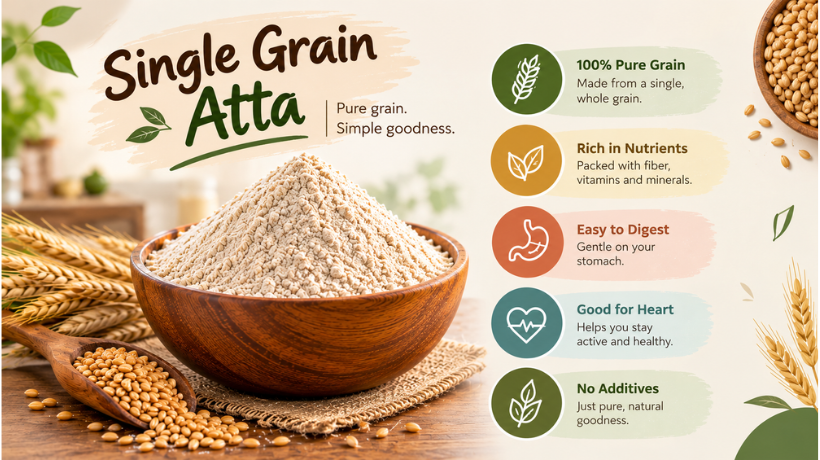
The term single grain refers to flour produced from one principal grain rather than a blend of multiple grains.
For example, flour made entirely from wheat can be described as a single-grain flour. Depending on the product, other individual grains can also be milled separately to create their own flours.
The idea is straightforward: one grain forms the foundation of the flour.
Why Does One Grain Matter?
Different grains have their own natural characteristics. Wheat, for instance, contains proteins that can form gluten when mixed with water and kneaded. Other grains have different compositions and behave differently during cooking.
Using one grain allows its individual characteristics to remain more clearly identifiable.
That can make a single-grain flour appealing to people who prefer:
-
A familiar grain flavour
-
Predictable ingredient composition
-
Straightforward flour selection
-
Traditional recipes based around one grain
-
A particular grain's natural characteristics
Multigrain Atta Takes a Blended Approach
Multigrain atta follows a different concept.
Instead of relying on one grain, it combines several grains or grain-based ingredients. The exact combination varies from one product to another.
A blend may contain ingredients such as wheat, barley, oats, millet, maize, or other cereals and pulses, depending on its formulation.
Why Create a Grain Blend?
Blending allows different ingredients to come together in one flour.
Each grain can contribute its own flavour, texture, and nutritional characteristics. For consumers, this can be a convenient way to include a wider selection of grains in everyday meals.
The important point is that "multigrain" is a broad description. Two multigrain flours do not necessarily contain the same ingredients or proportions.
A Side-by-Side Look at the Two
The easiest way to understand the difference is to look at their basic characteristics.
|
Feature |
Single Grain Atta |
Multigrain Atta |
|
Main composition |
One principal grain |
Combination of multiple grains or ingredients |
|
Flavour |
Reflects the selected grain |
Can have a more complex grain flavour |
|
Dough behaviour |
Determined mainly by one grain |
Influenced by several ingredients |
|
Ingredient variety |
More focused |
Broader |
|
Recipe experience |
Often familiar and predictable |
May have a distinct texture and taste |
|
Product formulation |
Usually straightforward |
Depends on the blend |
This does not make one category universally better than the other. They simply offer different approaches to flour selection.
The Dough Tells an Interesting Story
Flour differences become particularly noticeable once water enters the picture.
When flour is hydrated, its particles absorb water and begin forming dough. With wheat-based flour, gluten-forming proteins contribute elasticity and structure during kneading.
When multiple grains are introduced, the dough can respond differently because every ingredient has its own properties.
What You May Notice While Kneading
Depending on the formulation, a blended flour may:
-
Absorb water differently
-
Feel softer or denser
-
Have a different elasticity
-
Require adjustments in hydration
-
Roll differently
-
Produce a different cooked texture
There is no universal rule because the exact result depends on the ingredients and their proportions.
Single Grain Atta Keeps the Grain Profile Clear
One interesting advantage of using a single grain is that the characteristics of that grain remain easier to identify.
Single grain atta provides a focused flour experience. The aroma, flavour, colour, and cooking properties are largely connected to the selected grain and its processing.
This can be useful for people who enjoy understanding exactly what they are cooking with.
Single grain atta can also make it easier to compare different grains individually before deciding which ones fit your meals.
Multigrain Atta Brings More Variety Into One Flour
The appeal of multigrain flour lies in combination.
Instead of purchasing several individual flours and deciding how to mix them, a prepared blend brings multiple ingredients together in one product.
This can be convenient for households that enjoy experimenting with different grains while still preparing familiar foods such as rotis and parathas.
Variety Can Also Change the Eating Experience
A blend may produce a more pronounced grain character than plain wheat flour.
Depending on its ingredients, the cooked flatbread may have a slightly nuttier, earthier, or more complex flavour. Texture can also vary.
For someone accustomed to one-grain flour, this can provide a simple way to introduce something different into everyday meals.
Nutrition Depends on What Is Actually in the Flour
It is important not to judge flour solely by whether it says "single grain" or "multigrain."
Nutritional composition depends on the grain itself, processing, milling, and—in the case of a blend—the proportion of each ingredient.
For example, whole grains can contribute dietary fibre, protein, vitamins, minerals, and other naturally occurring components.
Read the Nutrition Panel
When comparing products, look at:
-
Dietary fibre
-
Protein
-
Calories per serving
-
Ingredients
-
Serving size
-
Whole-grain information where provided
This approach gives you product-specific information instead of relying on general assumptions.
Which One Is Easier to Cook With?
That depends on the recipe and the flour.
A wheat-based single-grain flour is generally familiar for traditional Indian flatbreads because wheat dough develops gluten structure.
A multigrain blend can also be used for rotis, but the presence of other grains may change the dough's handling characteristics.
A Useful Kitchen Tip
When trying a new flour, do not pour all the water into the bowl immediately.
Add it gradually.
Knead the dough and observe its texture. If it feels dry, add a little more water. If it becomes too soft, a small amount of flour can help adjust the consistency.
This simple approach works better than assuming every flour requires exactly the same amount of water.
Think About Your Usual Meals
Your cooking routine can help determine which category makes more sense.
If most meals revolve around traditional wheat-based rotis, a single-grain wheat flour can offer a familiar foundation.
If you enjoy experimenting with ingredients and want several grains incorporated into one flour, a multigrain blend may be more convenient.
There is also room for both. Flour choices do not have to remain fixed throughout the year.
What About Taste and Aroma?
Taste is often the deciding factor after the nutritional and practical considerations have been covered.
A single-grain flour lets the character of its chosen grain stand out. This can be especially appealing when the grain has a naturally distinctive flavour.
Multigrain flour combines the flavours of its ingredients. Depending on the blend, this can create a richer and more varied grain profile.
The final taste also depends on freshness, storage, hydration, cooking temperature, and the recipe itself.
Choosing the Right Flour Starts With the Label
A quick look at the back of the pack can answer many questions.
For a single-grain flour, check whether the ingredient list identifies one principal grain.
For a multigrain product, examine which grains are included and how the ingredients are listed.
Also check the manufacturing or packaging information, nutrition panel, storage guidance, and recommended serving information.
Four Questions Worth Asking
Before purchasing, consider:
What grain do I want?
Choose based on the grain characteristics and flavour you enjoy.
Do I want one grain or several?
This is the fundamental difference between the two categories.
How will I use the flour?
Think about rotis, parathas, baking, or other recipes.
How will I store it?
Flour should be protected from moisture, heat, and excessive exposure after opening.
There Is No Need to Overcomplicate the Choice
Flour selection becomes easier when you focus on your actual requirements.
A single-grain option gives you a more focused ingredient profile. A multigrain option provides a blend of different ingredients in one flour.
Both can have a place in a varied kitchen. The better choice is the one that matches your preferred taste, cooking method, ingredient preferences, and overall eating pattern.
Conclusion
Single grain and multigrain atta represent two different ways of approaching everyday flour. One focuses on the characteristics of a single principal grain, while the other brings multiple grains or grain-based ingredients together.
That difference can influence flavour, texture, dough behaviour, ingredient variety, and nutritional composition. However, the label alone does not tell the complete story. The specific grain, milling method, ingredient proportions, processing, and storage all deserve attention.
By reading the ingredient list and nutrition information and considering how you normally cook, you can choose the flour style that fits naturally into your everyday meals.
FAQs
1. What does single grain flour mean?
It means the flour is made primarily from one grain rather than a combination of several grains.
2. What does multigrain flour contain?
It contains a combination of two or more grains or grain-based ingredients. The exact ingredients vary according to the product formulation.
3. Can both types be used for making roti?
Yes. Both can be used for rotis, although dough texture, water absorption, and handling can vary depending on the flour composition.
4. Does multigrain flour always have more fibre?
Not necessarily. Fibre content depends on the specific ingredients, proportions, and processing. The nutrition panel provides the most reliable product-specific information.
5. Why does dough behave differently with different flours?
Grains vary in protein, fibre, starch, particle size, and water absorption. These differences influence the way dough forms and handles.
6. How should flour be stored after opening?
Keep it in a clean, dry, airtight container away from moisture, excessive heat, direct sunlight, and strong odours.
7. What should I compare when choosing between different flours?
Look at the ingredient list, nutrition information, grain type, intended use, packaging details, storage instructions, and your personal cooking preferences.

 English
 Arabic
 French
 Spanish
 Deutsch
 Turkish
 Dutch
Dutch
 Italiano
 Russian
 Romaian
 Portuguese (Brazil)
 Greek
Greek
 Bengali