


Saudi Arabia Fertilizer Market 2026-34: Agricultural Input Demand by Crop Application and Fertilizer Type
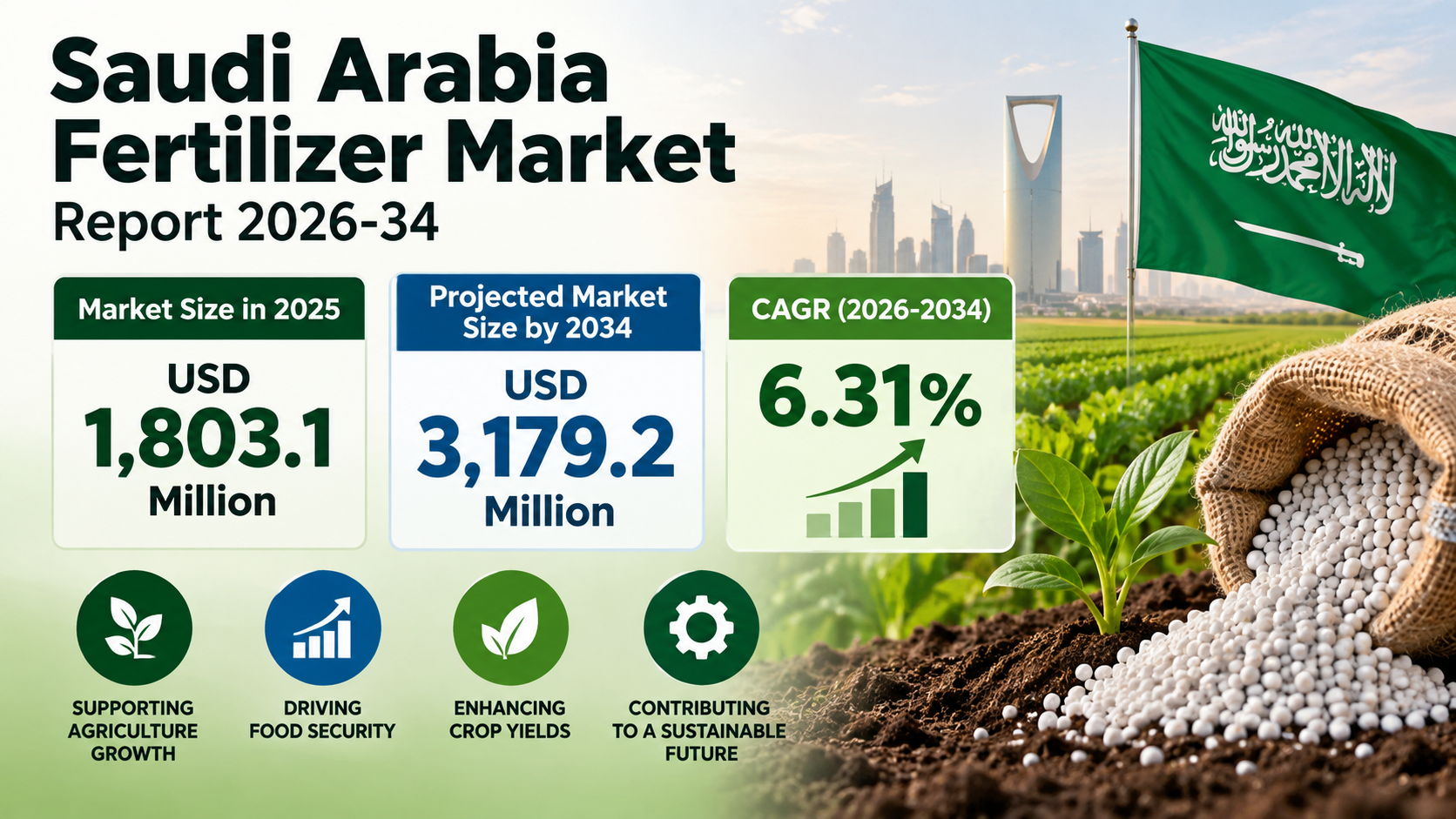
IMARC Group, a leading global market research and management consulting firm, has published its latest market intelligence report on the Saudi Arabia fertilizer market size reached USD 1,803.1 Million in 2025. The market is projected to reach USD 3,179.2 Million by 2034, exhibiting a growth rate (CAGR) of 6.31% during 2026-2034, driven by the ongoing development of agricultural megaprojects under Saudi Vision 2030, rising domestic food security priorities, expanding investments in phosphate and nitrogen production capacity, and continuous innovation in specialty, bio-based, and precision agriculture fertilizer solutions across the Kingdom.
The market is experiencing strong momentum as the Kingdom works to reduce its heavy reliance on food imports and build a more resilient domestic agricultural base. Saudi Arabia currently imports a substantial share of its food requirements, a structural gap that is pushing the government and private investors to scale up high-efficiency farming across large agricultural megaprojects. As these projects expand across the Eastern Region and other parts of the Kingdom, demand for nitrogenous, phosphatic, and potassic fertilizers is rising in tandem with the adoption of advanced irrigation and nutrient management systems. At the same time, Saudi Arabia's position as a major global fertilizer producer, anchored by SABIC Agri-Nutrients and Ma'aden's vast phosphate reserves at Wa'ad Al Shamal, gives the domestic market a unique dual character of being both a leading exporter and a market with acute local demand growth.
How AI is Reshaping the Future of the Saudi Arabia Fertilizer Market?
- AI-Powered Precision Agriculture and Nutrient Application: AI-driven precision agriculture systems are helping Saudi farms optimize fertilizer application by using satellite imagery and soil sensor data to identify nutrient deficiencies at the field level, reducing input waste while maximizing crop yields in the Kingdom's arid growing conditions, a critical advantage given the country's limited arable land and water resources.
- Machine Learning for Customized Fertilizer Blends: Fertilizer manufacturers are increasingly using machine learning algorithms to design customized nutrient blends tailored to Saudi Arabia's sandy soils and high-temperature climate, improving nutrient uptake efficiency and reducing the volume of fertilizer required per hectare compared to standardized formulations.
- Predictive Analytics for Production and Distribution Planning: AI-based demand forecasting tools are enabling fertilizer producers and distributors to better anticipate seasonal demand across grains, cereals, fruits, vegetables, and specialty crop segments, supporting more efficient production scheduling and reducing supply bottlenecks across the Kingdom's agricultural regions.
Grab a sample PDF of this report: https://www.imarcgroup.com/saudi-arabia-fertilizer-market/requestsample
Saudi Arabia Fertilizer Market Trends and Drivers
The Saudi Arabia fertilizer market is expanding on the back of the Kingdom's strategic push toward food self-sufficiency, supported by real government spending and large-scale agricultural investment programs. Saudi Vision 2030 has placed agricultural modernization and food security among its core economic diversification pillars, with government-backed megaprojects developing large tracts of land for high-efficiency farming. As more land comes under cultivation using advanced irrigation and greenhouse technologies, fertilizer consumption is rising to support consistent soil fertility and crop productivity across grains, pulses, oilseeds, fruits, and vegetables.
Domestic production capacity expansion is another defining trend shaping the market. SABIC Agri-Nutrients has continued to secure regulatory approvals for feedstock allocations to support new production capacity, including approval for a sixth plant in Jubail Industrial City designed to produce blue ammonia, urea, and specialized fertilizers as part of the company's broader decarbonization and growth strategy. Ma'aden, meanwhile, continues to invest heavily in its phosphate fertilizer complex at Wa'ad Al Shamal and Ras Al Khair, awarding large-value construction contracts to expand production capacity and strengthen the Kingdom's position among the world's top phosphate fertilizer producers. Together, SABIC Agri-Nutrients and Ma'aden account for the dominant share of domestic fertilizer supply through vertically integrated production chains linked to gas feedstock and phosphate reserves.
Sustainability and food security considerations are also reshaping product development within the market. Saudi Arabia's Ministry of Environment, Water and Agriculture, through the Estidamah Center, has been actively promoting bio and organic fertilizers among farmers through knowledge-transfer workshops and demonstration programs aimed at reducing reliance on synthetic chemical inputs while supporting sustainable farming practices. Investment in specialty products such as controlled-release urea, biofertilizers, and organic fertilizer alternatives derived from agricultural and municipal biowaste is broadening the range of nutrient solutions available to Saudi farmers, while also aligning with the Kingdom's environmental sustainability targets under Vision 2030.
Saudi Arabia Fertilizer Industry Segmentation
The report has segmented the market into the following categories:
Breakup By Type:
- Nitrogenous Fertilizers (Urea, Calcium Ammonium Nitrate, Ammonium Nitrate, Ammonium Sulfate, Anhydrous Ammonia, Others)
- Phosphatic Fertilizers (Mono-Ammonium Phosphate, Di-Ammonium Phosphate, Single Super Phosphate, Triple Super Phosphate, Others)
- Potassic Fertilizers (Muriate of Potash, Sulfate of Potash)
- Secondary Macronutrient Fertilizers
- Micronutrient Fertilizers
Nitrogenous fertilizers represent a dominant type segment, supported by the Kingdom's substantial domestic urea and ammonia production capacity, favorable natural gas feedstock allocations, and the central role nitrogen plays in supporting yields across cereal and grain cultivation, the largest crop category by cultivated area in Saudi Arabia.
Breakup By Application:
- Grains and Cereals
- Pulses and Oilseeds
- Fruits and Vegetables
- Others
Grains and cereals account for the largest application segment, reflecting their status as staple crops central to the Kingdom's food security strategy, with government-supported megaprojects prioritizing wheat, barley, and other grain cultivation to reduce dependence on imported staples.
Breakup By Region:
- Eastern Region
- Western Region
- Central Region
- Southern Region
- Northern Region
The Eastern Region dominates the market with the largest regional share, driven by its proximity to major fertilizer production hubs including Jubail and Ras Al Khair, established industrial infrastructure, and large-scale agricultural developments that benefit from direct access to domestic fertilizer manufacturing facilities.
Competitive Landscape
The report provides a comprehensive analysis of the competitive landscape in the Saudi Arabia fertilizer market with detailed profiles of major companies operating in the sector, including SABIC Agri-Nutrients Company, Saudi Arabian Mining Company (Ma'aden), National Agricultural Development Company (NADEC), and other domestic and regional fertilizer producers and distributors active across nitrogenous, phosphatic, and specialty fertilizer segments.
Recent News and Developments in Saudi Arabia Fertilizer Market
- August 2026: SABIC Agri-Nutrients and Ma'aden Integrated Fertilizer Company signed a memorandum of understanding to explore collaboration across the agri-nutrients value chain, establishing a three-year framework for joint development and investment in value-added fertilizer products, aligned with SABIC's strategy to expand its global leadership in nitrogenous fertilizers.
- March 2026: SABIC Agri-Nutrients reported strong annual financial results with revenue growth supported by higher average selling prices and sales volumes, announcing a substantial dividend payout to shareholders and citing continued strength in the nitrogen and phosphate fertilizer business.
- September 2025: The Estidamah Center organized a specialized workshop on bio and organic fertilizers in the Jazan region, aimed at introducing farmers to sustainable nutrient management techniques and supporting the Kingdom's Vision 2030 goals for environmental sustainability and food security.
- January 2025: Ma'aden awarded construction contracts worth over USD 922 Million to international engineering firms for its phosphate fertilizers megaproject at Wa'ad Al Shamal and Ras Al Khair, aimed at expanding annual production capacity as part of the company's long-term phosphate fertilizer expansion strategy.
- August 2024: Egypt's Biogrand, a fertilizer producer, announced plans to build a new factory in Saudi Arabia in partnership with Saudi investors, with the new plant intended to meet rising domestic fertilizer demand while allocating a portion of output for export to neighboring Arab markets.
- July 2024: SABIC Agri-Nutrients received Energy Ministry approval for feedstock allocation supporting its sixth production plant in Jubail Industrial City, designed to produce blue ammonia, urea, and specialized fertilizers as part of the company's decarbonization roadmap.
Note: If you require specific details, data, or insights that are not currently included in the scope of this report, we are happy to accommodate your request. As part of our customization service, we will gather and provide the additional information you need, tailored to your specific requirements. Please let us know your exact needs, and we will ensure the report is updated accordingly to meet your expectations.
About Us
IMARC Group is a global management consulting firm that helps the world's most ambitious changemakers to create a lasting impact. The company provides a comprehensive suite of market entry and expansion services. IMARC offerings include thorough market assessment, feasibility studies, company incorporation assistance, factory setup support, regulatory approvals and licensing navigation, branding, marketing and sales strategies, competitive landscape and benchmarking analyses, pricing and cost research, and procurement research.
Media and Sales Contact
IMARC Group
Email: sales@imarcgroup.com
United States: +1-201-971-6302
India: +91-120-433-0800
United Kingdom: +44-753-714-6104

 English
 Arabic
 French
 Spanish
 Portuguese
 Deutsch
 Dutch
Dutch
 Italiano
 Russian
 Romaian
 Portuguese (Brazil)
 Greek
Greek
 Bengali