


Automotive Digital Cockpit Market Growth Supported by Electric Vehicles
Market Overview
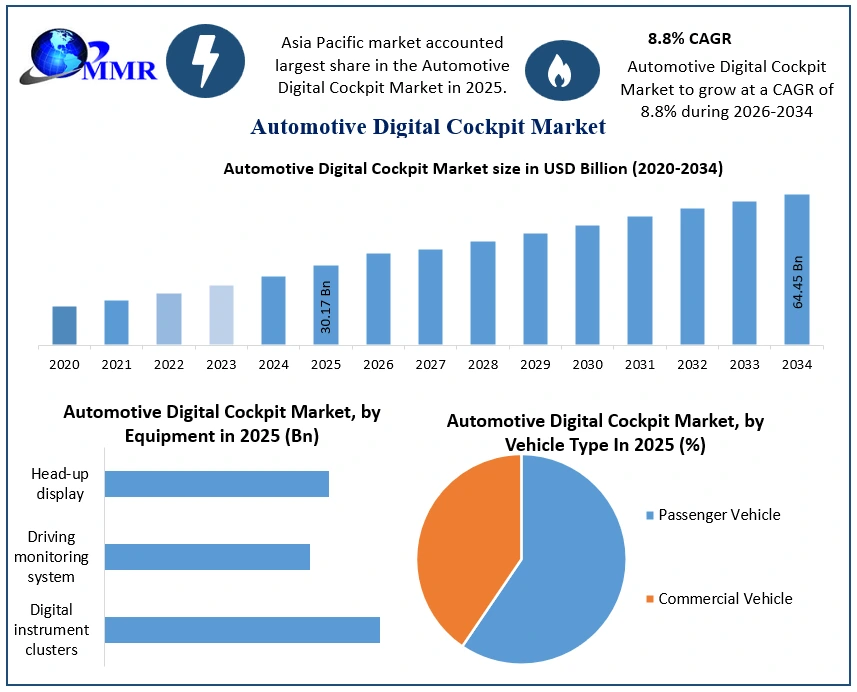
The Automotive Digital Cockpit Market is undergoing a significant transformation as automakers increasingly replace conventional instrument panels with connected, software-driven cockpit platforms. According to Maximize Market Research, the global Automotive Digital Cockpit Market was valued at USD 30.17 billion in 2025 and is projected to reach approximately USD 64.45 billion by 2034, expanding at a CAGR of 8.8% during 2026–2034. Digital cockpits combine digital instrument clusters, infotainment displays, head-up displays, human-machine interfaces, connectivity, navigation and driver-monitoring functions to provide a more integrated driving experience.
The major growth drivers include rising consumer demand for connected vehicles, increasing adoption of advanced driver-assistance systems (ADAS), the transition toward software-defined vehicles, growth in electric vehicles, and increasing demand for personalized in-car experiences. Cloud connectivity, 5G, artificial intelligence, over-the-air software updates and high-performance computing are also expanding the functionality of digital cockpit platforms. MMR identifies opportunities in AI-powered interfaces, augmented-reality head-up displays, centralized cockpit computers, multi-display systems and integrated infotainment-ADAS architectures. At the same time, cybersecurity, functional safety, data privacy and the complexity of integrating multiple software platforms remain important challenges for manufacturers.
United States Market Trends and Investment in 2025
The United States remained an important technology and innovation center for automotive digital cockpit development during 2025, with CES in Las Vegas providing a major platform for suppliers to demonstrate next-generation cockpit technologies. Companies increasingly focused on AI-enabled interfaces, software-defined vehicles, advanced displays and high-performance vehicle computers. Bosch announced in 2025 that it planned to invest more than USD 2.7 billion in AI through the end of 2027, supporting applications including assisted and automated driving. Continental also showcased its customizable Emotional Cockpit at CES 2025, featuring an E Ink Prism display designed to provide low-power personalization across the dashboard. These developments demonstrate the growing importance of AI, energy-efficient displays and software in the U.S.-connected vehicle ecosystem.
Request To Free Sample of This Strategic Report ➤ https://www.maximizemarketresearch.com/request-sample/29901/
Market Segmentation – Largest Market Share
By Equipment: The Driving Monitoring System segment dominated the market in 2025, accounting for approximately 48.3% of the market by volume, according to MMR. Demand is supported by the increasing integration of infotainment, navigation, cabin controls, driver monitoring and safety functions into connected cockpit environments.
By Vehicle Type: The Passenger Vehicle segment dominated the market in 2025, accounting for more than 80% of total sales. Increasing consumer expectations for connected features, digital displays, infotainment and advanced driver assistance are supporting the widespread adoption of digital cockpit systems in passenger cars.
Competitive Analysis
The competitive landscape includes major automotive electronics and technology suppliers such as Robert Bosch GmbH, Continental AG, Denso Corporation, Visteon and Panasonic Automotive Systems. MMR identifies these companies among the key players in the global Automotive Digital Cockpit Market.
Robert Bosch GmbH: Bosch is expanding its focus on AI-powered automotive computing. In 2025, the company announced an investment of more than USD 2.7 billion in AI through 2027. Bosch is also developing high-performance computers that combine functions such as infotainment and driver assistance, enabling fewer but more powerful vehicle computers.
Continental AG: Continental is advancing cockpit personalization, software-defined vehicle architecture and AI. Its CES 2025 Emotional Cockpit incorporated E Ink technology for customizable, low-power displays. The company also demonstrated an AD-Cockpit high-performance computer integrating cluster, infotainment and ADAS functions on a single SoC at Auto Shanghai 2025.
Denso Corporation: Denso is developing technologies for the software-defined vehicle era, including integrated vehicle computing. At Japan Mobility Show 2025, Denso highlighted its development of an Integrated Mobility Computer designed to control multiple vehicle domains and support increasingly intelligent vehicles.
Visteon: Visteon strengthened its digital cockpit portfolio through AI, high-performance computing and advanced displays. At CES 2025, it presented cognitoAI, a centralized computing platform, curved OLED clusters and technology for running ADAS, augmented-reality navigation, infotainment and driver monitoring on a unified computing architecture. During 2025, Visteon secured USD 7.4 billion in new business awards, including USD 3.6 billion in display awards and USD 2.1 billion in SmartCore and infotainment business.
Panasonic Automotive Systems: Panasonic expanded its collaboration with Qualcomm in 2025 to use Snapdragon Cockpit Elite platforms for cockpit domain controllers and high-performance computing systems. The collaboration targets generative AI, advanced graphics, connected infotainment and software-defined vehicle architectures.
Regional Analysis
United States: The U.S. benefits from a strong automotive technology ecosystem, major technology companies and substantial investment in AI, vehicle computing and connected mobility. CES and the presence of global automotive technology suppliers support innovation in cockpit systems.
United Kingdom: The UK market is supported by automotive R&D capabilities, connected-car development and increasing adoption of electrified and digitally enabled vehicles. The country's engineering and technology ecosystem provides opportunities for advanced HMI and cockpit software.
Germany: Germany remains a major automotive technology hub because of its large OEM base and established automotive electronics industry. Companies such as Bosch and Continental are developing high-performance computing, AI and software-defined vehicle technologies. Continental's 2025 activities included AI-based development tools and next-generation cockpit solutions.
France: France's automotive sector is increasingly focused on electrification, connected mobility and advanced vehicle electronics, supporting demand for digital cockpit technologies.
Japan: Japan has a strong automotive manufacturing and electronics ecosystem. Denso's 2025 work on software-defined vehicles and integrated mobility computing illustrates the country's continued development of centralized vehicle electronics.
China: China represents a major growth market because of its large passenger-vehicle production base, rapid EV adoption and strong development of connected and intelligent vehicles. MMR reports that Asia Pacific held 54.6% of the global Automotive Digital Cockpit Market in 2025, with China a major contributor to regional vehicle production and technology adoption.
MMR's published report provides the 54.6% share for Asia Pacific but does not provide individual global market-share percentages for each of the six countries above; therefore, country-level percentages are not stated here as estimates.
Request To Free Sample of This Strategic Report ➤ https://www.maximizemarketresearch.com/request-sample/29901/
Key Players
Key companies operating in the global Automotive Digital Cockpit Market include:
-
Robert Bosch GmbH
-
Continental AG
-
Denso Corporation
-
Visteon
-
Panasonic
-
Hyundai Mobis
-
Garmin
-
Faurecia
-
Aptiv
-
Valeo
-
Harman International
-
ZF Friedrichshafen
-
Magna International
-
Pioneer
-
Desay SV
-
Yazaki
-
Luxoft
-
Nippon Seiki
-
Marelli
-
Preh
Conclusion
The Automotive Digital Cockpit Market is transitioning from a collection of independent displays and electronic modules toward centralized, software-defined computing platforms. The combination of AI, high-performance computing, connected infotainment, ADAS integration, augmented-reality displays and over-the-air software updates is expected to create substantial opportunities through 2034. The strongest opportunities are likely to come from AI-enabled cockpit assistants, integrated cockpit domain controllers, energy-efficient displays and architectures capable of supporting continuous software upgrades. As automakers compete increasingly on digital user experience rather than hardware alone, suppliers that combine computing power, safety, cybersecurity, connectivity and intuitive HMI technologies will have significant opportunities to participate in the market's expansion.
About Maximize Market Research
Maximize Market Research Pvt. Ltd. (MMR) is a global market research and consulting company that provides reliable, data-focused, and practical business insights. The firm serves a wide range of industries, including healthcare, pharmaceuticals, technology, automotive, electronics, chemicals, personal care, and consumer goods. Through market forecasts, competitive analysis, strategic consulting, and industry impact assessments, MMR helps organizations understand changing market conditions, identify growth opportunities, and make informed business decisions for long-term success.
Contact Us
Maximize Market Research Pvt. Ltd.
2nd Floor, Navale IT Park Phase 3
Pune Banglore Highway, Narhe
Pune, Maharashtra 411041, India
+91 9607365656
sales@maximizemarketresearch.com

 English
 Arabic
 French
 Spanish
 Portuguese
 Turkish
 Dutch
Dutch
 Italiano
 Russian
 Romaian
 Portuguese (Brazil)
 Greek
Greek
 Bengali