


ESG Compliance in India: Meaning, Benefits, Audit Process and Reporting Guide
Environmental, Social and Governance, commonly known as ESG, has moved from being a corporate buzzword to an important part of how businesses are evaluated in India.
Companies are increasingly being asked questions such as: How much energy do you consume? What are your greenhouse gas emissions? How do you manage waste and water? What steps do you take for employee safety? How diverse is your workforce? How does your Board manage sustainability risks?
For many large listed companies, ESG reporting is already part of regulatory compliance. For private companies, manufacturers, exporters and suppliers, ESG may not always be directly mandatory, but customers, investors, banks and large corporate buyers are increasingly asking for sustainability information.
This is why understanding ESG compliance in India is becoming important even for businesses that are not currently covered by mandatory reporting requirements.
This guide explains ESG meaning, reporting requirements, benefits, audit or assessment process, documents and how an ESG consultant can help businesses prepare for growing sustainability expectations.
What is ESG Compliance?
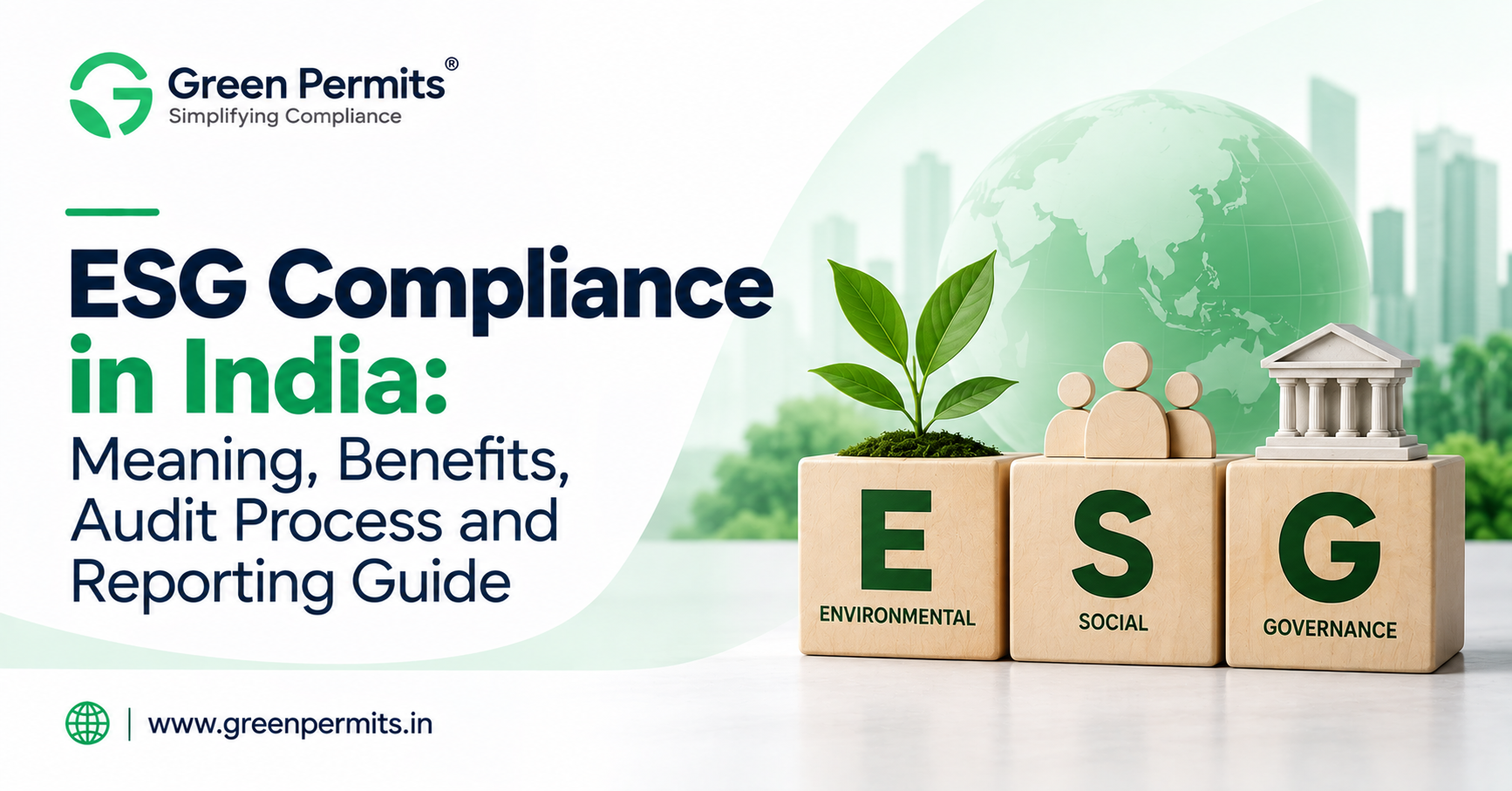
ESG stands for:
Environmental - how a business affects the environment.
Social - how the company deals with employees, workers, customers, communities and other stakeholders.
Governance - how the organisation is managed, controlled and held accountable.
ESG compliance therefore means establishing policies, processes, data systems and reporting mechanisms to measure and disclose a company's performance on these areas.
Environmental indicators may include energy consumption, greenhouse gas emissions, renewable energy, water consumption, wastewater, waste generation and recycling.
Social indicators can include employee health and safety, gender diversity, wages, training, human rights, community development and customer responsibility.
Governance indicators commonly include Board structure, ethics, anti-corruption systems, risk management, whistle-blower mechanisms and regulatory compliance.
ESG is therefore much broader than simply obtaining an environmental licence or preparing a sustainability report.
Why ESG Compliance is Important in India
India's ESG reporting framework has become significantly more structured over the last few years.
SEBI introduced the Business Responsibility and Sustainability Reporting, or BRSR, framework for listed companies. BRSR became mandatory from FY 2022-23 for the top 1,000 listed entities by market capitalisation. Other listed entities can submit BRSR voluntarily.
BRSR requires companies to report their performance against the nine principles of India's National Guidelines on Responsible Business Conduct. The framework is designed to provide more quantitative and comparable ESG information rather than only broad sustainability statements.
The reporting requirements mean that ESG information is increasingly moving through supply chains as well.
For example, a large listed manufacturer may need sustainability information from important suppliers. Even if the supplier itself is a private company, it may therefore receive questionnaires relating to electricity consumption, emissions, waste, occupational safety, diversity and other ESG indicators.
ESG compliance is consequently becoming relevant not only because of regulation, but also because of business relationships.
Who Needs ESG Compliance in India?
Not every Indian company has exactly the same ESG reporting obligation.
Mandatory BRSR reporting primarily applies to the top 1,000 listed entities by market capitalisation. However, ESG preparation can be relevant to a much wider group of businesses.
These include:
- Listed companies
- Large private companies
- Manufacturers
- Export-oriented businesses
- Suppliers to multinational companies
- Automotive and engineering suppliers
- Chemical and pharmaceutical companies
- Recycling and waste management businesses
- Renewable energy companies
- Infrastructure businesses
- Companies seeking institutional investment
- Businesses working with global customers
A company may therefore adopt ESG reporting voluntarily even where BRSR is not legally mandatory.
For exporters in particular, sustainability information is becoming more commercially relevant because overseas customers increasingly evaluate suppliers on environmental and social performance.
Understanding BRSR and BRSR Core
BRSR is one of the most important parts of India's ESG reporting ecosystem.
It covers a broad set of disclosures relating to business responsibility and sustainability.
The framework includes information relating to areas such as energy consumption, greenhouse gas emissions, water, waste, employee welfare, occupational health and safety, diversity, human rights, responsible sourcing and governance.
BRSR distinguishes between essential indicators, which are mandatory for covered entities, and leadership indicators, which generally represent more advanced voluntary disclosures.
SEBI later introduced BRSR Core, which focuses on a smaller set of key ESG indicators intended to improve reliability and comparability.
The BRSR Core assessment framework has been introduced gradually.
The original glide path covered:
- Top 150 listed entities for FY 2023-24
- Top 250 for FY 2024-25
- Top 500 for FY 2025-26
- Top 1,000 for FY 2026-27
SEBI subsequently allowed the requirement to be met through assessment or assurance, rather than treating assurance as the only route.
For companies preparing ESG reports, this means data quality is becoming increasingly important. Sustainability information needs to be backed by records rather than estimated at the end of the year without supporting evidence.
Main ESG Compliance Process
ESG compliance normally starts much earlier than preparation of the final report.
A good ESG programme generally follows several stages.
1. ESG Gap Assessment
The first step is understanding the company's current position.
A consultant or internal ESG team reviews existing operations, policies, permits, records and sustainability practices.
The company may already have significant ESG information available through departments such as HR, EHS, finance, purchase, production and legal.
However, the data is often scattered across departments.
The gap assessment identifies what information is available, what is missing and what needs to be improved before reporting.
2. Identify Material ESG Issues
Not every ESG topic carries the same importance for every business.
For example, water consumption may be highly material for a textile or chemical plant, while electricity consumption and Scope 2 emissions may be more significant for another manufacturing facility.
A recycling company may need greater emphasis on waste traceability, pollution control and worker safety.
The company should therefore identify the environmental, social and governance issues that have the greatest relevance to its operations and stakeholders.
3. ESG Data Collection
This is often the most time-consuming part of ESG reporting.
Companies may need to collect data from production units, offices, warehouses, HR departments, utility bills and pollution control records.
Typical ESG data may include:
- Electricity consumption
- Fuel consumption
- Renewable energy use
- Greenhouse gas emissions
- Water withdrawal and consumption
- Waste generation and recycling
- Employee numbers
- Gender diversity
- Lost-time injuries and safety incidents
- Training hours
- CSR activities
- Supplier information
- Environmental compliance records
Good reporting depends on reliable source documents.
For example, electricity consumption should preferably be linked to actual electricity bills or meter records rather than approximate estimates.
4. Carbon and Environmental Data Calculation
Many companies also calculate their greenhouse gas emissions as part of ESG reporting.
This may include Scope 1 emissions, arising directly from sources controlled by the organisation, and Scope 2 emissions, associated with purchased electricity or energy.
Larger companies may also evaluate Scope 3 emissions, which relate to activities within their wider value chain.
The calculation methodology, emission factors and underlying activity data should be documented carefully because inconsistencies can affect the reliability of the final ESG report.
5. Prepare ESG Policies and Governance Systems
Good ESG reporting should be supported by actual policies and management systems.
Depending on the company, these may include policies covering:
environmental management, occupational health and safety, human rights, diversity, anti-bribery, responsible sourcing, whistle-blower protection and business ethics.
Companies should avoid creating policies only for documentation purposes.
A policy should be supported by implementation responsibilities, records and monitoring mechanisms.
6. Prepare BRSR or ESG Report
Once the data has been collected and verified internally, the company can prepare its ESG disclosure.
For eligible listed companies, this normally involves preparation of the prescribed BRSR.
Other businesses may voluntarily use BRSR or internationally recognised sustainability frameworks depending on stakeholder requirements.
SEBI also allows listed entities that already report using internationally accepted frameworks to cross-reference relevant information with BRSR disclosures.
The final report should clearly explain performance, methodology, targets and limitations rather than presenting sustainability claims without supporting data.
ESG Audit, Assessment and Assurance Process
Many businesses use the term ESG audit, although the formal process may involve assessment or assurance depending on the reporting framework.
The objective is generally to verify whether reported ESG information can be supported by reliable evidence.
An assessor may review electricity bills, fuel purchase records, water records, waste manifests, employee databases, safety reports, statutory approvals and calculation sheets.
For example, if a company reports that it consumed 25 million kWh of electricity during a financial year, the supporting electricity invoices and consolidation methodology should justify that figure.
Similarly, waste recycling figures should be reconciled with waste generation and disposal records.
The process normally involves:
document review, data sampling, management discussions, reconciliation of reported numbers and identification of inconsistencies.
This is why companies should establish ESG data systems throughout the year rather than starting data collection a few weeks before reporting.
Important Documents Required for ESG Compliance
There is no single document checklist applicable to every company because ESG requirements vary by industry and reporting framework.
However, commonly required records include:
- Electricity and fuel bills
- Water consumption records
- Environmental monitoring reports
- Consent to Establish and Consent to Operate
- Environmental Clearances, where applicable
- Hazardous waste authorisations
- Waste disposal manifests
- EPR records, where applicable
- Renewable energy certificates or agreements
- Employee and payroll data
- Health and safety records
- Accident and incident reports
- Training records
- CSR information
- Board and committee records
- Business ethics and anti-corruption policies
- Supplier information
- ESG calculation worksheets
Maintaining these records systematically throughout the year can significantly reduce reporting difficulties.
ESG Value Chain Reporting
Supply-chain ESG reporting has become an important development for Indian businesses.
SEBI's current framework makes ESG disclosures for the value chain voluntary for the top 250 listed entities from FY 2025-26. Associated assessment or assurance is also voluntary.
For companies choosing to report value-chain information, SEBI defines the relevant scope around significant upstream and downstream partners. Partners individually accounting for 2% or more of purchases or sales by value may fall within the identified scope, while reporting entities can limit coverage to 75% of purchases and sales respectively.
This development is particularly important for MSMEs and private manufacturers.
Even when a supplier does not directly fall under mandatory BRSR requirements, its listed customer may request ESG information from it.
Developing basic ESG data systems today can therefore make it easier to respond to customer sustainability questionnaires in the future.
Benefits of ESG Compliance for Businesses
ESG compliance should not be viewed only as another reporting burden.
When properly implemented, the process can help businesses understand operational inefficiencies.
Tracking energy consumption may identify areas where electricity costs can be reduced. Water measurement can highlight excessive consumption. Waste mapping may identify materials that can be recycled or recovered rather than disposed of.
ESG preparedness can also provide several commercial benefits.
It can improve the company's ability to respond to sustainability requirements from investors, lenders, multinational customers and procurement teams.
Strong documentation can also reduce the risk of unsupported environmental claims.
For companies planning exports, institutional funding or long-term partnerships with major corporations, a structured ESG system can strengthen overall business readiness.
Common ESG Compliance Challenges
One of the biggest challenges is data availability.
Companies often find that electricity information sits with finance, waste records with EHS, workforce information with HR and supplier data with procurement.
When these teams use different reporting periods or units, consolidating the information becomes difficult.
Another common problem is lack of historical records.
A company may want to report its emissions or resource efficiency improvement but discover that comparable previous-year information was never recorded.
Other frequent challenges include incorrect emission calculations, incomplete supplier information, missing environmental records, inconsistent units, unclear ESG responsibilities and sustainability claims that cannot be supported with evidence.
The best solution is to build ESG reporting into normal business operations rather than treating it as an annual paperwork exercise.
How an ESG Consultant Can Help
An experienced ESG consultant in India can help businesses convert scattered sustainability information into a structured ESG management and reporting system.
The process normally begins with an ESG gap assessment.
The consultant evaluates the company's operations, identifies relevant indicators and develops a data collection framework.
Support may include:
ESG strategy development, BRSR preparation, BRSR Core readiness, carbon footprint calculation, Scope 1 and Scope 2 emission calculation, sustainability reporting, ESG policy development, environmental compliance review, supplier ESG assessment and preparation for third-party assessment or assurance.
For manufacturers, ESG consulting can also be integrated with existing environmental compliance such as Pollution Control Board approvals, waste management, EPR, resource efficiency and environmental monitoring.
This reduces duplication and creates a more reliable ESG data system.
Conclusion
ESG compliance in India is becoming increasingly important as regulators, investors, lenders and corporate customers demand more reliable sustainability information.
For India's top listed companies, BRSR has already created a structured reporting framework. For private businesses, exporters and MSMEs, ESG preparedness can help meet supply-chain expectations and prepare the organisation for future sustainability requirements.
The key is to start with reliable data.
Businesses should measure their energy, emissions, water, waste, workforce and governance performance systematically and maintain supporting documentation throughout the year.
Green Permits helps Indian businesses develop practical ESG and sustainability compliance systems, including ESG gap assessments, environmental compliance reviews, carbon accounting, BRSR support and sustainability reporting.
Need Help with ESG Compliance, BRSR or Sustainability Reporting?
Website: https://www.greenpermits.in
Phone: +91 78350 06182
Email: wecare@greenpermits.in

 English
 Arabic
 French
 Spanish
 Portuguese
 Deutsch
 Turkish
 Dutch
Dutch
 Italiano
 Russian
 Romaian
 Portuguese (Brazil)
 Bengali