


RVSF Registration under ELV Rules 2025: Process, Documents and Compliance
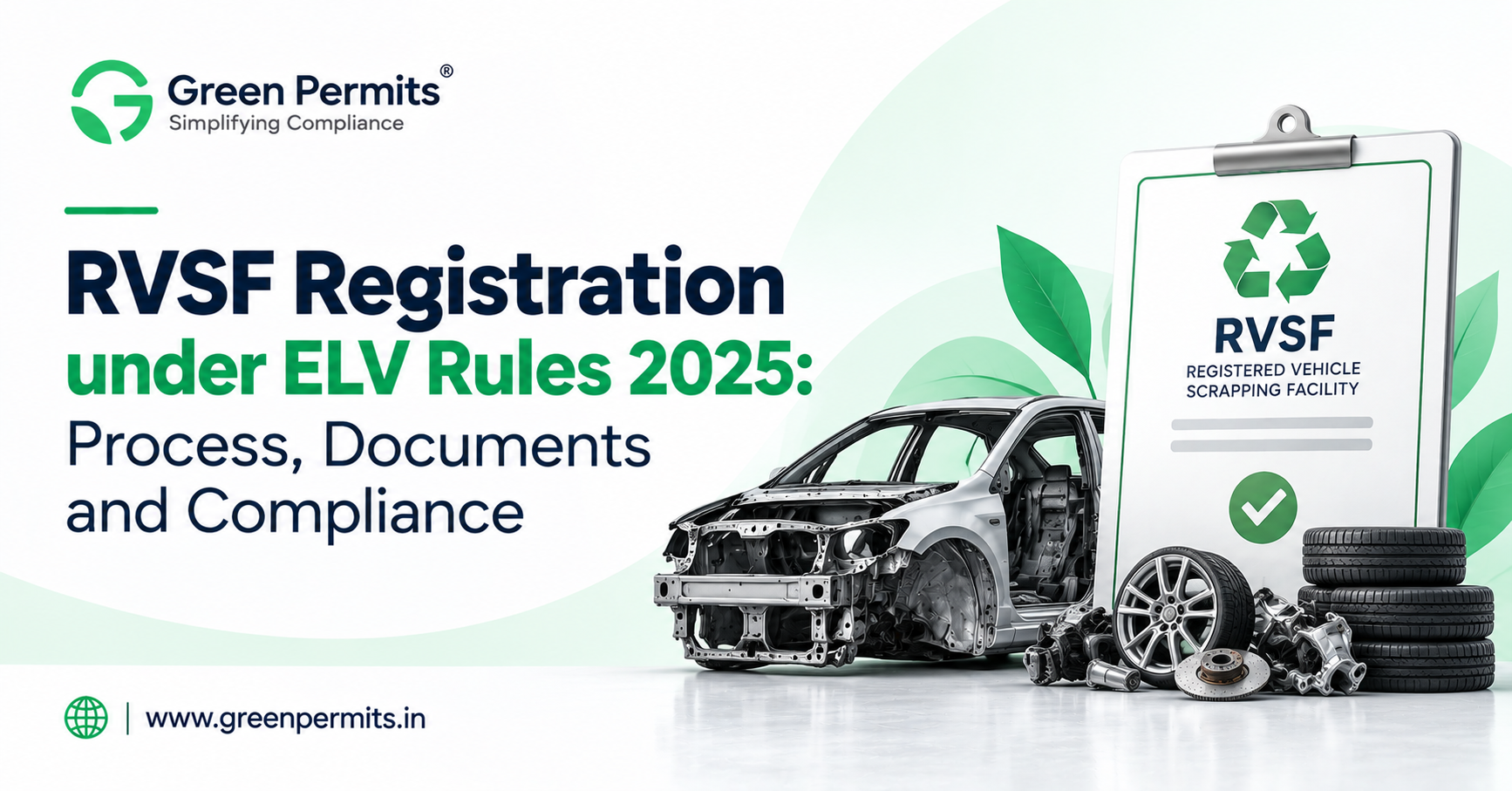
India is moving towards a more organised system for handling vehicles that have reached the end of their usable life. With millions of vehicles operating across the country, proper collection, dismantling, recycling and disposal of End-of-Life Vehicles, or ELVs, has become important for both environmental protection and resource recovery.
To regulate this growing sector, the Government of India notified the Environment Protection (End-of-Life Vehicles) Rules, 2025, which came into force on 1 April 2025. These rules introduce specific environmental responsibilities for vehicle producers, registered vehicle owners, bulk consumers, collection centres and Registered Vehicle Scrapping Facilities.
For businesses planning to establish or operate a vehicle scrapping facility, obtaining the required RVSF registration under the ELV Rules 2025 is now an important part of regulatory compliance.
However, setting up an RVSF is not simply about installing dismantling equipment. The project involves pollution control approvals, hazardous waste management, vehicle handling systems, record keeping, infrastructure planning and ongoing reporting.
This guide explains the RVSF registration process, documents, eligibility requirements and major compliance obligations in easy-to-understand language.
What is an RVSF?
RVSF stands for Registered Vehicle Scrapping Facility.
It is an authorised facility where unfit and End-of-Life Vehicles are received, depolluted, dismantled, segregated and processed in a controlled manner.
An RVSF may recover useful materials such as steel, aluminium, copper, plastics and other recyclable components from scrapped vehicles.
At the same time, potentially hazardous components such as oils, lubricants, batteries, electronic components, tyres and contaminated materials must be handled according to the applicable environmental regulations.
Under the ELV Rules 2025, an RVSF is required to carry out treatment, depollution, dismantling, segregation and scrapping activities in accordance with relevant laws.
Why RVSF Registration Has Become Important
Vehicle scrapping is becoming an organised recycling industry rather than an informal scrap activity.
A vehicle contains several materials that can return to the manufacturing supply chain. Steel recovered from vehicles can be recycled, while aluminium, copper, plastics and other components may also have significant commercial value.
But improper vehicle dismantling can create environmental risks.
For example, old vehicles may contain:
- Engine and transmission oil
- Brake fluid
- Coolants
- Fuel residues
- Batteries
- Electronic components
- Tyres
- Air-conditioning refrigerants
- Contaminated filters and hazardous residues
If these materials are released into the soil, drains or open land, they can create pollution and safety issues.
The ELV Rules therefore create a structured system in which authorised RVSFs become an important part of India's vehicle recycling ecosystem.
The rules also connect vehicle scrapping with the Extended Producer Responsibility, or EPR, framework. CPCB can issue EPR certificates based on the eligible steel scrap generated from End-of-Life Vehicles processed by registered vehicle scrapping facilities.
This creates an additional reason for vehicle scrapping facilities to maintain accurate operational and material records.
Who Needs RVSF Registration?
RVSF registration is relevant for businesses involved in organised vehicle dismantling and scrapping.
This can include:
- Entrepreneurs establishing a new vehicle scrapping plant
- Existing automobile dismantling businesses moving towards formal registration
- Recycling companies expanding into ELV processing
- Scrap processing businesses planning vehicle recycling operations
- Automobile groups setting up dedicated scrapping facilities
- Industrial groups entering the circular economy sector
The Environment Protection (End-of-Life Vehicles) Rules, 2025 apply to RVSFs along with producers, registered owners, bulk consumers, collection centres, automated testing stations and other entities handling End-of-Life Vehicles.
RVSF Registration under ELV Rules 2025
One important point for entrepreneurs is that environmental registration under the ELV Rules works alongside the vehicle scrapping regulatory framework.
The Environment Protection (End-of-Life Vehicles) Rules, 2025 require a Registered Vehicle Scrapping Facility to apply to the concerned State Pollution Control Board or Pollution Control Committee.
The application is made in Form 5.
According to the notified rules, the State Board is responsible for registration of RVSFs through the centralised online system.
The rules provide that registration should be issued within 15 days of receipt of the application, subject to the applicable requirements and verification. The registration remains valid until suspended or cancelled under the rules.
Main Process for RVSF Registration
The exact project sequence can vary depending on the state, project size and proposed facility, but a typical RVSF compliance journey involves several stages.
1. Business and Project Planning
Before filing applications, the promoter should clearly define the proposed project.
This includes:
- Proposed number of vehicles to be handled annually
- Categories of vehicles to be scrapped
- Land requirement
- Plant layout
- Dismantling process
- Machinery and equipment
- Material storage areas
- Hazardous waste handling systems
- Fire and safety provisions
- Wastewater management
- Recovered material storage and dispatch system
Incorrect capacity planning at this stage can create problems later when seeking environmental approvals.
2. Site Selection and Infrastructure Planning
An RVSF requires a properly designed industrial site.
The facility should have suitable areas for vehicle reception, temporary storage, depollution, dismantling, component segregation, recyclable material storage and hazardous waste storage.
A good plant layout should minimise the possibility of oil, fuel or chemical leakage reaching soil or stormwater drains.
Suitable flooring, drainage and designated storage systems become important because dismantling vehicles generates several different waste streams.
Site suitability should therefore be evaluated before significant investment is made in land or construction.
3. Pollution Control Approvals
Pollution control approvals are a critical part of RVSF registration.
Form 5 under the ELV Rules specifically asks for the validity of consent under the Air (Prevention and Control of Pollution) Act, 1981 and the Water (Prevention and Control of Pollution) Act, 1974.
Depending on the stage of the project and state requirements, the unit may therefore need applicable Consent to Establish and Consent to Operate approvals from the State Pollution Control Board or Pollution Control Committee.
Environmental compliance should be planned before machinery installation because pollution control infrastructure may need to be incorporated into the original plant design.
4. Hazardous Waste Authorisation
Vehicle dismantling can generate hazardous materials and residues.
The RVSF registration form requires details relating to the validity of hazardous waste authorisation.
Facilities must therefore identify waste streams generated during depollution and dismantling and determine how they will be stored, transported, recycled or disposed of through authorised entities.
Typical controlled waste streams may include waste oils, contaminated materials and other hazardous residues.
5. Application under the ELV Rules
Once the required supporting approvals and infrastructure are in place, the RVSF applies to the concerned State Board in Form 5.
The application seeks information including the facility's identity, authorised person, GST details, environmental consent validity, hazardous waste authorisation, waste processing details and installed capacity.
Accuracy at this stage is important because incorrect information can lead to objections or regulatory action.
Important Documents for RVSF Registration
The exact documentation may depend on the State Board and portal requirements, but businesses should normally prepare a comprehensive project and compliance file.
Important documents and information can include:
- Company incorporation or business registration documents
- PAN and GST details
- Details of authorised signatory
- Land ownership, lease or possession documents
- Site layout and plant layout
- RVSF project report
- Machinery and equipment details
- Installed vehicle processing capacity
- Consent under the Air Act
- Consent under the Water Act
- Hazardous waste authorisation
- Details of waste categories generated
- Details of authorised recyclers or refurbishers
- Fire and safety arrangements
- Wastewater and pollution control arrangements
- Photographs of infrastructure and equipment
- Registration or certification applicable to the industrial unit
Under Form 5, information on the facility's installed capacity is expressed in terms of number of vehicles per annum.
Compliance After RVSF Registration
Getting registered is only the beginning.
Once the facility becomes operational, the RVSF must maintain proper records of vehicles received, vehicles scrapped, materials recovered and waste sent to authorised recycling, refurbishment or disposal facilities.
One of the most important continuing requirements is the quarterly return.
Under Rule 8, an RVSF must file quarterly returns in Form 3 through the centralised online portal. The return must cover the weight of ELVs received and details of materials recycled, refurbished, processed or sent to authorised facilities. The return is required by the 30th day of the month following the previous quarter.
This makes a strong digital record-keeping system extremely important.
The facility should be able to reconcile:
vehicle received → vehicle dismantled → materials recovered → recycler/refurbisher → hazardous waste disposal.
Poor mass-balance records can create problems during audits or regulatory inspections.
EPR Certificates and RVSF Business Opportunity
A major feature of the ELV Rules 2025 is the connection between RVSFs and Extended Producer Responsibility.
The rules allow EPR certificates to be generated based on eligible steel scrap recovered from ELVs processed by an RVSF. Producers can purchase such certificates through the centralised online portal to meet their EPR obligations.
The notified rules state that an EPR certificate generated by an RVSF is valid for five years for meeting producer obligations.
This means that accurate weighing, documentation and traceability of recovered materials may become increasingly important to the commercial performance of organised vehicle scrapping facilities.
Common Challenges in RVSF Registration
Many entrepreneurs initially see an RVSF mainly as a machinery project.
In reality, regulatory planning can be just as important as machinery selection.
Some common challenges include selecting an unsuitable site, designing an incomplete layout, misunderstanding pollution control requirements, failing to identify hazardous waste streams and filing inconsistent capacity information across different approvals.
Another challenge is coordinating multiple regulations.
An RVSF may have to comply with vehicle scrapping regulations as well as environmental laws covering water pollution, air pollution, hazardous waste, batteries, e-waste, tyres and other recovered materials.
Poor coordination between these approvals can delay commissioning.
Benefits of Proper RVSF Compliance
A properly registered and compliant RVSF can benefit from participation in India's formal vehicle recycling ecosystem.
Major benefits include:
- Legal operation of vehicle scrapping activities
- Better acceptance from vehicle owners and institutional customers
- Improved traceability of dismantled vehicles and recovered materials
- Safer handling of hazardous components
- Access to organised recycling channels
- Better readiness for inspections and audits
- Potential participation in the ELV EPR certificate ecosystem
- Greater credibility with automobile producers and recycling partners
Compliance also helps businesses reduce the risk of environmental compensation, suspension or cancellation of registration.
Under the ELV Rules, environmental compensation can apply where entities fail to comply with environmentally sound handling and scrapping requirements and cause environmental or public health damage.
How an RVSF Consultant Can Help
Setting up a vehicle scrapping facility requires coordination between technical, environmental, operational and regulatory requirements.
An experienced RVSF registration consultant in India can help promoters understand these requirements before large investments are made.
Consulting support may include:
project feasibility assessment, site evaluation, capacity planning, plant layout review, process flow preparation, pollution control planning, Consent to Establish and Consent to Operate assistance, hazardous waste authorisation, documentation preparation, ELV registration support and post-registration compliance planning.
For new entrepreneurs, early regulatory planning can prevent expensive changes to the plant after machinery has already been installed.
For existing RVSFs, professional support can help build systems for quarterly returns, mass-balance records, authorised recycler documentation and ongoing environmental compliance.
Conclusion
The Environment Protection (End-of-Life Vehicles) Rules, 2025 have created a more structured environmental framework for India's vehicle scrapping industry.
For an RVSF, compliance is no longer limited to dismantling vehicles. Facilities need proper pollution control approvals, hazardous waste management, traceability systems, regulatory registration and periodic reporting.
Businesses planning to establish a vehicle scrapping facility should therefore evaluate regulatory requirements at the project planning stage itself.
Green Permits supports entrepreneurs and companies with RVSF project planning, environmental approvals, ELV compliance, pollution control permissions and regulatory documentation.
Need Support for RVSF Registration or Vehicle Scrapping Plant Setup?
Website: https://www.greenpermits.in
Phone: +91 78350 06182
Email: wecare@greenpermits.in

 English
 French
 Spanish
 Portuguese
 Deutsch
 Turkish
 Dutch
Dutch
 Italiano
 Russian
 Romaian
 Portuguese (Brazil)
 Greek
Greek
 Bengali