


What Is Driving Innovation in the Vendor Management Systems (VMS) Market Across EMEA?
The way enterprises manage external talent is changing. Organizations increasingly rely on contingent workers, staffing suppliers, independent professionals, and service providers to access specialized skills and maintain workforce flexibility.
However, managing a distributed contingent workforce can create challenges around supplier management, compliance, costs, onboarding, worker visibility, and governance.
This is driving greater interest in Vendor Management Systems (VMS), particularly among organizations operating across complex EMEA markets.
Download Sample Report Here: https://qksgroup.com/download-sample-form/spark-matrix-vendor-management-systems-vms-emea-2025-8457
What Are Vendor Management Systems?
Vendor Management Systems are technology platforms designed to help organizations manage contingent workforce programs and the suppliers supporting them.
A modern VMS can centralize processes such as:
- Worker requisition
- Supplier management
- Candidate submission
- Candidate selection
- Onboarding
- Time and expense management
- Contract management
- Workforce analytics
- Compliance monitoring
- Offboarding
- Supplier performance management
By connecting these activities within a centralized environment, VMS platforms can improve workforce visibility and standardize processes.
Why VMS Adoption Is Increasing
Contingent workforce programs can involve multiple staffing suppliers, business units, locations, worker categories, and regulatory requirements.
Without centralized technology, organizations may struggle to understand:
- How many contingent workers they have
- Which suppliers are providing workers
- How much contingent labor costs
- Whether workers meet compliance requirements
- How suppliers are performing
- Where workforce demand is increasing
A VMS can help bring these data points together and provide a more structured approach to contingent workforce management.
The EMEA Complexity
The EMEA market presents unique workforce management considerations because organizations operate across multiple countries, employment environments, languages, currencies, and regulatory frameworks.
A VMS serving EMEA organizations therefore needs to support more than basic workforce administration.
Enterprises may look for capabilities related to local compliance, supplier governance, workforce classification, data management, multilingual operations, and regional reporting.
This makes localization and scalability important considerations when selecting a platform.
Check SPARK Plus Study Here: https://qksgroup.com/sparkplus?market-id=427&market-name=vendor-risk-management-%28vrm%29
Automation Is Reshaping VMS Platforms
Automation is becoming increasingly important within VMS environments.
Organizations can automate repetitive activities across requisition management, supplier communication, onboarding, approval workflows, time management, and reporting.
Automation can help reduce manual administrative work while creating more standardized processes.
The evolution of VMS technology is also moving toward more intelligent workforce management, where analytics and AI can help organizations understand workforce patterns and supplier performance.
AI and Workforce Intelligence
AI can expand the role of VMS platforms beyond transaction management.
Potential applications include:
- Candidate matching
- Workforce demand forecasting
- Supplier performance analysis
- Rate benchmarking
- Anomaly detection
- Workforce classification support
- Automated recommendations
- Intelligent reporting
For procurement and workforce leaders, these capabilities can support more data-driven decisions.
VMS and Procurement
Vendor management increasingly sits at the intersection of HR, procurement, finance, and operations.
Procurement teams may use VMS data to understand supplier spend, negotiate staffing rates, monitor supplier performance, and identify opportunities for greater workforce efficiency.
Meanwhile, HR and talent teams may use the same platform to improve workforce visibility and manage the contingent talent lifecycle.
This cross-functional role makes integration increasingly important.
What Should Enterprises Consider?
Organizations evaluating VMS platforms should examine:
- Contingent workforce management
- Supplier management
- Worker onboarding
- Compliance capabilities
- Time and expense management
- Analytics and reporting
- AI and automation
- Integrations
- Regional support
- Data security
- Scalability
- User experience
For EMEA organizations, country-level compliance and localization capabilities can also be important selection factors.
QKS Group SPARK Matrix Perspective
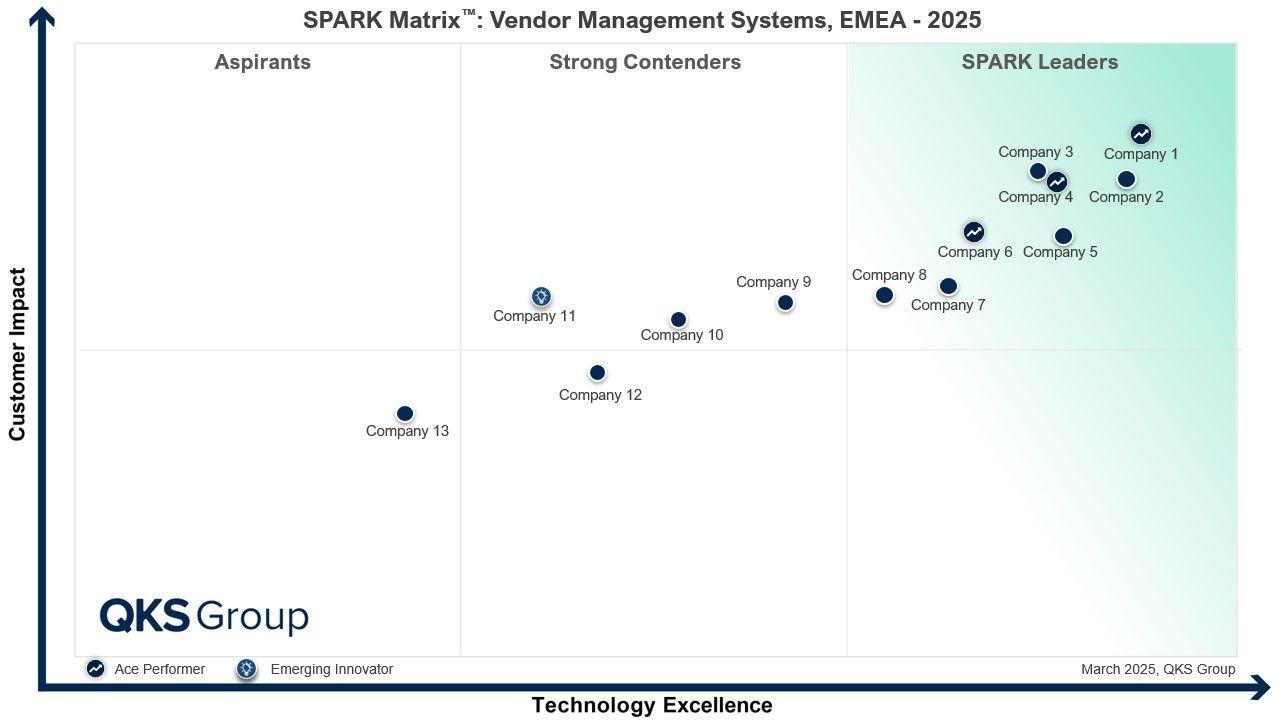
QKS Group's SPARK Matrix framework evaluates technology vendors based on dimensions including Technology Excellence and Customer Impact, providing a structured approach to understanding competitive positioning.
The Vendor Management Systems, EMEA 2025 research focuses specifically on the regional market, helping technology vendors and enterprises understand market dynamics and vendor capabilities.
Click Here For More Information: https://qksgroup.com/market-research/spark-matrix-vendor-management-systems-vms-emea-2025-8457
The Future of Vendor Management
Vendor management is evolving from administrative workforce coordination toward a more strategic, data-driven discipline.
As organizations continue to expand their use of contingent talent, VMS platforms can provide the visibility, automation, compliance support, and analytics required to manage complex workforce ecosystems.
For vendors, differentiation will increasingly depend on their ability to combine workforce intelligence, automation, supplier collaboration, compliance, and regional capabilities within a connected platform.

 English
 Arabic
 French
 Spanish
 Portuguese
 Deutsch
 Turkish
 Dutch
Dutch
 Italiano
 Romaian
 Portuguese (Brazil)
 Greek
Greek
 Bengali