


Plant Layout for Recycling Facility: Compliance, Safety and Workflow Planning
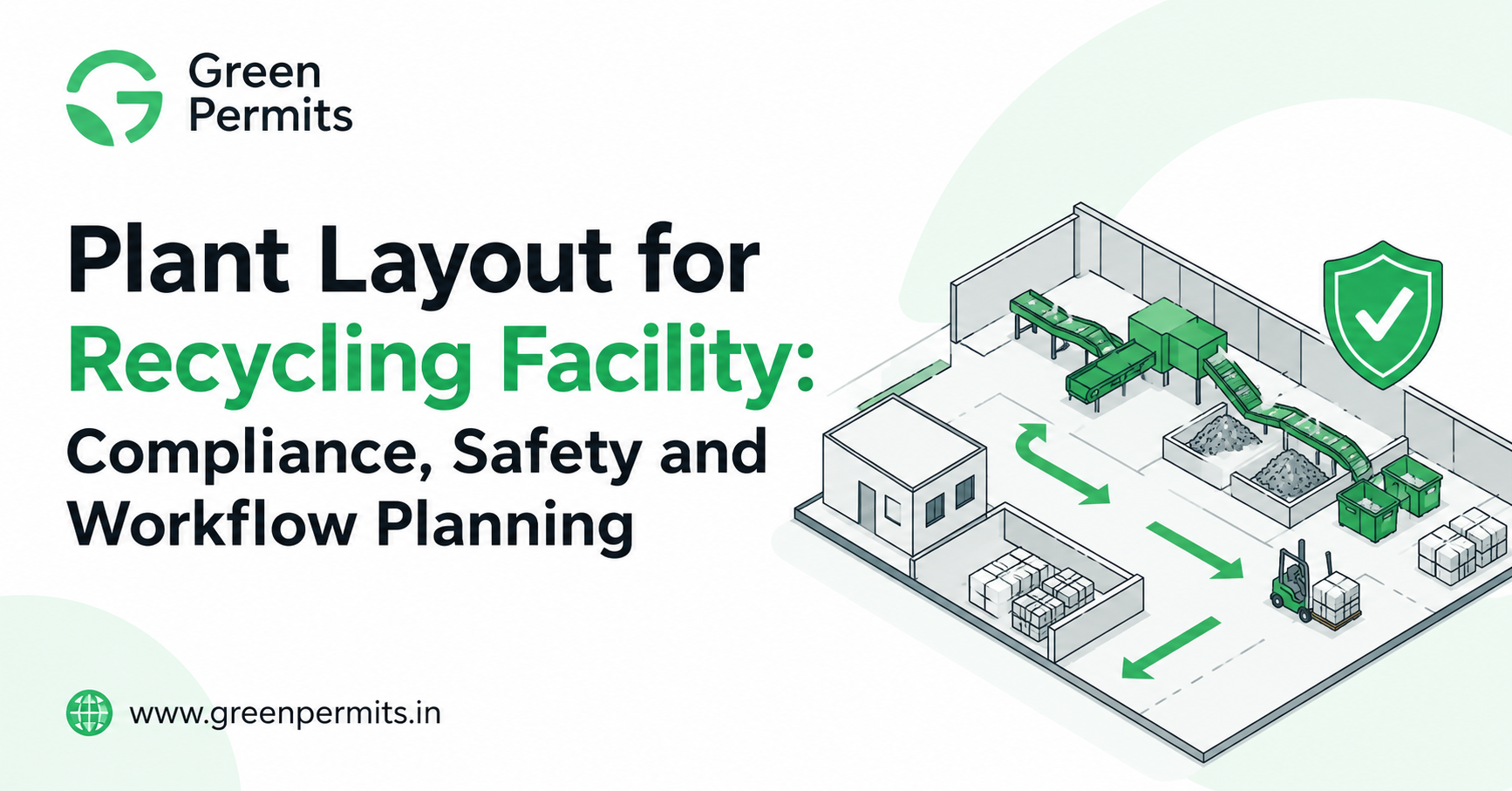
Setting up a recycling facility in India requires more than selecting machinery and arranging waste supply. One of the most important parts of the project is the plant layout.
A good recycling plant layout decides how raw waste enters the facility, where it is stored, how it moves through different processing stages, where finished material is kept, and how workers and vehicles move safely inside the premises.
Poor layout planning can create production delays, safety risks, material mixing, fire hazards and compliance problems. It can also make future expansion difficult.
Whether the project involves plastic waste, e-waste, batteries, waste tyres, used oil or other recyclable material, the plant should be designed around three basic principles:
Compliance + safety + smooth material flow
This guide explains how to plan a practical recycling facility layout in India, including important areas, workflow planning, safety requirements and environmental considerations.
Why Is Plant Layout Important for a Recycling Facility?
A recycling plant handles waste material at different stages.
Incoming waste may be bulky, contaminated or mixed. During processing, the material may be shredded, washed, dismantled, separated or chemically treated. After processing, different finished products and residues must be stored separately.
Without proper layout planning, these activities can interfere with each other.
For example, if raw waste storage is located in the same area as finished recycled material, cross-contamination can occur.
Similarly, if heavy vehicles move through worker areas, the risk of accidents increases.
A well-designed layout helps create a clear flow:
Waste receiving → inspection → storage → processing → recovery → finished material storage → dispatch
This also makes the plant easier to explain during environmental approval, inspection and compliance review.
Which Recycling Plants Need Proper Layout Planning?
Almost every recycling facility benefits from a structured plant layout.
This includes:
- Plastic recycling plants
- E-waste recycling facilities
- Lithium-ion battery recycling plants
- Lead-acid battery recycling
- Waste tyre recycling plants
- Used oil recycling or re-refining facilities
- Metal recycling plants
- Vehicle scrapping facilities
- Industrial waste processing units
However, the layout cannot be identical for all projects.
A plastic washing plant needs more attention to wastewater and drainage.
An e-waste recycling plant needs secure dismantling and component-storage areas.
A lithium-ion battery recycling plant needs additional fire-risk planning and separation for damaged batteries.
The layout must therefore reflect the actual process.
Start With the Process Flow
Before drawing the plant layout, the recycling process should be finalised.
For example, a plastic recycling facility may have the following sequence:
Waste receipt → sorting → shredding → washing → drying → extrusion → granulation → finished granule storage
An e-waste recycling facility may use:
Receipt → weighing → segregation → dismantling → shredding → separation → recovered material storage
A battery recycling process may involve:
Battery receipt → inspection → isolation → dismantling → shredding → separation → recovered material or black mass storage
The plant layout should follow this sequence as closely as possible.
Material should ideally move forward through the process rather than repeatedly moving backward across the plant.
This can reduce unnecessary material handling, labour and internal transportation.
1. Waste Receiving and Weighing Area
The first zone should be designed for incoming vehicles and material inspection.
Depending on the plant size, this area may include:
- Security entry
- Weighbridge or industrial weighing system
- Documentation point
- Inspection area
- Vehicle unloading area
The receiving area should be large enough to avoid vehicle congestion.
Incoming waste should also be inspected before being mixed with existing inventory.
For battery or e-waste plants, damaged, contaminated or unsuitable material may need to be identified immediately and moved into a separate storage area.
2. Raw Material Storage
Raw waste storage is often underestimated during plant planning.
A facility may have machinery capable of processing 5 tonnes per day, but raw material may arrive in larger weekly or monthly lots.
The storage area should therefore be planned according to expected inventory, not only daily processing capacity.
Different waste categories should be segregated.
For example, a plastic recycler may need separate areas for PET, HDPE, PP or other polymers.
An e-waste recycler may separate computers, cables, PCBs, appliances and other components.
Battery recyclers may need separate storage for different battery chemistries.
Clear labelling improves inventory control and reduces processing errors.
3. Processing Area
The processing area should be planned around the machinery sequence.
Machines should not be placed only according to where they physically fit.
Their position should follow material movement.
For example:
Shredder → conveyor → separator → processing machine → finished-product collection
Adequate space should be maintained for:
- Operator movement
- Machinery maintenance
- Material loading
- Emergency access
- Electrical panels
- Safety barriers
Machinery placed too close together may save floor space initially but can make maintenance and safe operation difficult.
4. Finished Goods Storage
Finished recycled products should ideally be kept away from unprocessed waste.
This helps protect material quality and simplifies stock management.
For example, recycled plastic granules should not be stored in an open area where raw waste is unloaded.
Similarly, recovered copper, aluminium or black mass should have clearly identified storage locations.
The finished-goods area should also be close enough to the dispatch point to avoid unnecessary internal movement.
5. Reject and Residue Storage
Not all incoming waste becomes a marketable recycled product.
A recycling plant may generate:
- Dirt and contamination
- Sludge
- Non-recyclable plastic
- Dust
- Used filters
- Hazardous fractions
- Chemical residues
- Rejected components
These materials need dedicated storage.
One common mistake is focusing on raw material and finished products while leaving no suitable area for process residues.
The layout should clearly define:
What residue is generated, how much, where it will be stored and how it will leave the facility.
Hazardous or regulated waste should not be mixed with normal scrap.
6. Pollution Control Area
Pollution-control equipment requires proper space and access.
Depending on the recycling process, this may include:
- Effluent Treatment Plant
- Air pollution control system
- Dust collector
- Scrubber
- Wastewater collection tanks
- Sludge drying area
- Water recycling system
The pollution-control section should not be squeezed into unused corners after the machinery layout has already been finalised.
It should be part of the original plant design.
This becomes especially important for facilities involving washing, shredding, chemical recovery or processes producing dust and fumes.
7. Drainage and Wastewater Planning
Water movement across the plant should be planned carefully.
Areas handling washing or liquid waste should have appropriate drainage.
Clean rainwater, process wastewater and potentially contaminated runoff should not automatically be treated as one common stream.
For a plastic washing unit, the layout may need to connect washing equipment with wastewater collection, ETP and recycled-water storage.
Proper floor slopes and collection arrangements can help avoid water accumulation around machinery.
Poor drainage can create both environmental and workplace-safety problems.
8. Fire and Emergency Safety
Fire planning is especially important for recycling facilities because many waste materials are combustible.
Plastic, rubber, batteries, oils and electronic components can create significant fire risks.
The layout should consider:
- Emergency exits
- Fire-fighting equipment
- Clear access routes
- Emergency assembly areas
- Safe storage distances
- Isolation areas for higher-risk materials
Battery recycling facilities need special attention.
Damaged lithium-ion batteries can present thermal and fire risks, so they should not simply be stored with normal material.
A dedicated isolation or quarantine area may be required based on the project's safety assessment.
9. Worker and Vehicle Movement
Workers and vehicles should not use the same movement path wherever possible.
Large recycling plants may have forklifts, loaders, trucks and other material-handling equipment operating throughout the day.
Marking dedicated pedestrian routes can reduce accident risk.
The layout should also consider:
Vehicle entry → unloading → turning → loading → exit
If trucks repeatedly reverse through crowded areas, the design may need improvement.
Simple movement planning can significantly improve daily operations.
10. Utility and Electrical Areas
Electrical equipment and utilities should have clearly identified spaces.
These may include:
- Transformer
- DG set
- Compressor
- Electrical panel room
- Water storage
- Pumps
- Boiler or heating equipment, where applicable
These areas should be accessible for maintenance but protected from unnecessary worker or waste movement.
Electrical systems should also be planned according to machine load rather than added after installation.
Documents Needed for Recycling Plant Layout Planning
Before preparing the final layout, several project details should be available.
These may include:
- Land dimensions
- Site map
- Proposed plant capacity
- Process flow diagram
- Machinery dimensions
- Machinery capacity
- Utility requirements
- Raw material storage requirement
- Finished-product storage requirement
- Pollution-control systems
- Fire and safety requirements
- Vehicle movement plan
If machinery dimensions are not available, the first layout should be treated as preliminary.
The final layout should be updated after machinery vendors provide accurate technical drawings.
Layout Planning for CTE and CTO
The plant layout is also important during environmental compliance.
Applications for Consent to Establish (CTE) often require site and plant information explaining where the proposed industrial activity will take place.
Later, during Consent to Operate (CTO) or inspection, the actual facility should generally remain consistent with the approved project.
If the original layout shows one process but completely different machinery is installed later, questions may arise.
This is why the layout, DPR, machinery list and environmental applications should all describe the same project.
Common Plant Layout Mistakes
One common mistake is trying to maximise machinery inside the smallest possible building.
This can leave insufficient storage and maintenance space.
Another mistake is allowing raw material, finished products and waste residues to overlap.
Other common problems include poor truck movement, no dedicated hazardous-waste area, inadequate drainage, limited emergency access and insufficient room for future expansion.
Entrepreneurs should also avoid preparing a layout only for approvals.
The same drawing should make operational sense when the plant begins running daily.
Plan Space for Future Expansion
If the business expects to increase capacity later, some expansion space should be considered from the beginning.
For example, a plastic recycling plant may initially install one extrusion line and add another after two years.
If the first layout uses the entire site without expansion planning, adding machinery later can become difficult.
Expansion planning does not mean installing unnecessary equipment immediately.
It simply means keeping future movement, utilities and land use in mind.
Benefits of a Good Recycling Plant Layout
A properly planned layout can help improve:
- Material movement
- Worker safety
- Machinery utilisation
- Waste segregation
- Pollution control
- Inventory management
- Regulatory compliance
- Emergency response
- Future expansion
It can also reduce unnecessary handling costs.
Every extra movement of waste inside the facility requires manpower, equipment or electricity.
A logical workflow can therefore improve both compliance and profitability.
How Can a Recycling Plant Consultant Help?
A Recycling Plant Layout Consultant can review the process before machinery installation begins.
The consultant can study plant capacity, waste type, machinery sequence, storage requirement and pollution-control systems.
Support may include process-flow planning, preliminary plant layout, DPR preparation, CTE/CTO documentation and waste-specific recycler-registration support.
For projects such as e-waste, batteries and vehicle scrapping, layout planning can also help ensure that hazardous or sensitive waste streams have dedicated handling areas.
Green Permits can coordinate plant-layout planning with the wider environmental approval roadmap so that engineering and compliance do not develop separately.
Conclusion
A good plant layout for a recycling facility should support safe, compliant and efficient operations.
The design should begin with the process flow and then organise receiving, raw-material storage, machinery, pollution-control systems, finished goods and residue storage in a logical sequence.
Worker safety, fire protection, drainage, vehicle movement and future expansion should also be considered before the plant is finalised.
Most importantly, the plant layout should match the DPR, machinery capacity, CTE, CTO and recycler-registration requirements.
Green Permits assists entrepreneurs and businesses with Recycling Plant Layout Planning, DPR preparation, CTE/CTO approvals, recycler registrations and complete environmental compliance support across India.
Website: https://www.greenpermits.in
Phone: +91 78350 06182
Email: wecare@greenpermits.in

 English
 Arabic
 French
 Spanish
 Deutsch
 Turkish
 Dutch
Dutch
 Italiano
 Russian
 Romaian
 Portuguese (Brazil)
 Greek
Greek
 Bengali