


Automotive Intelligent Battery Sensor Market to Reach USD 24.7 Billion by 2036, Driven by Vehicle Electrification, Smart Battery Management, and Hall-effect Technology at 10.1% CAGR
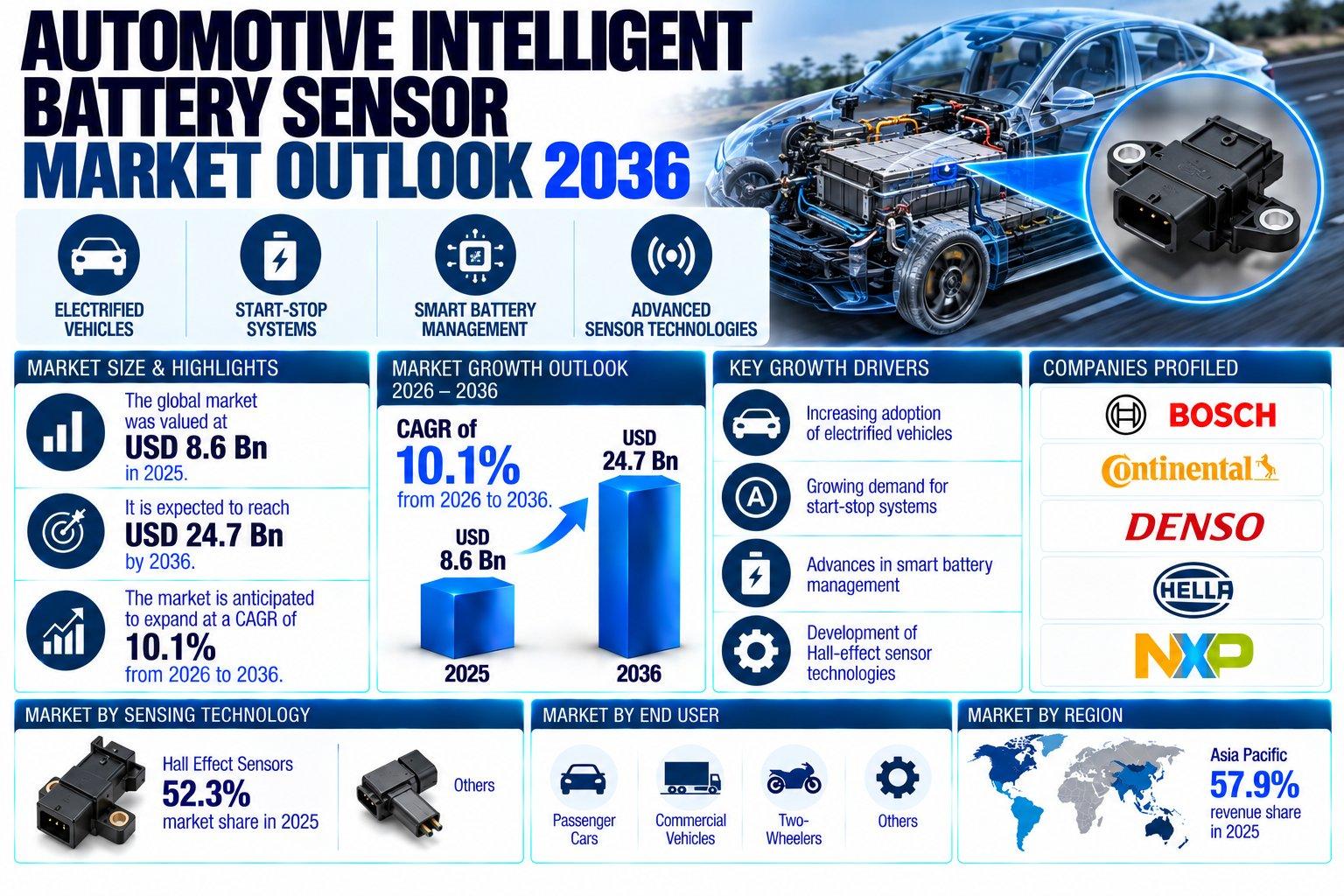
The global automotive intelligent battery sensor market is experiencing strong growth as vehicle electrification, advanced energy-management systems, and intelligent battery technologies become increasingly important across passenger and commercial vehicles. Valued at USD 8.6 Billion in 2025, the market is projected to reach USD 24.7 Billion by 2036, expanding at a CAGR of 10.1% from 2026 to 2036.
Automotive intelligent battery sensors continuously monitor critical battery parameters, including voltage, current, temperature, state of charge (SoC), state of health (SoH), and state of function (SoF). The data generated by these sensors enables electronic control units and battery management systems to optimize charging, energy distribution, battery performance, and overall vehicle operation.
The growing adoption of start-stop systems, mild hybrid electric vehicles, hybrid electric vehicles, plug-in hybrid vehicles, and battery electric vehicles is creating significant demand for intelligent battery monitoring. Advances in Hall-effect sensing, precision shunt resistors, semiconductor integration, and battery-monitoring integrated circuits are further improving measurement accuracy and system performance.
Asia Pacific dominated the global market in 2025, accounting for approximately 57.9% of total revenue. By sensing technology, Hall-effect sensors represented the leading segment, accounting for approximately 52.3% of market revenue in the same year.
Analysts’ Viewpoint on the Automotive Intelligent Battery Sensor Market
The automotive intelligent battery sensor industry is expanding as automotive manufacturers increasingly prioritize vehicle electrification, energy efficiency, battery reliability, and advanced power management. Intelligent battery sensors have become important components of modern electrical architectures because they provide continuous information regarding battery operating conditions.
Start-stop systems, hybrid powertrains, battery electric vehicles, and connected vehicles all require increasingly sophisticated battery monitoring. Accurate information regarding current, voltage, temperature, SoC, and SoH allows vehicle-control systems to optimize battery usage and charging strategies while supporting longer battery operating life.
Technological advances in Hall-effect current sensing, precision shunt sensing, integrated battery-monitoring ICs, and semiconductor technologies are improving the capabilities of intelligent battery sensors. At the same time, automotive manufacturers are increasingly integrating artificial intelligence, predictive analytics, and cloud-based diagnostics into battery-management systems.
These developments are creating opportunities for intelligent battery sensors to move beyond basic monitoring toward predictive maintenance, battery-life optimization, remote diagnostics, and intelligent energy management. The tightening of emission standards and continued electrification of the automotive industry are expected to further support market expansion.
Automotive Intelligent Battery Sensor Market Introduction
Automotive intelligent battery sensors are electronic sensing units generally mounted near battery terminals to continuously measure critical battery-operating parameters. These systems can monitor battery current, voltage, temperature, state of charge, state of health, and other indicators associated with battery aging and performance.
The information generated by intelligent battery sensors is transmitted to battery management systems and vehicle electronic control units. These systems use the data to support charging optimization, energy distribution, start-stop functionality, regenerative braking, alternator control, electrical load management, and battery replacement diagnostics.
Modern intelligent battery sensors combine sensing technologies with microcontrollers, temperature sensors, signal-processing capabilities, and communication interfaces such as Local Interconnect Network and Controller Area Network. Hall-effect and shunt-based current-sensing technologies are increasingly integrated into intelligent monitoring architectures.
The growing complexity of vehicle electrical systems is strengthening the importance of accurate battery monitoring. Modern vehicles incorporate multiple electronic control units, infotainment systems, advanced driver assistance systems, and increasingly electrified powertrains. These systems require efficient and reliable power distribution.
The expansion of electric and hybrid vehicles, together with the emergence of software-defined vehicles, is creating additional demand for smart battery-monitoring systems capable of maximizing battery performance, reliability, and operating life.
Increasing Adoption of Electrified Vehicles and Start-Stop Systems Drives Market Growth
The increasing adoption of electrified vehicles and automatic start-stop systems is a major factor driving the automotive intelligent battery sensor market. Modern vehicles require continuous monitoring of battery performance to ensure reliable engine starting, optimized charging, and sufficient electrical power for increasingly sophisticated onboard systems.
The growing number of mild hybrid electric vehicles, hybrid electric vehicles, plug-in hybrid vehicles, and battery electric vehicles is increasing demand for advanced battery-monitoring technologies. Intelligent battery sensors provide accurate current, voltage, and temperature information that vehicle-control systems can use to optimize battery charging and energy consumption.
Start-stop systems also place additional requirements on automotive batteries because vehicles may repeatedly stop and restart the engine during operation. Accurate monitoring allows the vehicle's electrical system to determine battery conditions and manage energy availability more effectively.
Vehicle electrification is simultaneously increasing the importance of battery performance and energy efficiency. Automotive manufacturers are using intelligent battery sensors as part of broader strategies to improve fuel efficiency, reduce emissions, and manage increasingly complex electrical architectures.
As electrified powertrains and advanced vehicle electrical systems become more widespread, intelligent battery sensors are expected to remain an important component of automotive energy-management systems.
Advances in Smart Battery Management and Hall-effect Sensor Technologies Support Market Expansion
Technological improvements in Hall-effect sensing, semiconductor integration, and battery-management electronics are supporting the development of increasingly sophisticated intelligent battery sensors. Hall-effect sensors enable non-contact current measurement, helping provide accurate measurements while maintaining electrical isolation and minimizing power losses.
The integration of sensing elements with microcontrollers, signal-processing systems, and communication interfaces allows intelligent battery sensors to perform multi-parameter monitoring and communicate information directly to vehicle-control systems.
Advances in semiconductor technology and low-power microcontrollers are contributing to improved accuracy, faster response times, and enhanced diagnostic capabilities. These improvements are particularly relevant to modern vehicles with increasingly complex electrical and energy-management requirements.
In November 2025, at MEDICA 2025, ams-OSRAM AG presented its AS6223 ultra-miniature temperature sensor. The sensor provides accuracy of ±0.09°C through a sub-1 mm² design and is characterized by low power consumption. The development demonstrates continued innovation in compact sensing technologies relevant to automotive electronics, battery monitoring, and thermal-management applications.
AI-based Predictive Battery Diagnostics and Connected Battery Management Create Opportunities
The integration of artificial intelligence and connected-vehicle technologies is creating new opportunities for intelligent battery sensors. Modern battery management systems can use AI algorithms and vehicle operating data to analyze battery condition, estimate battery degradation and remaining life, and optimize charging strategies.
Intelligent battery sensors can supply diagnostic information to connected vehicle platforms and cloud-based fleet-management systems. Manufacturers and service providers can use this information for remote battery monitoring, predictive maintenance, and diagnostics.
Predictive battery management can help identify potential battery issues before they result in unexpected failures. For fleet operators, this capability can support vehicle uptime and potentially reduce maintenance requirements by enabling condition-based servicing.
The emergence of software-defined vehicles is creating further opportunities. Intelligent battery sensors and their associated systems can potentially benefit from software improvements and over-the-air updates that enhance diagnostic capabilities and monitoring algorithms.
As connected and software-defined vehicles become increasingly sophisticated, intelligent battery sensors are expected to evolve beyond conventional battery monitoring and become an important component of intelligent energy management across electrified mobility platforms.
Hall-effect Sensors Segment Dominates the Automotive Intelligent Battery Sensor Market
By sensing technology, the Hall-effect sensors segment dominated the global automotive intelligent battery sensor market in 2025, accounting for approximately 52.3% of total market revenue.
Hall-effect technology is widely used for automotive current sensing because it enables non-contact measurement while providing electrical isolation and low power consumption. These characteristics make the technology suitable for battery monitoring across conventional vehicles as well as hybrid and battery electric vehicles.
Hall-effect sensors can provide stable performance across broad temperature ranges and can support the measurement of high currents required in automotive electrical systems. Their resistance to mechanical wear and suitability for demanding automotive environments further support their use in intelligent battery-sensing applications.
The increasing adoption of advanced battery management systems, intelligent alternator control, regenerative braking, start-stop systems, and 48V electrical architectures is creating additional demand for Hall-effect-based intelligent battery sensors.
Continued advances in semiconductor manufacturing, signal conditioning, integrated communication interfaces, and sensor design are expected to support the development of increasingly capable Hall-effect sensing systems for automotive applications.
Asia Pacific Automotive Intelligent Battery Sensor Market Outlook
Asia Pacific dominated the global automotive intelligent battery sensor market in 2025, accounting for approximately 57.9% of total revenue. The region's leading position is supported by its extensive automotive manufacturing network, growing electric vehicle production, and increasing adoption of advanced battery-management technologies.
China, Japan, South Korea, and India are investing significantly in electric vehicle manufacturing, battery production, automotive electronics, and intelligent mobility technologies. These developments are creating substantial demand for intelligent battery sensors.
China represents a major market due to its strong electric vehicle manufacturing ecosystem and initiatives supporting new-energy vehicles. Japan and South Korea have established automotive electronics industries, supported by major automotive manufacturers and Tier 1 suppliers incorporating advanced battery-management systems into conventional and electrified vehicles.
India is also developing its electric mobility ecosystem, creating opportunities for battery-management technologies and automotive sensing systems.
In August 2025, FORVIA HELLA announced initial mass production of its 12V Lithium Battery Management System in China for electric, plug-in hybrid, and mild-hybrid vehicles. The system provides battery monitoring and charge-status information and supports 12V, 48V, and high-voltage systems. The development highlights the growing importance of intelligent low-voltage power management within vehicle electrification architectures.
The combination of automotive manufacturing capabilities, electric vehicle production, battery technology development, and automotive electronics expertise is expected to support continued growth of the Asia Pacific intelligent battery sensor market.
Competitive Landscape of Automotive Intelligent Battery Sensor Market
The global automotive intelligent battery sensor market is characterized by competition among automotive electronics suppliers, semiconductor manufacturers, sensor companies, and battery-management technology providers. Market participants are focusing on Hall-effect current sensing, multi-parameter battery monitoring, AI-enabled diagnostics, integrated communication systems, and advanced power-management capabilities.
Key companies operating in the market include Continental AG, HELLA GmbH & Co. KGaA, inomatic GmbH, NXP Semiconductors, ams-OSRAM AG, Furukawa Electric Co., Ltd., Vishay Intertechnology, Robert Bosch GmbH, DENSO Corporation, MTA S.p.A., Abertax Technologies Ltd., and Autotec Components.
Companies are investing in sensing accuracy, semiconductor integration, intelligent algorithms, vehicle communication technologies, and automotive-grade reliability. The competitive environment is also being shaped by the transition toward electrified vehicles and increasingly software-defined vehicle architectures.
Manufacturers are seeking to provide sensing solutions that can support multiple vehicle architectures and battery types while improving diagnostics, energy efficiency, and battery performance. The ability to integrate sensors with broader battery-management and vehicle-control systems is becoming increasingly important to competitive positioning.
Recent Developments in the Automotive Intelligent Battery Sensor Market
In July 2026, Vishay Intertechnology introduced the 34 PHE multi-turn absolute position sensor, a non-contact Hall-effect sensing solution designed for demanding industrial and automotive environments. The sensor provides multi-turn position measurement and incorporates features intended to support durability in harsh operating conditions.
In November 2025, at the 2025 ams OSRAM Technology Forum, ams-OSRAM AG presented developments across automotive sensing technologies, including intelligent lighting systems, CMOS sensors, ASICs, and infrared sensing solutions. The company also established a new product design center in China to expand its regional research and development capabilities for automotive sensing and intelligent mobility applications.
In October 2025, NXP Semiconductors introduced an electrochemical impedance spectroscopy-based battery management system chipset combining advanced battery diagnostics with battery cell controllers and junction-box controllers. The solution is designed to provide battery-health monitoring and fault identification, supporting applications in electric vehicles and energy storage systems.
In May 2025, FORVIA HELLA secured a USD 1.1 billion contract to develop its Advanced Control Module, incorporating eFuse ASIC integration and smart power-management software. The system is designed to enable real-time power-consumption monitoring and optimized electrical power distribution while supporting vehicle electrification and advanced vehicle functions.
Future Outlook for the Automotive Intelligent Battery Sensor Market
The global automotive intelligent battery sensor market is positioned for significant expansion as vehicle electrification and intelligent energy management become increasingly important. From USD 8.6 Billion in 2025, the market is projected to reach USD 24.7 Billion by 2036, expanding at a CAGR of 10.1% during 2026–2036.
The increasing adoption of mild hybrid, hybrid, plug-in hybrid, and battery electric vehicles is expected to remain a major market driver. The continued use of start-stop systems and increasingly complex vehicle electrical architectures will further strengthen the need for accurate battery monitoring.
Technological advances in Hall-effect sensors, shunt sensing, semiconductor integration, AI-based diagnostics, and connected battery management are expected to create additional opportunities. Intelligent battery sensors are increasingly becoming part of broader vehicle energy-management systems rather than functioning solely as individual monitoring devices.
Asia Pacific is expected to remain a major center of market activity due to its extensive automotive production base and growing electric vehicle ecosystem. Meanwhile, the continued development of software-defined vehicles and connected mobility platforms could further increase the importance of real-time battery data.
As automotive manufacturers continue to improve vehicle electrification, energy efficiency, battery reliability, and predictive maintenance capabilities, intelligent battery sensors are expected to play an increasingly important role in the next generation of automotive electrical and battery-management systems.

 English
 Arabic
 Spanish
 Portuguese
 Deutsch
 Turkish
 Dutch
Dutch
 Italiano
 Russian
 Romaian
 Portuguese (Brazil)
 Greek
Greek
 Bengali