


Connected Motorcycle Market Size to Reach USD 2,363.7 Million by 2034, Growing at 29.17% CAGR
Market Overview
According to a research report by IMARC Group, the global connected motorcycle market size reached USD 221.8 Million in 2025. Looking forward, IMARC Group expects the market to reach USD 2,363.7 Million by 2034, exhibiting a growth rate (CAGR) of 29.17% during 2026-2034. The growing emphasis on driver safety, increasing demand for a comfortable and safe riding experience, rising reliance on smartphones, expanding 5G networks, and the integration of advanced connectivity technologies are some of the major factors positively influencing the market.
Connected Motorcycle Market Key At a Glance
-
Base Year: 2025
-
Historical Period: 2020–2025
-
Forecast Period: 2026–2034
-
Market Size (2025): USD 221.8 Million
-
Market Forecast (2034): USD 2,363.7 Million
-
CAGR (2026–2034): 29.17%
Request for a Sample Report for Detailed Evaluation: https://www.imarcgroup.com/connected-motorcycle-market/requestsample
Connected Motorcycle Market Report: Key Highlights
-
Market Size & Growth: The global connected motorcycle market reached USD 221.8 Million in 2025 and is projected to reach USD 2,363.7 Million by 2034, registering a CAGR of 29.17% during 2026–2034, according to IMARC Group.
-
Key Market Drivers: Growing emphasis on driver safety, increasing demand for comfortable and safe riding experiences, rising smartphone reliance, expanding 5G networks, and increasing road safety initiatives.
-
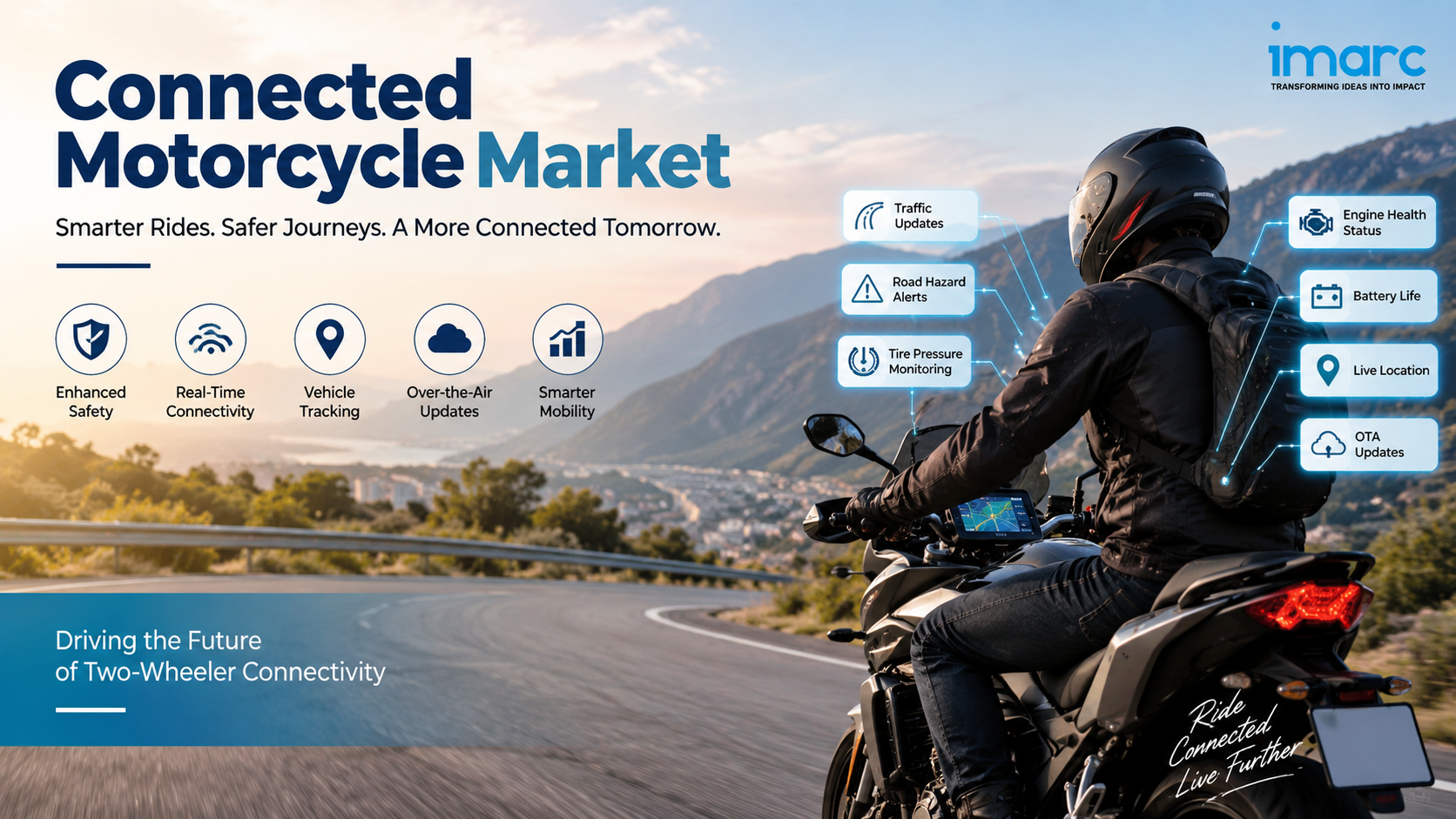
Connected Features: Connected motorcycles enable riders to access traffic conditions, pothole alerts, road curves, oil levels, tire pressure, battery life, vehicle location, performance information, roadside assistance, and over-the-air updates.
-
Key Technologies: The integration of smart sensors, big data, Internet of Things (IoT) technologies, telematics control units, and cellular connectivity is supporting the development of advanced connected motorcycle solutions.
-
Service Segmentation: The market covers driver assistance, infotainment, safety, vehicle management and telematics, and insurance services.
-
Hardware Segmentation: The market is divided into embedded and tethered hardware.
-
Network Type: The market covers Cellular V2X and Dedicated Short Range Communication.
-
End User: The market comprises private and commercial users.
-
Key Market Trends: Increasing deployment of 5G networks, development of two-wheeler-specific applications, real-time vehicle monitoring, remote diagnostics, maintenance reminders, automatic collision notifications, and OTA updates.
-
Competitive Landscape: Leading companies operating in the connected motorcycle market include Aeris, Autotalks Ltd., BMW AG, Continental AG, DXC Technology Company, Facomsa, IAV, KPIT Technologies Ltd, Panasonic Corporation, Robert Bosch GmbH, Starcom Systems Ltd, and TE Connectivity.
What Is Driving Connected Motorcycle Market Growth in 2026?
Growing Emphasis on Driver Safety
The growing emphasis on driver safety represents one of the key factors positively influencing the connected motorcycle market. Connected motorcycles provide riders with advanced assistance features and real-time information related to traffic conditions, road curves, potholes, tire pressure, oil levels, and battery life. These capabilities can help riders remain informed about vehicle and road conditions and support a safer riding experience.
Moreover, the considerable rise in the number of road accidents is escalating demand for technologies designed to enhance driver safety. Road safety authorities worldwide are also undertaking initiatives to minimize fatal road accidents, further supporting the adoption of connected motorcycle technologies.
Rising Demand for Comfortable and Safe Riding Experiences
Increasing consumer demand for comfortable and safe riding experiences is contributing to the adoption of connected motorcycles. Advanced connectivity systems provide riders with access to vehicle information, navigation-related alerts, roadside assistance, maintenance reminders, and other services through integrated digital platforms.
These features can improve convenience while providing riders with greater access to information about their motorcycles. As consumers increasingly seek advanced assistance and connected features, manufacturers and technology providers are focusing on improving the safety, reliability, efficiency, and convenience of vehicle connectivity systems.
Increasing Reliance on Smartphones and 5G Networks
The increasing reliance on smartphones and the rising deployment of 5G networks are supporting market growth. Connected motorcycle solutions can interact with smartphone applications to provide motorcycle status information, tamper alerts, vehicle location, and other connected services.
The expansion of high-speed connectivity infrastructure is further supporting the development of real-time communication between motorcycles, riders, applications, and connected systems. This is encouraging manufacturers and technology providers to develop more sophisticated connectivity solutions for two-wheelers.
Growing Development of Two-Wheeler Applications
App developers are increasingly creating two-wheeler-specific applications that provide riders with a range of connected services. These applications can offer motorcycle status updates, tamper alerts, vehicle location information, automatic collision notifications, remote diagnostics, and maintenance reminders.
The availability of such applications is expanding the functionality of connected motorcycles beyond basic vehicle monitoring and creating an increasingly integrated digital riding experience.
Integration of IoT, Smart Sensors, and Big Data
Leading market players are integrating smart sensors, big data, and Internet of Things (IoT) technologies to monitor motorcycle health and deliver real-time warnings to riders. These technologies can collect and analyze vehicle information, helping provide insights into motorcycle performance and operating conditions.
The increasing integration of these technologies is also supporting remote monitoring, performance analytics, roadside assistance, and other connected services. Companies are consequently focusing on developing connectivity systems that enhance vehicle safety, reliability, efficiency, and convenience.
Connected Motorcycle Market Segmentation Analysis
By Service
-
Driver Assistance
-
Infotainment
-
Safety
-
Vehicle Management and Telematics
-
Insurance
The connected motorcycle market is segmented by service into driver assistance, infotainment, safety, vehicle management and telematics, and insurance. These services collectively expand the functionality of connected motorcycles by providing riders with assistance, vehicle information, safety-related alerts, entertainment, monitoring capabilities, and insurance-related solutions.
Driver assistance and safety-related services are particularly relevant to the growing focus on rider protection, while vehicle management and telematics services support remote monitoring and performance analytics. Infotainment services further contribute to the connected riding experience.
By Hardware
-
Embedded
-
Tethered
The market is divided by hardware into embedded and tethered systems. Connected motorcycle hardware provides the technological foundation required to establish communication between the motorcycle, telematics control unit, rider, and connected applications.
The adoption of these hardware configurations is supporting the deployment of connected services across motorcycles, enabling features such as remote monitoring, vehicle tracking, diagnostics, and real-time alerts.
By Network Type
-
Cellular V2X
-
Dedicated Short Range Communication
Cellular V2X and Dedicated Short Range Communication represent the key network types covered in the connected motorcycle market. These communication technologies support connectivity between vehicles and surrounding systems, enabling the exchange of relevant information.
The increasing deployment of advanced communication networks and growing focus on connected mobility are supporting the development and adoption of network-enabled motorcycle technologies.
By End User
-
Private
-
Commercial
The connected motorcycle market is segmented into private and commercial end users. Private users represent individual riders who can benefit from connected features such as safety alerts, vehicle tracking, maintenance reminders, and motorcycle status information.
Commercial users can leverage connected motorcycle technologies for vehicle monitoring, operational information, performance analytics, remote diagnostics, and other connectivity-enabled services. The availability of these capabilities is supporting the adoption of connected solutions across different motorcycle applications.
By Region
-
North America
-
United States
-
Canada
-
-
Asia Pacific
-
China
-
Japan
-
India
-
South Korea
-
Australia
-
Indonesia
-
Others
-
-
Europe
-
Germany
-
France
-
United Kingdom
-
Italy
-
Spain
-
Russia
-
Others
-
-
Latin America
-
Brazil
-
Mexico
-
Others
-
-
Middle East and Africa
The report provides a comprehensive analysis of the connected motorcycle market across North America, Asia Pacific, Europe, Latin America, and the Middle East and Africa. The regional analysis covers major markets including the United States, Canada, China, Japan, India, South Korea, Australia, Indonesia, Germany, France, the United Kingdom, Italy, Spain, Russia, Brazil, and Mexico, along with other countries.
The increasing focus on connected mobility, rider safety, smartphone-based applications, advanced communication networks, and vehicle connectivity is supporting the development of the market across different regions.
Key Regional Insight: Expanding Connected Mobility Ecosystem
The connected motorcycle market is being supported by the broader development of connected mobility technologies. The increasing deployment of advanced communication networks, rising smartphone usage, and growing adoption of IoT-enabled solutions are encouraging the integration of connectivity features into two-wheelers.
As manufacturers and technology providers continue to develop systems capable of delivering real-time vehicle information, safety alerts, remote diagnostics, and other connected services, the connected motorcycle ecosystem is expanding across different markets.
Competitive Landscape in the Connected Motorcycle Industry
The competitive landscape of the global connected motorcycle market has been examined in the report along with profiles of key players operating in the industry. Companies are focusing on developing advanced connectivity solutions that improve motorcycle safety, reliability, efficiency, and convenience.
Leading players are integrating telematics, smart sensors, IoT, big data, cellular connectivity, and application-based services to expand the functionality of connected motorcycles. The increasing demand for real-time vehicle information, remote monitoring, safety alerts, and digital riding services is encouraging continued innovation across the industry.
Key Connected Motorcycle Market Players Include:
-
Aeris
-
Autotalks Ltd.
-
BMW AG
-
Continental AG
-
DXC Technology Company
-
Facomsa
-
IAV
-
KPIT Technologies Ltd
-
Panasonic Corporation
-
Robert Bosch GmbH
-
Starcom Systems Ltd
-
TE Connectivity
Note: The above represents the key companies identified in the provided report information.
Market Drivers, Challenges & Opportunities
Major Market Drivers:
-
Growing Emphasis on Driver Safety: Increasing focus on reducing road accidents and improving rider safety is supporting demand for connected motorcycle solutions.
-
Demand for Comfortable Riding Experiences: Consumers are increasingly seeking advanced assistance, monitoring, and convenience features that can enhance the riding experience.
-
Smartphone Adoption: Growing reliance on smartphones is supporting the development of application-based motorcycle connectivity services.
-
5G Network Deployment: The rising deployment of 5G networks is supporting faster and more sophisticated connectivity solutions.
-
IoT and Smart Sensor Integration: Increasing integration of IoT, smart sensors, and big data is enabling real-time motorcycle monitoring and warnings.
Key Challenges:
-
Connectivity Requirements: The effectiveness of connected motorcycle services depends on reliable communication and connectivity infrastructure.
-
Technology Integration: Integrating telematics, sensors, applications, and communication technologies into motorcycle systems requires continued technological development.
-
Data-Driven Systems: The increasing reliance on vehicle data and connected platforms requires sophisticated systems capable of collecting and processing motorcycle information effectively.
Emerging Opportunities:
-
Advanced Driver Assistance: Growing demand for technologies that provide riders with real-time road and vehicle information is creating opportunities for connected motorcycle providers.
-
5G-Enabled Connectivity: Expanding 5G networks are creating opportunities for more advanced and responsive connected motorcycle applications.
-
Remote Diagnostics and Vehicle Management: Increasing demand for remote monitoring, maintenance reminders, and performance analytics is creating new avenues for market participants.
-
Two-Wheeler Applications: The development of dedicated motorcycle applications offering status monitoring, tamper alerts, vehicle location, collision notifications, and other features is creating opportunities for technology providers.
Connected Motorcycle Market FAQs
1. What is the current size of the connected motorcycle market?
The global connected motorcycle market reached USD 221.8 Million in 2025 and is expected to grow at a CAGR of 29.17% during 2026-2034, reaching USD 2,363.7 Million by 2034.
2. What is driving the growth of the connected motorcycle market?
The market is driven by growing emphasis on driver safety, increasing demand for comfortable and safe riding experiences, rising reliance on smartphones, increasing deployment of 5G networks, road safety initiatives, and the integration of IoT, smart sensors, and big data technologies.
3. What are connected motorcycles?
Connected motorcycles are intelligent mobility solutions that connect riders to a telematics control unit (TCU) through cellular connectivity. They can provide information and alerts related to traffic conditions, potholes, road curves, oil levels, tire pressure, battery life, vehicle performance, vehicle location, roadside assistance, and other connected services.
4. What services are included in the connected motorcycle market?
The market includes driver assistance, infotainment, safety, vehicle management and telematics, and insurance services.
5. What are the key trends in the connected motorcycle market?
Key trends include the increasing deployment of 5G networks, growing reliance on smartphone applications, development of two-wheeler-specific applications, integration of smart sensors and IoT, remote diagnostics, automatic collision notifications, maintenance reminders, real-time vehicle monitoring, and over-the-air updates.
Conclusion: Connected Motorcycle Market Outlook to 2034
The global connected motorcycle market is set for significant growth through 2034, supported by the increasing emphasis on rider safety, rising demand for comfortable and connected riding experiences, growing smartphone reliance, expanding 5G networks, and continued integration of IoT, smart sensors, and big data technologies.
Connected motorcycles are increasingly evolving beyond basic transportation solutions by incorporating vehicle monitoring, driver assistance, safety alerts, remote diagnostics, performance analytics, roadside assistance, and OTA updates. The development of dedicated two-wheeler applications is further expanding the range of connected services available to riders.
With continued advancements in connectivity technologies and increasing focus on improving the safety, reliability, efficiency, and convenience of motorcycle systems, the connected motorcycle market is expected to expand significantly through 2034. Companies investing in advanced connectivity platforms, telematics, sensor technologies, and digital motorcycle services are positioned to participate in the evolving connected mobility ecosystem.
About the Author:
IMARC Group is a leading global market research company providing data-driven insights and expert consulting services to businesses seeking to achieve their strategic objectives. With a multi-disciplinary team of industry experts, IMARC delivers thorough, reliable market intelligence across sectors including Energy and Mining, Construction and Manufacturing, Automotive, Chemicals and Materials, and more.
Media & Sales Contact:
IMARC Group
United States: +1-201-971-6302
India: +91-120-433-0800
United Kingdom: +44-753-714-6104

 English
 French
 Spanish
 Portuguese
 Deutsch
 Turkish
 Dutch
Dutch
 Italiano
 Russian
 Romaian
 Portuguese (Brazil)
 Greek
Greek
 Bengali