


Pollution Control Compliance Required for Recycling Plants in India
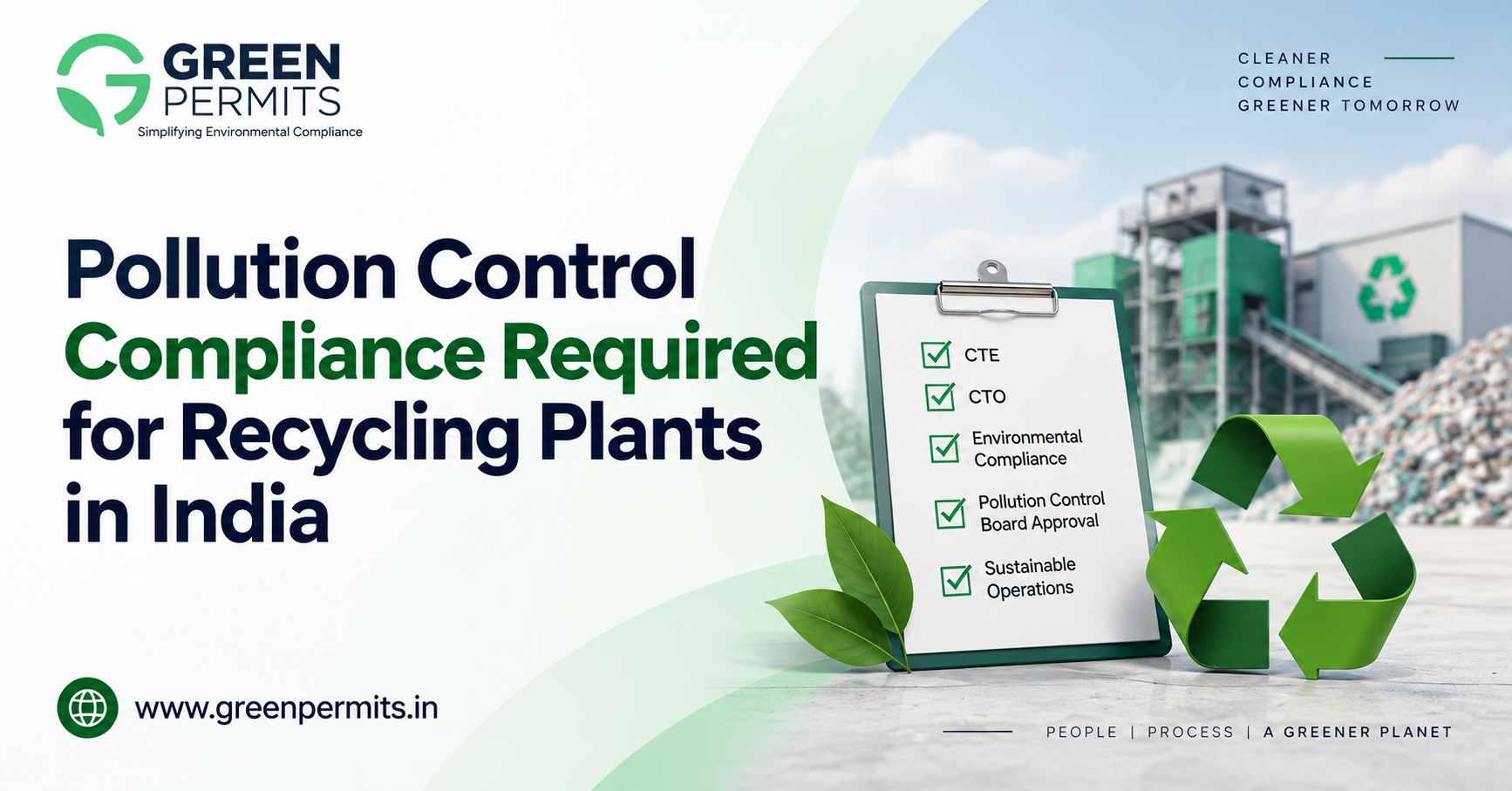
Recycling plants play an important role in reducing waste and recovering useful materials, but recycling itself can create air emissions, wastewater, dust, sludge, hazardous residues and safety risks if the plant is not properly designed.
That is why setting up a recycling facility in India involves more than purchasing machinery and arranging waste material.
Whether a business plans to recycle plastic waste, e-waste, batteries, waste tyres, used oil, metals or end-of-life vehicles, it must understand the pollution-control requirements that apply to its process.
In most projects, compliance starts with the State Pollution Control Board or Pollution Control Committee and may include Consent to Establish, Consent to Operate, pollution-control systems, waste-specific registration, record keeping and periodic reporting.
The exact requirements depend on the waste handled, technology, production capacity, state and pollution category.
This guide explains the major pollution-control compliance requirements that recycling businesses should consider before starting operations.
Why Is Pollution Control Compliance Important for Recycling Plants?
Recycling is environmentally beneficial only when waste is processed safely.
For example, a plastic recycling plant may create wastewater during washing. An e-waste recycling facility can generate fine dust and hazardous fractions. Battery recycling may involve contaminated material, chemicals and air emissions.
If these waste streams are not controlled, the recycling activity itself can cause pollution.
India's pollution-control framework is implemented through the Central Pollution Control Board, State Pollution Control Boards and Pollution Control Committees under laws including the Water and Air Acts. CPCB provides technical guidance, while SPCBs and PCCs handle many site-specific consent and compliance functions.
For entrepreneurs, proper compliance also reduces the risk of investing in a plant that later cannot obtain permission to operate.
Which Recycling Plants Need Pollution Control Compliance?
Most industrial recycling activities should assess environmental compliance before establishing the facility.
This commonly includes:
- Plastic recycling units
- E-waste recycling plants
- Lithium-ion and lead-acid battery recycling
- Waste tyre recycling
- Used oil re-refining
- Metal recycling
- Vehicle scrapping facilities
- Hazardous waste recovery units
The compliance requirement will not be identical for every project.
A mechanical plastic granulation unit and a hydrometallurgical battery recycling facility have very different pollution profiles.
The correct approach is to review the actual process flow, waste input and final output before preparing applications.
1. Consent to Establish for the Recycling Plant
For many recycling plants, Consent to Establish, or CTE, is one of the first major environmental approvals.
CTE is generally obtained from the concerned SPCB or PCC before establishing an industrial unit where the consent requirement applies.
The 2025 Water Pollution Consent Guidelines recognise applications for both Consent to Establish and Consent to Operate and classify industrial activities under categories such as Red, Orange, Green and Blue.
During the CTE stage, the authority may review information such as:
Plant capacity, process, machinery, raw material, water consumption, wastewater generation, emissions and pollution-control systems.
For a recycling entrepreneur, this means the plant should be properly planned before the application is submitted.
Buying machinery first and deciding the approved capacity later can create problems.
2. Consent to Operate Before Commercial Operations
After the plant is established, the business generally needs to address Consent to Operate, or CTO, before beginning operations where applicable.
At this stage, the Pollution Control Board may verify whether the plant has been established according to the approved project.
The authority may compare:
CTE capacity vs installed capacity
Approved machinery vs installed machinery
Declared process vs actual process
Approved pollution controls vs systems installed at site
This makes consistency extremely important.
For example, if CTE permits 1,000 tonnes per annum but machinery capable of 4,000 tonnes has been installed, the plant may face regulatory questions.
Any major expansion or process change should therefore be reviewed before implementation.
3. Waste-Specific Recycler Registration
CTE and CTO are not the only approvals a recycling plant may require.
Many waste streams have their own registration systems.
Plastic Waste Recycling
Plastic recyclers participating in the EPR framework are covered as Plastic Waste Processors, or PWPs. CPCB's SOP requires applicable PWPs to register with the concerned SPCB or PCC through the EPR system.
E-Waste Recycling
Under the E-Waste Management Rules, 2022, a recycler is one of the categories required to register on the prescribed portal. The rules state that covered entities should not carry on the relevant business without registration.
Battery Waste Recycling
Battery recyclers are regulated under the Battery Waste Management Rules, 2022 and are subject to recycler registration requirements.
Tyre recycling, used-oil recycling and other waste categories may also involve separate EPR or recycler-registration requirements.
Therefore, businesses should not assume that obtaining CTO automatically completes recycling compliance.
4. Air Pollution Control Requirements
Recycling processes can generate dust, fumes, vapours and particulate matter.
The required Air Pollution Control Device, or APCD, depends on the plant technology.
For example:
An e-waste shredding unit may need dust extraction and filtration.
A plastic recycling extruder may require adequate ventilation and emission control depending on the polymer and process.
A battery recycling facility can require more advanced air-pollution-control systems.
Tyre grinding and crushing operations can also create rubber dust.
Pollution-control systems should be designed based on the actual process instead of installing generic equipment only to satisfy an application checklist.
The equipment must also be operated and maintained after approval.
5. Wastewater and Effluent Treatment
Water management is particularly important for recycling plants involving washing or chemical processing.
A plastic recycling facility washing post-consumer plastic may generate wastewater containing dirt, labels, suspended solids and other contamination.
Battery and metal recovery facilities may generate more complex industrial effluent depending on the technology.
The plant may therefore need:
Effluent collection - treatment - filtration - reuse or permitted discharge
An Effluent Treatment Plant, or ETP, should be properly sized according to actual wastewater generation.
One common compliance problem is declaring very low or zero wastewater even though large washing equipment is installed.
The water balance in the application should make technical sense.
Businesses should clearly calculate:
Fresh water input + process use + wastewater generation + recycled water + final discharge or disposal
6. Hazardous Waste and Process Residue Management
Not every material entering a recycling plant becomes a saleable recycled product.
Processing may generate:
- Sludge
- Contaminated residues
- Dust
- Rejects
- Used filters
- Waste oil
- Chemical residues
- Non-recyclable fractions
Some of these materials may fall under hazardous-waste requirements depending on their characteristics and the process.
Where applicable, the plant may need hazardous-waste authorisation and must store, label and send such waste through permitted channels.
Recycling businesses should therefore calculate their material balance, not just production output.
For example:
1,000 kg waste input ≠ 1,000 kg finished recycled product
The difference needs to be identified and managed properly.
7. Storage and Plant Infrastructure
Pollution control also includes how waste is stored before and after processing.
Incoming waste, hazardous fractions and finished materials should normally be separated.
A well-planned plant may include dedicated areas for:
Raw waste storage - processing - hazardous waste storage - finished goods - rejects - utilities
The flooring and drainage system should reduce the risk of soil and groundwater contamination.
Battery and tyre facilities also need strong fire-safety planning because stored materials can create significant fire risks.
Storage capacity should match the actual quantity of waste expected at the facility.
8. Environmental Monitoring and Record Keeping
Environmental compliance continues after the plant starts operating.
Depending on the plant and consent conditions, the business may need periodic monitoring of:
- Air emissions
- Effluent quality
- Water consumption
- Waste generation
- Hazardous-waste movement
- Recycling quantities
- Production data
Records should support both Pollution Control Board compliance and waste-specific registration requirements.
This becomes particularly important in EPR-linked recycling sectors because recycling quantities may be connected with certificate generation and transactions.
Weak data can create problems even when the physical plant is operating properly.
Documents Commonly Required for Pollution Control Approval
The exact requirements differ between states, but recycling businesses should generally prepare a complete technical file.
Important documents may include:
- Company PAN and GST
- Incorporation or business-registration documents
- Land ownership or lease agreement
- Site and plant layout
- Process flow diagram
- Machinery list
- Installed or proposed capacity
- Raw-material details
- Finished-product details
- Water balance
- Air-emission details
- Wastewater and ETP information
- Pollution-control equipment details
- Waste and residue management plan
- Electricity requirement
- Fire and safety information
- Previous CTE or CTO, where applicable
- Authorized-person details
The documents should all describe the same plant configuration.
Is Environmental Clearance Required for Every Recycling Plant?
No.
Environmental Clearance and Pollution Control Board consent are different approvals.
Not every recycling plant automatically requires an Environmental Clearance under the EIA framework.
Whether EC is applicable depends on the specific project, activity, capacity and relevant environmental notification.
Businesses should therefore assess applicability rather than adding EC to every recycling project checklist.
CTE, CTO and waste-specific registration are more commonly encountered, but the final approval matrix should always be project-specific.
Common Pollution Control Challenges
One of the most common mistakes is setting up the plant first and preparing compliance documents later.
Other problems include incorrect plant capacity, inadequate ETP design, missing air-pollution-control equipment and improper waste storage.
Businesses also face delays due to:
Mismatch between land and proposed activity, incomplete technical data, machinery changes after CTE, incorrect waste classification and poor responses to SPCB queries.
Another issue is copying documents from another recycling facility.
Even two plastic recycling plants may have different water use, capacity, machinery and pollution-control requirements.
Applications should reflect the real project.
Benefits of Proper Pollution Control Compliance
A properly compliant recycling facility has a stronger foundation for long-term operations.
It becomes easier to work with larger manufacturers and brands that prefer documented and authorised recycling partners.
Proper compliance also supports:
- Regulatory inspections
- EPR registration and certificate systems
- Capacity expansion
- Corporate due diligence
- Environmental and ESG reporting
- Better operational discipline
Most importantly, the business knows the environmental limits within which the plant can operate.
How Can a Recycling Plant Compliance Consultant Help?
A Pollution Control Consultant for Recycling Plants can review the project before major investment is made.
The consultant can assess the proposed land, capacity, process and pollution-control requirements.
Support may include CTE and CTO applications, process-flow preparation, water and material balance, ETP and air-pollution documentation, waste-specific registration and regulatory query handling.
For new recycling projects, Green Permits can also coordinate the compliance roadmap with the plant's DPR and machinery planning.
This helps ensure that the plant described in the approval documents is the same facility that is actually installed.
Conclusion
Pollution control compliance for recycling plants in India should be planned from the beginning of the project.
The key requirements may include Consent to Establish, Consent to Operate, air-pollution controls, wastewater treatment, waste-management systems and waste-specific recycler registration.
The exact approvals will depend on whether the plant processes plastic, e-waste, batteries, tyres, used oil or another material.
A recycling project becomes easier to manage when the site, machinery, capacity and environmental approvals are planned together.
Green Permits assists businesses with recycling plant CTE/CTO, Pollution Control Board approvals, recycler registrations, DPR preparation and complete environmental compliance across India.
Website: https://www.greenpermits.in
Phone: +91 78350 06182
Email: wecare@greenpermits.in

 English
 Arabic
 French
 Spanish
 Portuguese
 Deutsch
 Dutch
Dutch
 Italiano
 Russian
 Romaian
 Portuguese (Brazil)
 Greek
Greek
 Bengali