


The Inbox Is the New Battleground: Why Cold Email Still Wins in 2026
We sent 2,138 cold emails in seven days.
Not a single reply.
For anyone building a B2B business, that silence hits differently. You refresh your inbox every hour, hoping for a notification that never comes. You start questioning everything — the copy, the list, the offer.
But the truth was simpler, and far more painful: our emails were never even being read. They were landing in spam. Every single one.
That moment changed how I think about cold email forever.
The Hidden War Nobody Talks About
There's a quiet war happening inside your inbox. On one side: Gmail, Outlook, and every major email provider, armed with AI-driven spam filters that analyze hundreds of signals per email. On the other side: you, a founder with a message worth reading.
The problem? The filters don't know you yet. Your domain has no reputation. Your mailbox has no history. And without a track record, every email provider defaults to the safe choice — the spam folder.
This is why 87% of cold emails from fresh mailboxes never reach the inbox.
What Changed Everything
The fix wasn't a better subject line. It wasn't a more compelling offer. It was something called email warmup.
Warmup is the process of gradually building a positive sending reputation. Instead of blasting 500 emails on day one, you start small — 5 to 10 emails per day — and slowly ramp up. Your mailbox engages in real conversations with other trusted mailboxes. Over 10 to 15 days, you build the kind of reputation that tells Gmail and Outlook: this sender is legitimate.
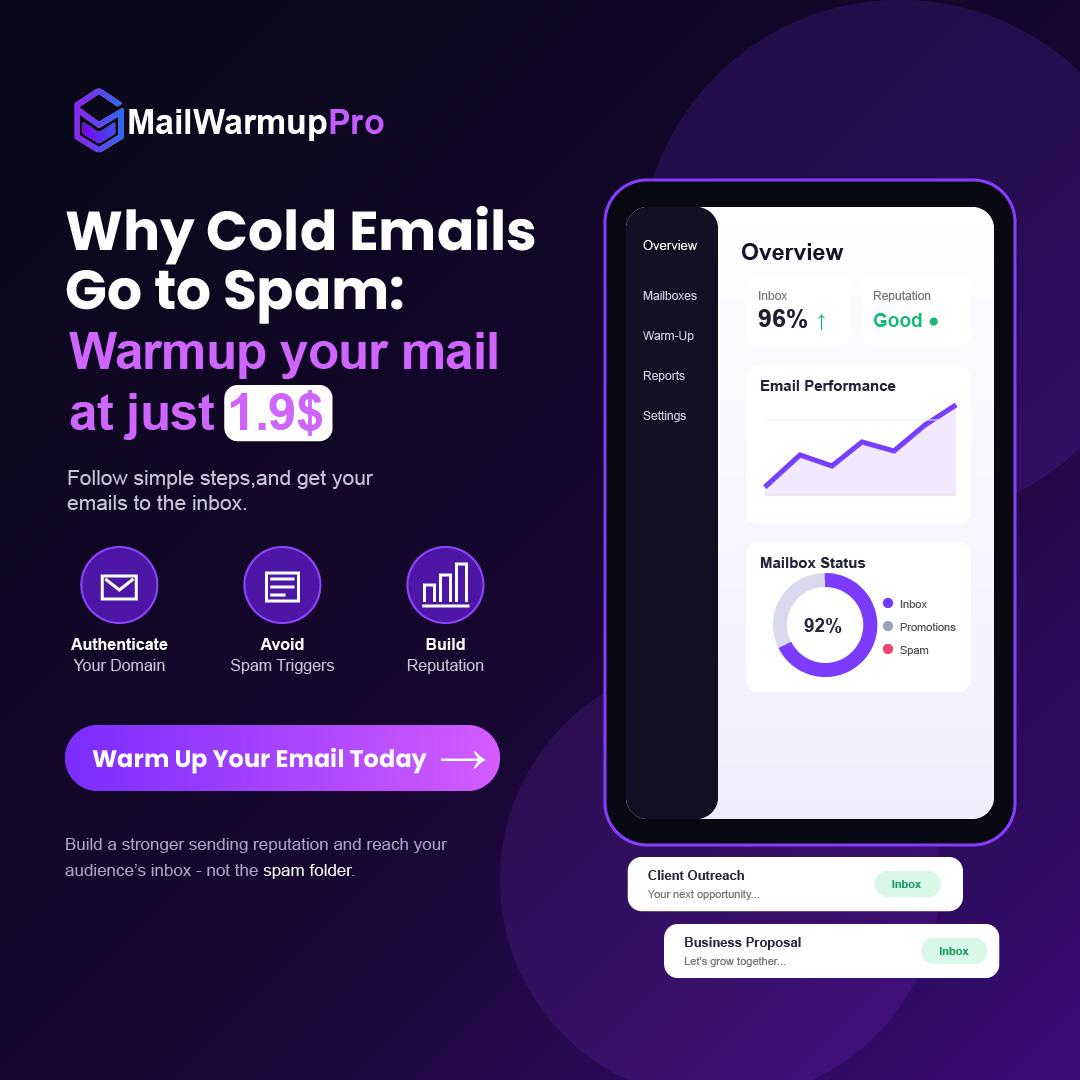
We tried it. We committed to a four-week schedule. And by week three, something remarkable happened: our inbox placement rate jumped from under 20% to 96%.
Replies started coming in. Conversations began. Pipeline opened.
The Lesson I Wish I'd Learned Sooner
Cold email still works in 2026. It's still the highest-ROI channel in B2B — returning $42 for every $1 spent. But it only works if your emails actually reach the inbox.
Here's what I'd tell every founder starting today:
-
Start with warmup. Before you send a single cold email, warm up your mailbox for at least 14 days.
-
Authenticate your domain. Set up SPF, DKIM, and DMARC. Without them, even a warmed mailbox struggles.
-
Monitor your reputation weekly. Tools like Google Postmaster Tools show you exactly how Gmail views your domain.
And most importantly — be patient. Deliverability is a slow, compounding investment. The teams that win aren't the ones sending the most emails. They're the ones whose emails actually get read.
Building the Tool I Wish Existed
That experience is what led me to build MailWarmupPro. I wanted a warmup tool that was affordable, automated, and worked across every provider — Gmail, Outlook, and custom SMTP.
Today, MailWarmupPro helps over 2,000 teams achieve 96%+ inbox placement with real reply threads, automatic spam recovery, and 24/7 monitoring. You can try it free for 7 days — no credit card required.
Or if you want to see how it works first, you can start a free warmup and watch your inbox placement climb within two weeks.
For a deeper dive into the technical setup, this complete email warmup guide covers everything from SPF/DKIM to the four-week ramp-up schedule.
The Bottom Line
Your cold email isn't failing because your copy is bad. It's failing because nobody's reading it.
Fix deliverability first. Warm up your mailboxes. Authenticate your domain. Then write that perfect email — because now, people will actually see it.
The inbox is the new battleground. And the winners are the ones who prepare for it.

 English
 Arabic
 French
 Spanish
 Portuguese
 Deutsch
 Turkish
 Dutch
Dutch
 Italiano
 Russian
 Portuguese (Brazil)
 Greek
Greek
 Bengali