


Hypertension-Specific Nutrition Market to Grow Significantly, Reaching USD 677.1 Million by 2036
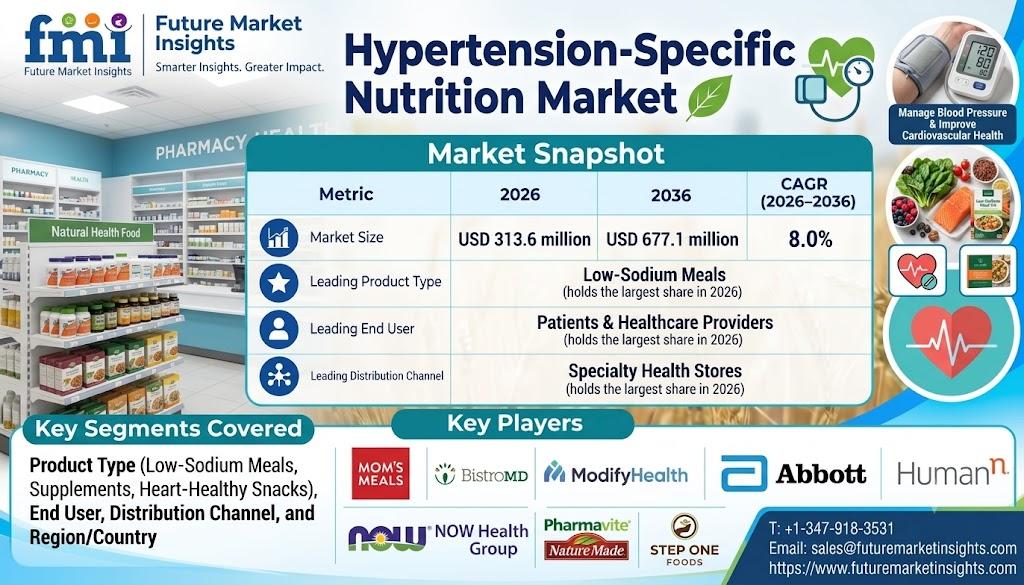
Hypertension-Specific Nutrition Market as Sodium Reduction by FMI Report.
The global Hypertension-Specific Nutrition Market is projected to grow from USD 313.6 million in 2026 to USD 677.1 million by 2036, advancing at an 8.0% CAGR during the forecast period, according to the latest research from Future Market Insights (FMI).
The market is supported by growing demand for nutrition products that translate sodium-reduction and dietary guidance into repeatable meal and supplement routines. Healthcare providers, payers, and consumers are increasingly looking for practical ways to incorporate dietary recommendations into everyday eating habits without requiring extensive meal planning.
Commercial adoption depends on more than clinical positioning. Taste, familiarity, recurring purchase costs, and benefit coverage can influence whether consumers continue using specialized nutrition products after receiving dietary guidance.
Get Detailed Market Forecasts, Competitive Benchmarking, and Pricing Trends: https://www.futuremarketinsights.com/reports/sample/rep-gb-35243
DASH-pattern medical meals are estimated to account for 39.1% of product type revenue in 2026. These structured meals can reduce the daily planning required to follow sodium-conscious dietary patterns while providing a more standardized approach to meal composition.
By sodium level, products containing below 140 mg of sodium per serving are projected to represent 50.4% of demand in 2026. A clearly defined sodium threshold provides consumers, healthcare professionals, and purchasing programs with a straightforward basis for comparing products.
By care context, physician-payer-referred programs are expected to account for 47.5% of revenue in 2026. Clinical referral combined with payer involvement can reduce product-selection uncertainty and help connect specialized nutrition products with patients who have received dietary guidance.
Analyst Perspective
"Hypertension-specific nutrition gains commercial traction by removing a daily decision from sodium control without breaking familiar eating habits. Benefit coverage determines part of the recurring cost for payer-linked meals, producing different refill economics from consumer supplements." — Nandini Roy Choudhury, Principal Consultant, Future Market Insights
Sodium Reduction Creates Commercial Demand
Demand for hypertension-specific nutrition products is being supported by the need to convert dietary recommendations into practical daily routines.
Hypertension management frequently involves dietary changes, including efforts to reduce sodium intake. However, consumers must incorporate those recommendations into meals they purchase, prepare, and consume repeatedly.
Specialized nutrition products provide an opportunity to reduce this decision-making burden by offering meals, supplements, and other products with defined nutritional characteristics.
The commercial opportunity is particularly relevant when products can provide predictable sodium levels while maintaining acceptable taste and familiar eating experiences.
For suppliers, the challenge is therefore to balance nutritional specifications with sensory quality, convenience, affordability, and repeat-purchase behavior.
DASH-Pattern Medical Meals Support Structured Dietary Management
DASH-pattern medical meals are forecast to account for 39.1% of product type revenue in 2026.
These products can provide a structured approach to dietary management by reducing the amount of daily planning required from consumers.
Rather than requiring individuals to determine the sodium content and nutritional composition of every meal independently, prepared products can incorporate dietary specifications directly into the product.
However, continued use depends on whether consumers find the meals acceptable in terms of taste, portion size, variety, convenience, and price.
For manufacturers, maintaining familiar flavors while controlling sodium remains an important product-development consideration. Products that feel excessively clinical or substantially different from familiar meals may face challenges in sustaining repeat orders.
Low-Sodium Products Simplify Product Comparison
Products containing below 140 mg of sodium per serving are expected to represent 50.4% of sodium-level demand in 2026.
A defined sodium threshold provides a relatively straightforward benchmark for consumers and healthcare programs evaluating specialized nutrition products.
Clear labeling can also support comparison across products and simplify selection when nutrition programs specify sodium targets.
Nevertheless, sodium reduction must be achieved without compromising consumer acceptance. Taste remains an important factor because sodium contributes to the flavor profile of many familiar foods.
Manufacturers therefore face the challenge of developing formulations and recipes that meet nutritional requirements while retaining an appealing sensory experience.
Physician-Payer Referrals Strengthen Care-Linked Demand
Physician-payer-referred programs are projected to account for 47.5% of care context revenue in 2026.
Clinical referral can reduce uncertainty about which nutrition products are appropriate for a particular dietary requirement. Payer involvement can further influence purchasing decisions by determining whether specialized meals or nutrition products qualify for financial support.
This creates a distinct commercial model compared with conventional consumer nutrition products.
For payer-linked programs, recurring economics depend partly on benefit eligibility and reimbursement structures. Consumers who initially receive a product through a clinical or payer-supported pathway may face different costs if coverage changes or ends.
Consequently, suppliers need to consider both clinical utility and long-term affordability when developing products for care-linked nutrition programs.
Taste and Repeat-Order Costs Influence Adherence
Although clinical guidance can encourage initial adoption, sustained use depends on the consumer's experience after purchase.
Taste problems can discourage repeat ordering even when a product meets its nutritional specifications. Consumers may also discontinue specialized products when recurring costs become difficult to manage.
This makes retention a central commercial consideration for manufacturers and providers.
Products that offer familiar flavors, practical preparation, adequate variety, and predictable nutritional specifications can help address some of the barriers associated with long-term use.
For suppliers, balancing nutritional performance with consumer satisfaction remains essential as the market expands beyond initial clinical recommendations.
Familiar Food Patterns Shape Regional Adoption
National food preferences and established dietary patterns influence how consumers respond to sodium-reduction products.
Japan provides an example of the challenge. According to the information cited in the FMI analysis, Japan's Ministry of Health, Labour and Welfare reported average salt intake of 9.6 grams per day during 2024, compared with the national Health Japan 21 target of 7 grams per day.
The figures illustrate the importance of developing products that reduce sodium while remaining compatible with familiar food habits.
Products positioned as clinically appropriate but disconnected from established eating patterns may face difficulties with long-term adoption.
Manufacturers therefore need to adapt recipes, flavors, formats, and meal structures to local dietary expectations rather than relying on a single global product configuration.
Large Hypertension Population Creates a Broad Addressable Need
The underlying prevalence of hypertension creates a substantial potential market for dietary-support products.
The information provided in the FMI analysis cites World Health Organization estimates from September 2025 indicating that approximately 1.4 billion adults aged 30 to 79 had hypertension during 2024.
This figure represents a large potential need for hypertension-related dietary support, although the size of the affected population should not be interpreted as equivalent to the number of consumers who will purchase specialized nutrition products.
Commercial conversion depends on awareness, clinical recommendations, affordability, availability, taste preferences, benefit coverage, and willingness to maintain dietary changes over time.
Competitive Landscape
The Hypertension-Specific Nutrition Market includes specialized meal providers, medical nutrition companies, supplement manufacturers, and established health and wellness brands.
Key companies identified by FMI include Mom's Meals (PurFoods), BistroMD, ModifyHealth, Abbott, HumanN, NOW Health Group, Pharmavite (Nature Made), and Step One Foods.
Competition centers on sodium control, nutritional composition, taste, convenience, meal variety, clinical positioning, pricing, reimbursement access, and distribution capabilities.
Companies serving physician- and payer-referred programs also need to manage the recurring economics of specialized nutrition delivery. In consumer-oriented channels, brand familiarity, product accessibility, nutritional transparency, and taste can influence purchasing and repeat use.
Market Outlook
The Hypertension-Specific Nutrition Market is expected to expand as consumers, healthcare professionals, and payer-linked programs seek practical approaches to incorporating sodium-conscious nutrition into everyday routines.
With the market projected to reach USD 677.1 million by 2036, commercial opportunities will increasingly depend on combining nutritional specifications with consumer-friendly product experiences.
DASH-pattern medical meals, low-sodium products below 140 mg per serving, and physician-payer-referred programs are expected to represent important areas of demand in 2026.
At the same time, taste, recurring purchase costs, and uneven benefit coverage can affect long-term adherence. Manufacturers therefore need to balance clinical nutrition requirements with affordability, convenience, familiar eating patterns, and repeat-purchase economics.
To explore how FMI Custom Research can support your strategic priorities, please connect with our team at – sales@futuremarketinsights.com
About Future Market Insights (FMI)
Future Market Insights (FMI) delivers actionable, decision-focused market intelligence designed to support strategic business and investment decisions.
The company provides:
- In-depth pricing and cost benchmarking analysis
- Demand forecasting based on real industry inputs
- Procurement and buyer behavior insights
- Supply chain and trade flow intelligence
- Technology and application trend analysis across industries
FMI follows a bottom-up research methodology, combining insights from industry experts, procurement leaders, manufacturers, and technical professionals to provide practical market intelligence.
For Press & Corporate Inquiries
Rahul Singh AVP – Marketing and Growth Strategy
Future Market Insights, Inc.
Web: https://www.futuremarketinsights.com

 English
 Arabic
 French
 Spanish
 Portuguese
 Turkish
 Dutch
Dutch
 Italiano
 Russian
 Romaian
 Portuguese (Brazil)
 Greek
Greek
 Bengali