


White Cement Price Trend 2026: Regional Outlook and Key Insights
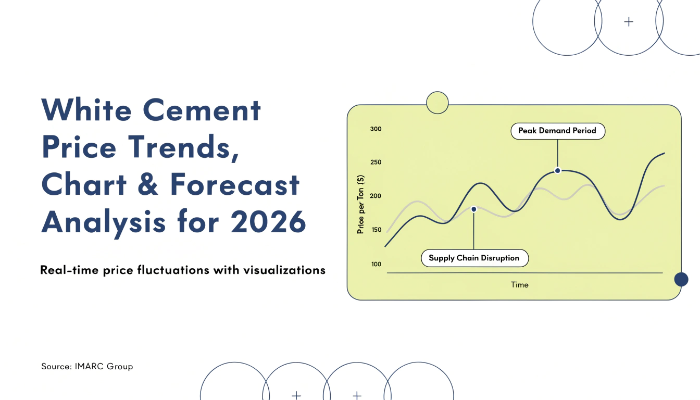
Global White Cement Price Trend & Outlook – Q2 2026
White Cement Price Analysis 2026 shows a firm upward market during Q2, with all five supplied country benchmarks recording sequential increases from Q1 2026. The reported QoQ movements ranged from 2.93% to 4.11%, indicating broad-based price strengthening across major markets. The White Cement price Trend was supported by construction activity, infrastructure projects, residential development, and steady procurement from architectural and decorative applications. IMARC Group’s Q2 2026 price-tracking database and methodology indicate that supply availability, construction demand, production conditions, and logistics remained key factors behind the quarterly movement. The White Cement Price Trend 2026 provides a useful benchmark for buyers assessing regional quotations, purchasing costs, and market direction.
Regional White Cement Price Snapshot: Q2 2026
- China: USD 153/MT — 3.45% Up QoQ
- Germany: USD 252/MT — 2.93% Up QoQ
- India: USD 133/MT — 3.92% Up QoQ
- Turkey: USD 182/MT — 4.11% Up QoQ
- USA: USD 242/MT — 3.05% Up QoQ
The Q2 spread shows a clear regional cost gap, with Germany at USD 252/MT compared with India at USD 133/MT. China, Turkey, and the USA occupied the middle range. The broad upward movement across all supplied markets indicates firm construction-related demand, while differences in manufacturing costs, domestic supply, freight, project activity, and regional procurement patterns explain the price gap.
Q2 2026 Price Analysis: USA, China, India, Germany and Turkey
North America: USA White Cement Price and Demand Conditions
The USA benchmark reached USD 242/MT, increasing 3.05% QoQ. Construction and infrastructure activity supported steady consumption, while residential development, commercial refurbishment, decorative concrete, and precast applications maintained procurement volumes. Supply chains remained functional, helping producers meet downstream requirements without major disruptions.
Asia-Pacific: China and India White Cement Prices
China reached USD 153/MT, up 3.45% QoQ, supported by stronger residential and infrastructure procurement. India recorded USD 133/MT, rising 3.92% QoQ, as housing development, public infrastructure, road projects, and urban construction strengthened demand. Both markets experienced firm downstream consumption during the quarter.
Europe: Germany And Turkey White Cement Market Conditions
The supplied dataset includes Germany and Turkey rather than Japan and Brazil. Germany reached USD 252/MT, up 2.93% QoQ, supported by commercial construction and renovation demand. Turkey recorded USD 182/MT, increasing 4.11% QoQ, the strongest movement among the five supplied markets, driven by residential construction and reconstruction activity.
Supply And Demand Overview – Q2 2026
White cement supply remained broadly aligned with demand across the major markets covered. Producers maintained active operations as construction activity supported regular procurement from contractors, distributors, and architectural finishing businesses. In China and India, infrastructure and housing requirements strengthened consumption, while Germany benefited from commercial and renovation projects.
Turkey recorded the strongest quarterly increase among the five markets as reconstruction and residential activity supported demand. In the USA, construction and infrastructure projects maintained stable order volumes. Overall, the balance between available production and downstream consumption supported firm pricing without evidence of a major supply shortage.
White Cement Price Trend: Quarterly Index and Historical Analysis
The quarterly movement was consistently positive across all five supplied benchmarks. Germany recorded the lowest QoQ increase at 2.93%, while Turkey posted the highest at 4.11%. China, India, and the USA increased by 3.45%, 3.92%, and 3.05%, respectively. The simple average of these reported country-level QoQ changes is approximately 3.49%.
This broad-based movement indicates that Q2 pricing strengthened across different regional market structures rather than being driven by a single country. Demand from construction, infrastructure, renovation, housing, and decorative applications provided the main support, while balanced production helped maintain product availability.
White Cement Price Chart: What Q2 2026 Shows
The White Cement Price Chart shows substantial regional variation, with Germany recording the highest supplied benchmark at USD 252/MT and India the lowest at USD 133/MT. The difference reflects variations in production economics, construction demand, logistics, supply conditions, and local procurement patterns.
For buyers, regional benchmarks should be assessed alongside delivery terms, product specifications, freight, supplier availability, and contract structures when evaluating actual purchasing costs.
White Cement Price Forecast 2026: Next 12 Months
The next 12 months are likely to remain closely connected to construction activity, infrastructure investment, housing development, energy costs, and raw-material availability. Continued project execution could support consumption, while changes in producer operating rates or weaker construction activity could moderate price growth.
Energy and transportation costs will remain important because white cement requires energy-intensive manufacturing and specialized raw materials. Procurement teams should also monitor regional construction pipelines, export availability, freight rates, and inventory levels when planning forward purchases.
Key Factors Affecting White Cement Prices: Quarterly Perspective
- Construction activity: Residential, commercial, and infrastructure projects directly influence consumption.
- Infrastructure spending: Roads, public buildings, urban development, and beautification projects support demand.
- Energy costs: Kiln fuel and electricity expenses influence production economics.
- Raw materials: High-purity limestone, kaolin, and low-iron inputs affect manufacturing costs.
- Freight: International shipping and inland transportation influence delivered prices.
- Plant operating rates: Maintenance or production changes can affect regional availability.
- Renovation demand: Commercial and residential renovation supports specialty cement consumption.
- Decorative applications: Architectural finishes, precast products, tiles, and facades provide additional demand.
What Is White Cement and Where Is It Used?
White cement is a specialized cement manufactured from selected low-iron raw materials to achieve its characteristic white appearance. It is widely used in architectural and decorative applications where appearance, surface finish, and color consistency are important.
Common applications include decorative concrete, precast products, terrazzo, tile grout, facades, flooring, wall finishes, and architectural elements. Its production requires carefully controlled raw materials and processing conditions, making its cost structure different from conventional grey cement.
Recent White Cement Developments: Q2 2026 Highlights
Q2 2026 was marked by stronger construction-related procurement across the five supplied markets. China benefited from residential and infrastructure activity, while India saw stronger housing and public infrastructure consumption. Germany maintained firm demand from commercial construction and renovation projects.
Turkey recorded the strongest quarterly price increase at 4.11%, supported by residential construction and reconstruction activity. In the USA, steady residential, commercial, and infrastructure demand supported a 3.05% increase. Overall, the quarter showed synchronized upward movement across the covered markets.
FAQs About White Cement Prices 2026
What Is the White Cement Price Trend in Q2 2026?
The White Cement Price Trend was upward across all five supplied markets in Q2 2026. QoQ increases ranged from 2.93% in Germany to 4.11% in Turkey, with construction and infrastructure demand providing broad support.
What Does the White Cement Price Chart Show?
The White Cement Price Chart shows Q2 2026 prices ranging from USD 133/MT in India to USD 252/MT in Germany. The regional spread reflects differences in construction demand, production costs, supply availability, and logistics.
What Is the White Cement Price Forecast 2026?
The White Cement Price Forecast 2026 will depend on construction activity, infrastructure spending, energy costs, raw-material availability, plant operating rates, and freight conditions. Continued project demand could support firm pricing, while weaker construction activity or improved supply could moderate increases.
How IMARC Helps with White Cement Procurement Planning
IMARC Group tracks white cement prices across major markets and evaluates the supply, demand, production, logistics, and downstream factors influencing procurement costs. Its pricing analysis helps buyers compare regional benchmarks, understand quarterly movements, and assess supplier quotations more effectively. Q2 2026 data shows broad-based price increases across the five supplied markets, although the magnitude of movement differed by country. Going forward, monitoring construction activity, energy costs, raw-material availability, production rates, and international trade flows will remain important for white cement procurement planning.
Explore pricing coverage across 500+ commodities: https://www.imarcgroup.com/pricing-market-reports
Contact Us:
IMARC Group
134 N 4th St., Brooklyn, NY 11249, USA
Email: sales[@]imarcgroup.com
Tel No:(D) +91 120 433 0800
United States: +1-201971-6302

 English
 French
 Spanish
 Portuguese
 Deutsch
 Turkish
 Dutch
Dutch
 Italiano
 Russian
 Romaian
 Portuguese (Brazil)
 Greek
Greek
 Bengali