


Polyurethane (PU) Foam Market Size, Trends & Forecast 2026-2034
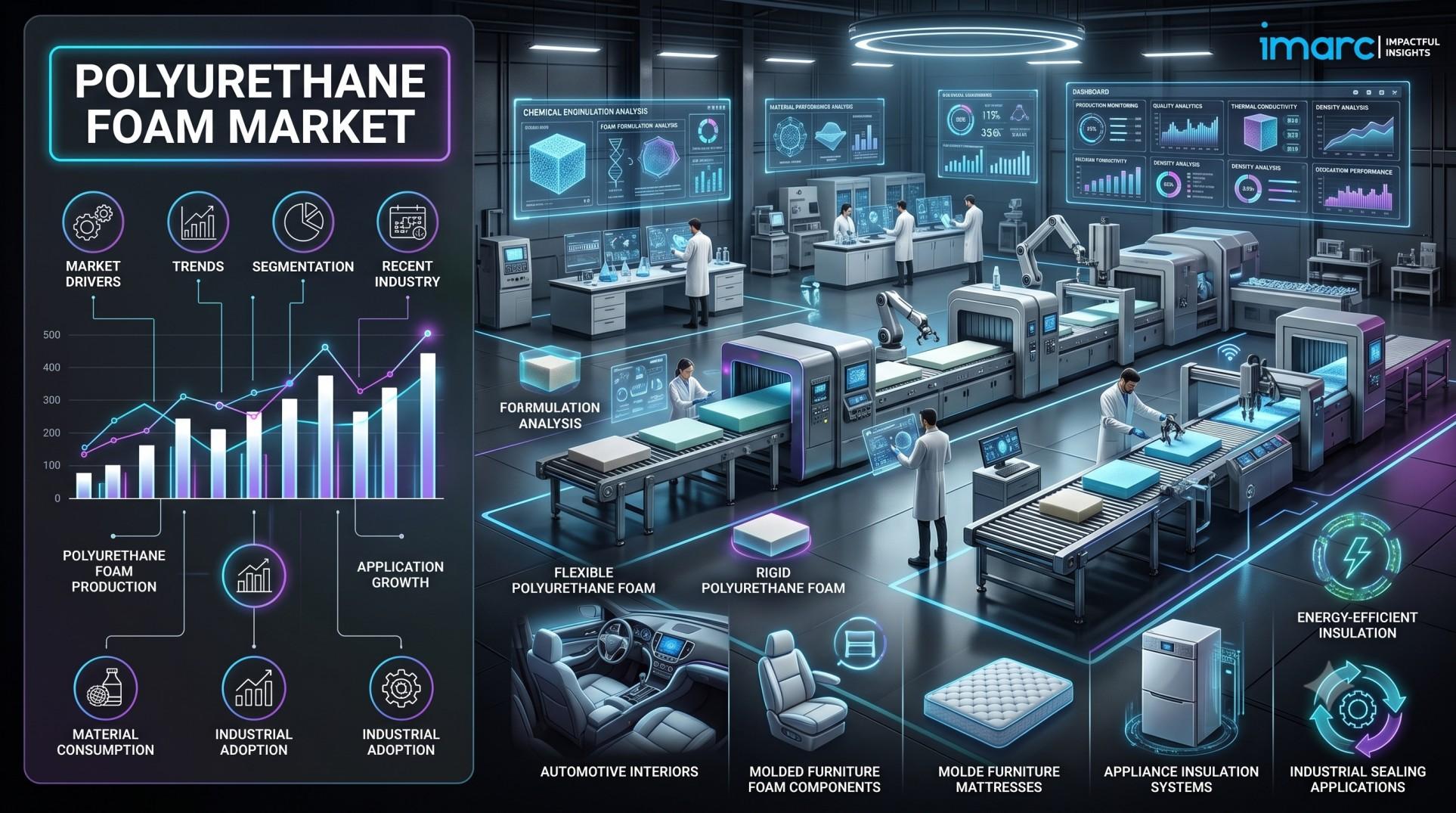
IMARC Group, a leading global market research and management consulting firm, has published its latest market intelligence report on the polyurethane (PU) foam market. The global polyurethane foam market size reached USD 58.2 Billion in 2025. Looking forward, IMARC Group expects the market to reach USD 92.5 Billion by 2034, exhibiting a CAGR of 5.13% during 2026-2034, driven by expanding construction activity worldwide, rising vehicle production, the thriving furniture industry, the broadening of e-commerce packaging needs, and continued advancements in foam technology including bio-based and recyclable formulations.
The market's growth is anchored in the material's versatility across insulation, cushioning and protective applications. Rigid foam continues to dominate product type given its thermal insulation performance and structural stability, properties that make it indispensable in building envelopes, roofing systems and refrigeration equipment. Low density foam leads on a density basis thanks to its cost efficiency and broad use across furniture, bedding and packaging, while building and construction remains the largest end-use industry as energy efficiency regulations worldwide push builders toward higher-performance insulation. Asia Pacific dominates the regional landscape, propelled by rapid industrialization, urban expansion and infrastructure development across China and India.
Polyurethane Foam Market at a Glance
- Market Size 2025: USD 58.2 Billion
- Forecast Size 2034: USD 92.5 Billion
- Growth Rate 2026-2034: CAGR of 5.13%
- Leading Product Type: Rigid Foam
- Leading Density Segment: Low Density
- Leading End-Use Industry: Building and Construction
- Dominant Region: Asia Pacific
How AI Is Reshaping the Future of the Polyurethane Foam Market
- AI as a Design Co-Pilot for Foam Formulation: A November 2025 study published in Advanced Science introduced an AI-directed 3D printing platform for hierarchical PU foams, using a prompt-based large language model as a design co-pilot that helps engineers co-optimize formulation chemistry and print parameters beyond what conventional batch foaming can achieve.
- Machine Learning Cutting Formulation Development Time: Chemical producers are applying machine learning forward and reverse models to years of slabstock foam recipe and performance data, allowing formulators to predict target density and hardness properties, or work backward from a target property to a formulation, dramatically compressing development cycles for complex multi-component PU chemistry.
- Computer Vision Predicting Mechanical Properties From Microstructure: A September 2026 study trained dual-head convolutional neural networks on scanning electron microscope images of lignin-containing rigid PU foams to predict density, compression modulus and yield stress directly from microstructure, reducing reliance on slow, destructive mechanical testing for bio-based foam development.
Grab a sample PDF of this report: https://www.imarcgroup.com/polyurethane-foam-market/requestsample
Polyurethane Foam Market Trends and Drivers
Rising construction activity remains the foundational driver of PU foam demand, with the global buildings construction market reaching USD 6.8 Trillion in 2024. Rigid PU foam's superior thermal performance makes it a preferred material for insulation panels, roofing and wall systems as governments worldwide tighten energy efficiency requirements for new and renovated buildings.
A structural driver reshaping the supply side of the market is the shift toward bio-based and bio-circular feedstocks. Covestro's Bio4PURConti project uses continuous fermentation of plant-based sugars to produce bio-based aniline, a precursor that is drop-in compatible with existing polyurethane value chains and meets MDI specifications without requiring changes to downstream processing, scaling from lab trials to semi-industrial demonstration at facilities in Ghent and Leverkusen.
A third driver, and one that sets up the regulatory landscape detailed further below, is the tightening web of safety, environmental and circular economy regulation surrounding polyurethane chemistry. From mandatory worker training requirements for diisocyanate handling in Europe to insulation R-value certification rules in the United States to mandatory green building codes across the Gulf, regulators worldwide are reshaping how PU foam is manufactured, specified and eventually recycled.
Ask an analyst for customized report: https://www.imarcgroup.com/request?type=report&id=2247&flag=E
Global Polyurethane (PU) Foam Industry Segmentation
Breakup by Structure:
- Open Cell
- Closed Cell
Open cell PU foam, softer and more flexible, is widely used in acoustic insulation, furniture, bedding and packaging for its sound absorption and cushioning properties, while closed cell PU foam, denser and more rigid, excels in thermal insulation, buoyancy and automotive applications owing to its superior moisture resistance.
Breakup by Product Type:
- Flexible Foam
- Rigid Foam
- Spray Foam
Rigid foam holds the largest market share, characterized by high insulation properties and structural integrity, with key players continuing to introduce innovative rigid PU foam panels designed for superior thermal insulation in building envelopes that significantly reduce energy consumption.
Breakup by Density:
- Low Density
- Medium Density
- High Density
Low density PU foam represents the largest segmentation due to its cost-effectiveness and versatility, widely used in furniture and bedding for cushions and mattresses, in acoustic insulation for buildings and vehicles, and in lightweight, protective packaging.
Breakup by End-Use Industry:
- Bedding and Furniture
- Building and Construction
- Electronics
- Automotive
- Packaging
- Footwear
- Others
Building and construction accounts for the majority of total market share, as rigid PU foam's exceptional insulating properties are extensively used in insulation panels, roofing and wall systems, a position reinforced by tightening energy efficiency regulations and rising emphasis on green building practices worldwide.
Breakup by Region:
- North America: United States, Canada
- Asia Pacific: China, Japan, India, South Korea, Australia, Indonesia, Others
- Europe: Germany, France, United Kingdom, Italy, Spain, Russia, Others
- Latin America: Brazil, Mexico, Others
- Middle East and Africa
Asia Pacific currently dominates the polyurethane foam market, driven by rapid industrialization, urbanization and a booming construction sector across China, India and Japan, supported by numerous local and international manufacturers investing in advanced production technologies and sustainable practices alongside government policies promoting energy efficiency.
Competitive Landscape
The report provides a comprehensive analysis of the competitive landscape in the polyurethane foam market with detailed profiles of key companies, including:
- BASF SE
- Covestro AG
- Foamcraft Inc.
- Future Foam Inc.
- Huntsman International LLC (Indorama Ventures Public Company Limited)
- Recticel NV/SA
- Rogers Corporation
- Saint-Gobain S.A.
- Sekisui Chemical Co. Ltd.
- The Dow Chemical Company
- Tosoh Corporation
- UFP Technologies Inc.
- Wanhua Chemical Group Co. Ltd.
Global chemical majors including BASF, Covestro, Dow and Huntsman control much of the world's upstream isocyanate and polyol feedstock, while a broad tier of regional converters and specialty fabricators, from Foamcraft and Future Foam in North America to Sekisui in Japan, compete on downstream foam conversion and application engineering.
Recent News and Developments in Polyurethane Foam Market
- March 2025: Ecomaison, Covestro, Secondly and Federal Eco Foam launched the FREE consortium, a research project combining mechanical and chemical recycling technologies to recover polyol and isocyanate precursor from end-of-life flexible PU foam mattresses.
- May 2025: Gulf-O-Flex inaugurated Saudi Arabia's first fully localized thermal insulation manufacturing facility, designed to serve the Kingdom's expanding construction, HVAC and infrastructure sectors under Vision 2030.
Note: If you require specific details, data, or insights that are not currently included in the scope of this report, we are happy to accommodate your request. As part of our customization service, we will gather and provide the additional information you need, tailored to your specific requirements. Please let us know your exact needs, and we will ensure the report is updated accordingly to meet your expectations.
About Us
IMARC Group is a global management consulting firm that helps the world's most ambitious changemakers to create a lasting impact. The company provides a comprehensive suite of market entry and expansion services. IMARC offerings include thorough market assessment, feasibility studies, company incorporation assistance, factory setup support, regulatory approvals and licensing navigation, branding, marketing and sales strategies, competitive landscape and benchmarking analyses, pricing and cost research, and procurement research.
Media and Sales Contact
IMARC Group
Email: sales@imarcgroup.com
United States: +1-201-971-6302
India: +91-120-433-0800
United Kingdom: +44-753-714-6104

 English
 Arabic
 French
 Spanish
 Portuguese
 Turkish
 Dutch
Dutch
 Italiano
 Russian
 Romaian
 Portuguese (Brazil)
 Greek
Greek
 Bengali