


Carbon Capture Utilisation Project Implementation in India
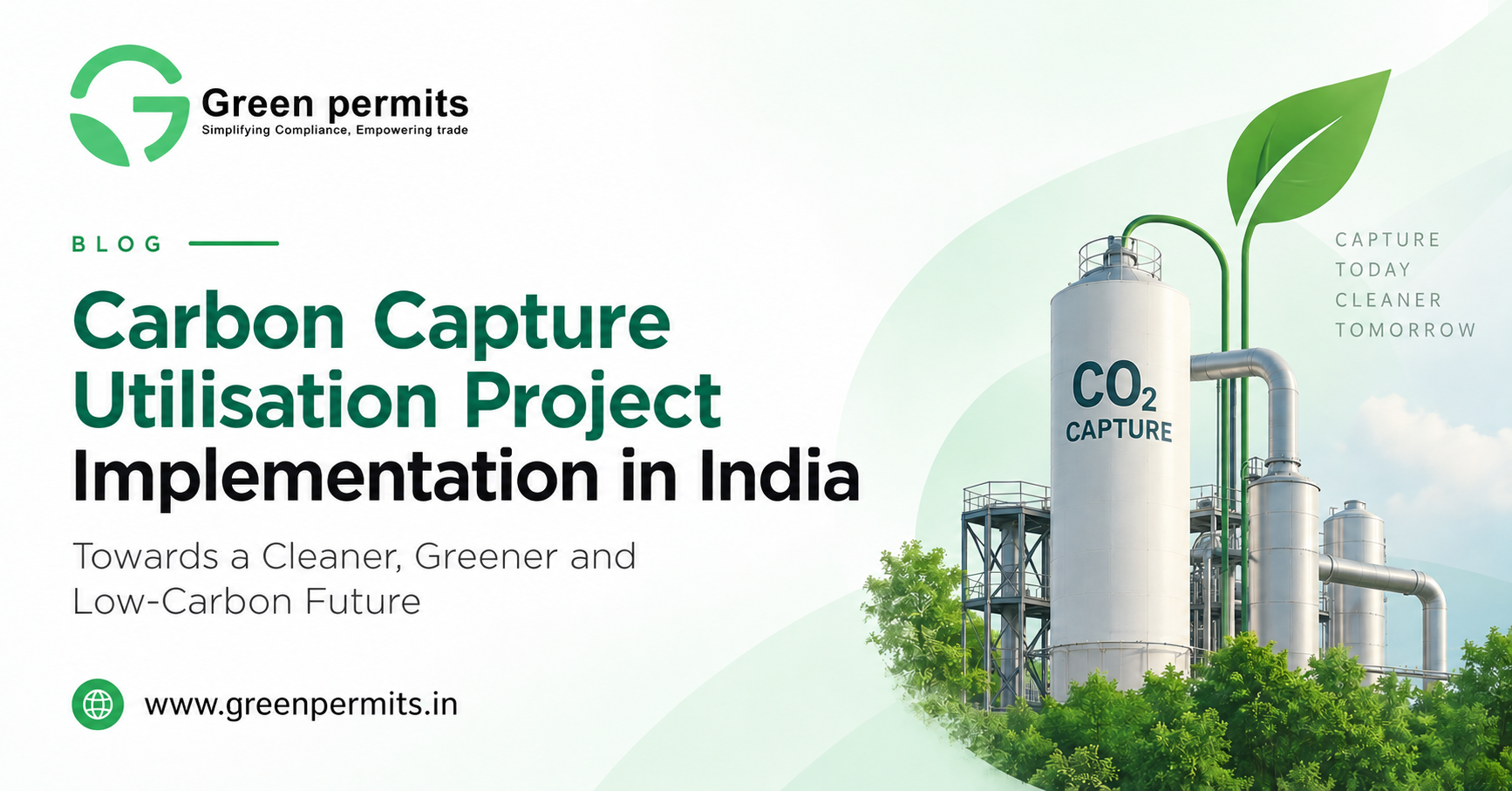
A Carbon Capture Utilisation Project is designed to capture carbon dioxide from industrial or energy-related emissions and convert or reuse it instead of releasing it directly into the atmosphere.
CCU projects are being considered by industries such as cement, steel, refineries, chemicals, fertilisers, power plants, hydrogen projects and other large industrial emitters. Depending on the project, captured CO₂ may be used for chemicals, fuels, building materials, industrial applications or other commercially viable utilisation routes.
However, a CCU project should not begin with capture equipment alone. The project first needs to understand the CO₂ source, concentration, capture volume, utilisation route, buyer demand, energy requirement and complete project economics.
Green Permits Consulting supports businesses with CCU feasibility studies, technology assessment, DPR preparation, site planning, CAPEX and OPEX analysis, project finance and environmental approval planning.
What is a Carbon Capture Utilisation Project?
Carbon Capture Utilisation, commonly called CCU, involves separating carbon dioxide from an emission stream and converting or using it for another purpose.
A simplified project flow is:
Industrial Emission → CO₂ Capture → Purification → Compression → Utilisation / Conversion → Saleable Product
The technical process depends heavily on where the CO₂ comes from.
A cement kiln, refinery, chemical plant and fermentation facility can have very different flue-gas compositions.
This means capture technology must be selected according to the actual emission source rather than using one standard solution for every industry.
Start with the CO₂ Source
The first stage of project implementation is to understand the carbon dioxide source.
The study should determine how much CO₂ is generated, its concentration, pressure, temperature and contaminants.
Higher CO₂ concentration can simplify separation compared with low-concentration flue gas, although the complete economics depend on many other factors.
The project should establish:
CO₂ Source → Concentration → Available Quantity → Capture Requirement
Without reliable source data, it is difficult to size the capture system accurately.
Selecting the Right Capture Technology
Different carbon capture technologies can be considered depending on the industrial process.
Post-combustion capture is one common route where CO₂ is separated from flue gas after fuel combustion.
Chemical absorption systems using suitable solvents are widely studied, although other technologies can include adsorption, membranes, cryogenic separation and process-specific capture methods.
Technology selection should compare:
Capture Efficiency + Energy Demand + Chemical Consumption + CO₂ Purity + Operating Cost
A technology that achieves very high capture efficiency but requires excessive steam or electricity may not necessarily provide the best project economics.
CO₂ Purification and Compression
Captured carbon dioxide may contain moisture and other impurities.
Depending on the final use, the gas may need purification, drying and compression.
The required purity depends on the utilisation route.
For example, a chemical conversion process may require a different CO₂ specification from mineralisation or another industrial application.
The project should therefore define the final product requirement before designing downstream equipment.
The better sequence is:
Utilisation Requirement → CO₂ Specification → Purification System → Compression
Choosing a CO₂ Utilisation Route
The commercial success of the project depends on what happens after the CO₂ is captured.
Possible utilisation routes can include production of chemicals, synthetic fuels, carbonated materials, mineralised construction products or direct industrial use where technically and commercially suitable.
However, not every utilisation option works at every location.
The project should evaluate the size of the potential market, required CO₂ quality, technology maturity, customer demand and product selling price.
A technically possible route may still be commercially weak if the final product has limited buyers.
The implementation strategy should therefore be:
Captured CO₂ → Suitable Conversion Route → Product → Customer
Market Study Before Technology Finalisation
A market study should be completed before the final plant configuration is selected.
The study should identify who may purchase the CO₂-derived product and what specification they require.
It should also determine whether the local market can absorb the proposed annual production.
For example, there is little benefit in designing a large CO₂ utilisation facility if the nearby market can purchase only a small portion of its output.
Plant capacity should follow realistic demand.
The market study should also compare competing products and conventional manufacturing routes.
Energy Requirement is Critical
Carbon capture can require substantial energy.
Energy may be needed for solvent regeneration, gas compression, pumps, cooling and downstream conversion.
The project should therefore calculate energy use carefully.
A simple implementation model is:
Capture Energy + Purification Energy + Compression Energy + Conversion Energy = Total Project Energy Requirement
This directly affects OPEX.
If the project uses high-carbon electricity or steam, the net environmental benefit should also be evaluated carefully.
For this reason, some projects consider integration with renewable power, waste heat or low-carbon energy sources.
Site Selection and Integration
A CCU project is often developed within or close to an existing industrial plant.
This can reduce CO₂ transportation requirements and allow the project to share utilities, water, steam, electricity and existing infrastructure.
The site study should evaluate land availability, distance from the emission source, utility connections and access to downstream customers.
Where CO₂ must be transported, logistics can become a major cost.
The ideal configuration generally minimises:
Capture Point → Processing Distance → Utilisation Location
This is why industrial clusters can be attractive for CCU projects.
Major Equipment Required
The exact machinery depends on the capture and utilisation technologies.
A typical project may include flue-gas conditioning equipment, absorbers or separation units, regeneration systems, heat exchangers, pumps, compressors, dryers, purification units and CO₂ storage systems.
The utilisation section may then require additional reactors, mixers, furnaces, mineralisation equipment or chemical-processing systems.
The project should not compare machinery based only on purchase price.
Supplier evaluation should include:
Capture Rate → Energy Consumption → CO₂ Purity → Reliability → Maintenance Cost
These factors affect long-term project economics.
CAPEX and OPEX Planning
There is no single standard investment cost for a Carbon Capture Utilisation project.
CAPEX depends on CO₂ volume, gas composition, capture technology, purification requirement, compression pressure and final utilisation process.
The financial model should include:
Capture Plant + Purification + Compression + Utilisation Plant + Utilities + Storage + Civil Works + Environmental Systems
OPEX may include electricity, steam, chemicals, cooling water, manpower, maintenance and catalyst or solvent replacement.
For many projects, energy cost can become one of the largest operating expenses.
Carbon Balance and Project Performance
A CCU project should not measure success only by the amount of CO₂ entering the capture system.
The project should evaluate how much CO₂ is actually captured, how much is lost during processing and how much remains incorporated or utilised in the final product.
A useful project balance is:
CO₂ Generated → CO₂ Captured → Processing Losses → CO₂ Utilised
This helps provide a more realistic picture of project performance.
It is also important to understand whether the CO₂ is stored in the product for a long period or released again during later product use.
Environmental and Regulatory Planning
A CCU project may require environmental and industrial approvals depending on its location, capacity and process.
The project should assess Consent to Establish, Consent to Operate, chemical handling, pressure systems, storage, fire and other applicable industrial approvals.
If the utilisation process creates wastewater, emissions or hazardous residues, these should also be included in the environmental management plan.
Approval requirements should be assessed before final machinery and layout are frozen.
Project Finance and Financial Viability
CCU projects can require significant capital investment.
A bankable project needs more than an environmental objective. It should have a clear commercial model.
The financial study should identify:
CO₂ Source Security + Technology + Product Buyer + Revenue + Operating Cost
Revenue may come from the sale of CO₂-derived products or other contractual arrangements linked to the project.
Any carbon-related revenue should be treated carefully and should not automatically be considered guaranteed.
The project should remain financially understandable under realistic operating assumptions.
DPR for Carbon Capture Utilisation Project
A Detailed Project Report - DPR connects the technical, commercial and financial sides of the project.
The DPR should cover CO₂ source data, capture technology, utilisation route, plant capacity, machinery, utilities, site requirement, CAPEX, OPEX and project implementation schedule.
The financial model should include revenue, operating cost, cash flow, break-even, debt servicing and sensitivity analysis.
A practical project sequence is:
CO₂ Assessment → Market Study → Technology Selection → Feasibility → DPR → Approvals → Finance → Construction → Commissioning
How Green Permits Helps with CCU Project Implementation
Green Permits Consulting supports industrial companies, investors and project developers with Carbon Capture Utilisation feasibility studies, technology evaluation, market assessment, DPR preparation, site planning, CAPEX and OPEX modelling, project finance documentation and environmental approval support.
The objective is to confirm that the CO₂ source, technology, customer market and financial model are aligned before major investment.
Learn More About Carbon Capture Utilisation Project Implementation
If you are planning a CCU project, the project should first be evaluated for CO₂ availability, capture technology, energy requirement, utilisation route, customer demand and financial viability.
Read more about project feasibility and plant setup consulting services here:
👉 https://www.greenpermits.in/09/carbon-capture-utilisation-project-roadmap-in-india/
📞 Get Expert Assistance for Carbon Capture Utilisation Projects
If you need help with a Carbon Capture Utilisation Project feasibility study, DPR preparation, technology assessment, financial modelling or project implementation, Green Permits Consulting can assist you.
🌐 Website: www.greenpermits.in
📞 Phone: +91 78350 06182
📧 Email: wecare@greenpermits.in

 English
 Arabic
 French
 Spanish
 Deutsch
 Turkish
 Dutch
Dutch
 Italiano
 Russian
 Romaian
 Portuguese (Brazil)
 Greek
Greek
 Bengali