


Why Occupational Medicine Clinics Are Switching to Specialized EMR Software
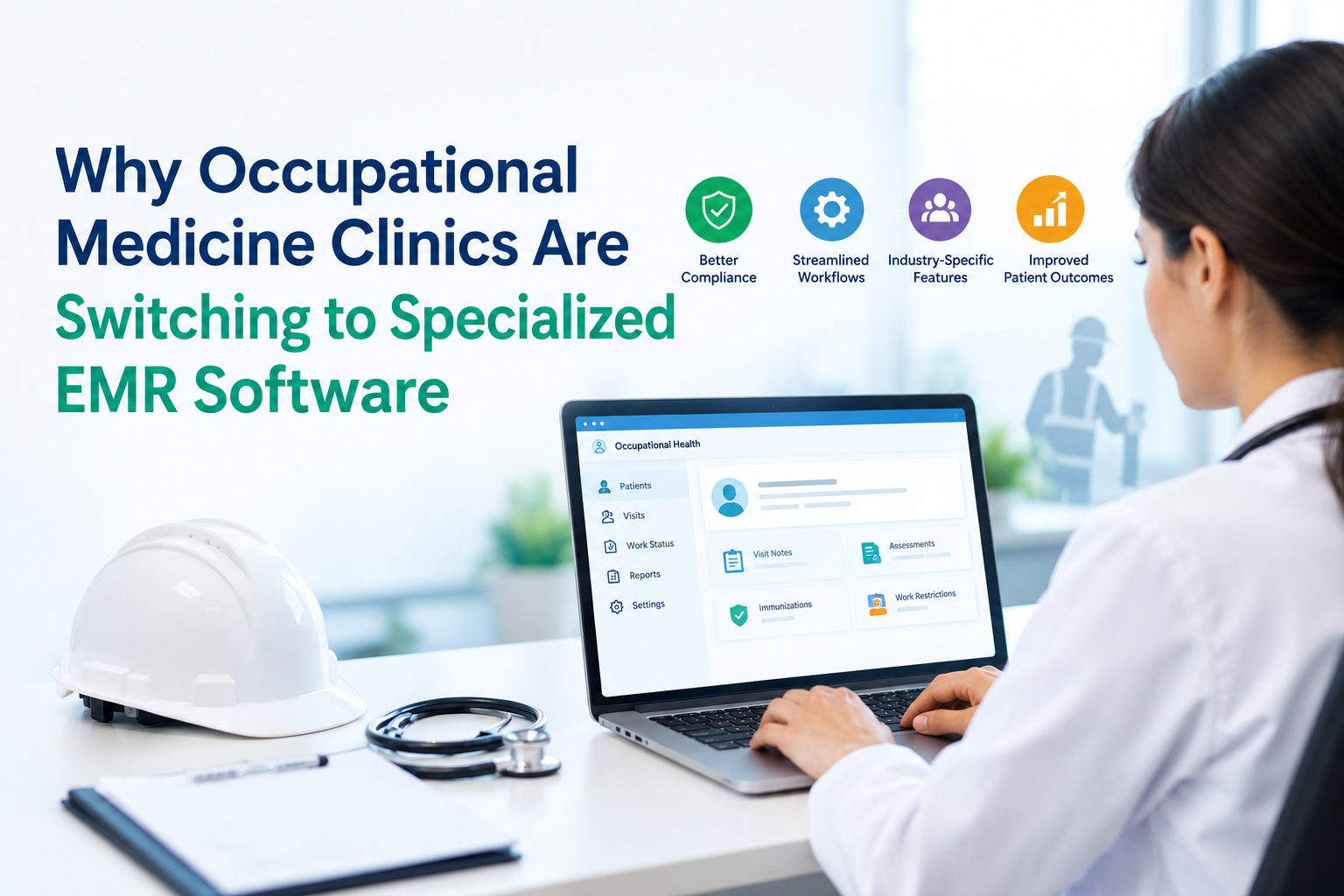
What if your occupational medicine clinic could spend less time managing paperwork and more time taking care of employees?
That question is becoming increasingly important as occupational medicine practices deal with growing patient volumes, employer requirements, regulatory documentation, workplace injury records, and increasingly complex reporting needs. Traditional medical systems can handle general patient care, but they may not be designed around the unique workflows of occupational health.
This is one reason more occupational medicine clinics are exploring EMR Software. Unlike generic healthcare platforms, specialized solutions are built to support the specific needs of occupational health providers, employers, and workplace safety teams.
What Makes Occupational Medicine Different?
Occupational medicine sits at the intersection of healthcare and workplace safety. A typical clinic may manage routine medical visits alongside pre-employment examinations, workers' compensation cases, drug and alcohol testing, physical exams, injury management, and return-to-work evaluations.
That creates workflows that are different from those of a general medical practice.
For example, occupational health providers may need to track information related to:
- Workplace injuries and incidents
- Employer-specific requirements
- Medical surveillance programs
- Drug and alcohol testing
- Return-to-work recommendations
- Regulatory and compliance records
A conventional EMR Software platform may manage basic clinical information effectively, but specialized occupational health technology can connect these requirements within a more focused workflow.
EMR Software vs. EHR Software for Occupational Health
The terms EMR and EHR are often used interchangeably, but they can refer to slightly different concepts.
EMR software generally focuses on maintaining a patient's medical record within a particular practice. EHR Software, on the other hand, is designed to provide a broader electronic health record that can support information sharing across healthcare settings.
For occupational medicine clinics, the important question isn't simply whether a platform is called EMR or EHR software. The bigger consideration is whether the system supports the clinic's actual occupational health workflows.
A specialized platform may combine clinical documentation with occupational health information, helping providers reduce repetitive data entry and organize records more efficiently.
Why Clinics Are Looking Beyond Generic Healthcare Systems?
One of the biggest challenges with general-purpose healthcare software is customization.
Occupational medicine practices often have processes that don't fit neatly into standard primary-care workflows. Staff may have to create workarounds, maintain spreadsheets, enter information multiple times, or rely on separate systems.
Specialized occupational health EMR software can be designed around the way these clinics actually operate. Features such as configurable forms, occupational medicine templates, automated workflows, employer portals, testing management, and reporting capabilities can help reduce friction.
Connecting EMR With EHS and OHS Workflows
Another important development is the growing connection between healthcare and workplace safety technology.
Environmental, Health, and Safety software is commonly used by organizations to manage workplace safety, environmental compliance, incidents, inspections, and risk management.
Similarly, OHS Software focuses on workplace health and safety processes.
For occupational medicine providers, connecting clinical information with broader EHS or OHS workflows can provide a more complete picture of workplace health.
For example, an organization may need to understand whether workplace incidents are resulting in injuries, whether employees require medical follow-up, or whether certain occupational health programs need additional attention.
This creates an opportunity for healthcare providers and employers to work with more connected information rather than relying on disconnected systems.
Better Data Can Support Better Decisions
When information is scattered across paper records, spreadsheets, email communications, and multiple applications, it can be difficult to identify trends.
Modern occupational health platforms can help organize information into structured digital records and reports. Depending on the system, administrators may be able to monitor appointment activity, testing results, injury information, employee health programs, and other operational metrics.
Better-organized information can help clinic leaders identify bottlenecks and make more informed operational decisions.
Improving the Patient and Employer Experience
Technology also affects the experience of people interacting with an occupational medicine clinic.
Employees generally want appointments and paperwork to be straightforward. Employers want timely documentation and reliable communication. Healthcare providers want easy access to relevant information without navigating unnecessary screens.
Specialized EMR software can support these needs through features such as digital forms, streamlined registration, automated notifications, electronic documentation, and employer-facing workflows.
What Should Clinics Look for in Occupational Medicine Software?
Before choosing a platform, clinics should evaluate their specific workflows rather than selecting software based solely on a feature list.
Important considerations may include:
- Customizable workflows and forms
- Employer and client management
- Workers' compensation support
- Drug and alcohol testing workflows
- Medical surveillance capabilities
- Scalability as the practice grows
It's also worth considering how the platform could interact with existing safety software, EHS systems, or OHS platforms.
The Future of Occupational Medicine Technology
The move toward specialized EMR technology reflects a broader change in occupational medicine. Clinics are increasingly looking for systems that understand the relationship between healthcare, employers, employees, and workplace safety.
Rather than forcing occupational health workflows into generic healthcare software, specialized platforms can provide tools designed around the realities of occupational medicine.
For clinics evaluating their next technology investment, the key question is simple: Does the software adapt to the way your occupational health practice works, or does your practice have to adapt to the software?
As occupational health becomes increasingly digital, that distinction may play an important role in how efficiently clinics manage patients, employers, compliance requirements, and workplace health programs.
Conclusion
Occupational medicine clinics are exploring specialized EMR software because their needs extend beyond traditional clinical recordkeeping. From employee health and workers' compensation to workplace safety and employer reporting, occupational medicine requires workflows that connect several areas of healthcare and safety.
For clinics comparing EMR software, EHR software, EHS software, OHS software, and safety software, the right choice ultimately depends on their workflows, reporting requirements, integrations, and long-term goals.
The best technology is not necessarily the platform with the longest feature list. It's the one that helps your team work more efficiently while delivering a smoother experience for patients and employer clients.

 English
 Arabic
 French
 Spanish
 Portuguese
 Deutsch
 Turkish
 Dutch
Dutch
 Italiano
 Russian
 Romaian
 Greek
Greek
 Bengali